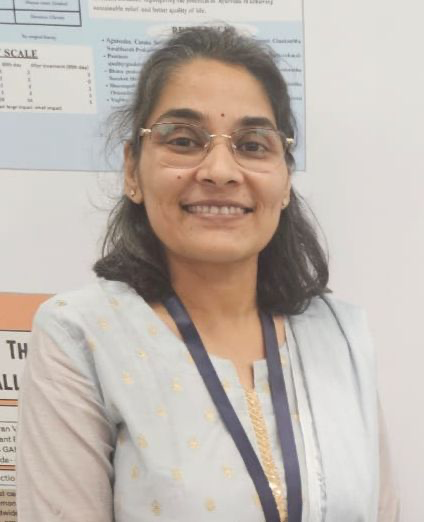
After more than two decades of translation work, Aditi Budkuley has published her first full book translation, rendering Dr. Nithyanantha Bhat’s Indological essays into Konkani
KALYANI JHA | NT KURIOCITY
Translation plays an important role in moving ideas across languages, particularly in multilingual contexts where access to knowledge depends on it. Assistant professor of anatomy at the Goa College of Naturopathy and Yogic Sciences, Aditi Budkuley, began working on translation more than two decades ago, initially through small assignments.
“I started doing translations around 2004. I began with small assignments and gradually realised I could choose the kind of work I wanted to take up – literary, research or autobiographical texts,” she shares.
Her work includes the translation of three research articles from English into Hindi on Konkani people and culture, published in Languages of Goa (2024), a volume brought out under the People’s Linguistic Survey of India, Vol. VIII, Part I, edited by Professor Ganesh Devi.
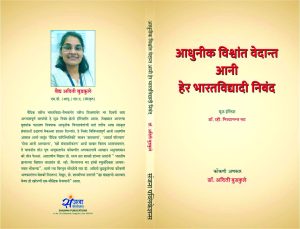
Budkuley has now completed her first complete book translation, ‘Adhunik Vishwant Vedant ani Her Bharavidyadi Nibandh’, a Konkani rendering of Dr. V. Nithyanantha Bhat’s ‘Vedanta and the Modern World and Other Indological Essays’. The book is being published by Sanjana Publication, Sanguem for Aksharpath-Goa.
This project came about during the COVID-19 period. Basti Vaman Shenoy, popularly known as the Konkani Sardar and the founder- president of the Vishwa Konkani Bhas ani Samkruti Pratishthan spotted her during a five-day translation workshop at their World Konkani Centre in Mangalore and got in touch. “I translated a sample of around 20 pages. The author was satisfied and later approved the full translation,” she recalls.
The book contains 12 essays written at different points in time, with a preface by Sanskrit scholar and professor Mahamahopadhyaya Satyavrat Shastri.
“The essays are largely Indological. They include a comparison of Vedanta and modern science, discussions on globalisation and reflections on the role of the teacher or guru,” she says. “Each essay explores ideas through Indian philosophical thought alongside contemporary frameworks.”
But there were challenges during the translation process. “Konkani is close to Sanskrit, so philosophical terms and shlokas were relatively easier to render. The difficulty was translating from English into Konkani,” she says, calling it a “double layer” of translation. “Sanskrit ideas had already been explained in English and I had to bring those explanations into Konkani. Finding appropriate terminology was often difficult.”
Though completed by 2021 end, the manuscript took time to move from translation to publication, during which she attended a few terminology workshops that helped her revisit the text. “These were organised by the Commission for Scientific and Technical Terminology (CSTT) at Goa University, Dhempe College, Miramar, and Directorate of Official Language (DOL) Panaji covering subjects such as electronics, zoology and agriculture,” she says. “They were not directly related to the book but they helped in understanding how technical terms can be adapted into Konkani.”
Budkuley says translation is also important in access to knowledge. “Under the National Education Policy, the Indian Knowledge System requires original texts to be made accessible. Not everyone can access Sanskrit, so these ideas need to be available in regional languages,” she says.
She also points to its relevance for language development. “For natural language processing and building language models for Konkani, we need a larger corpus of texts. Comparable multilingual material is essential. At present, the corpus is relatively modest in comparison with some of the other languages.”
Budkuley credits Aksharpath-Goa for providing a collaborative environment and spearheading this publication. “It is a group where people work without immediate expectations. Most members come from language backgrounds, which helped during the process of translation,” she says.
The assistant professor has also completed two additional book-length translations that are yet to be published, including ‘Bhuimchafiem’, translated from Konkani into English and a book on the Constitution of India translated from English into Konkani.
(The book will be released on June 27, 5 p.m. at the Mini Hall of the Institute Menezes Braganza, Panaji, following a panel discussion on ‘Translating Knowledge Texts’ from 4 p.m. to 5 p.m.)











Recent Comments