Artist Diptej Vernekar gives a peek into ‘The Mini Narkasur Archive’ to be showcased at the old Directorate of Accounts building in Panaji during the upcoming 10th Serendipity Arts Festival (SAF)
CHRISTINE MACHADO
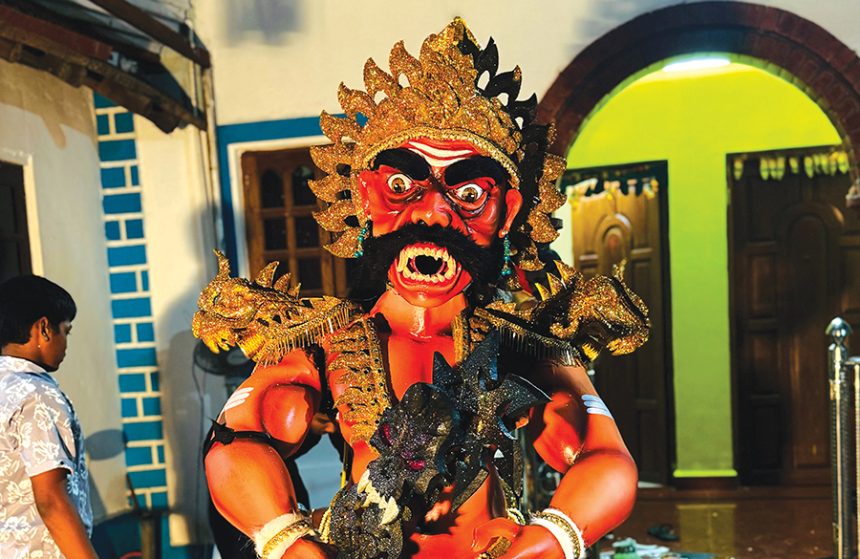
Every year during the Diwali season, towering creatures with ominous expressions appear across the state. These figures, symbolising the demon king Narkasur, are burnt at dawn before the festival day in one of Goa’s most unique traditions. Their making is a showcase of artistic talent, with many beginning the work weeks in advance. It often turns into a friendly competition to see who can create the most imaginative design. In recent years, the use of mechanisms has added even more drama and eeriness.
Diptej Vernekar, from the village of Cumbarjua, has been involved in crafting these Narkasurs since childhood. Over time, he noticed that many effigies have animalistic traits, sometimes even resembling dinosaurs. “I became interested in understanding which other traditions may have influenced their making, whether Shigmotsav or the Carnival,” he says.
In recent years, he has also noticed a new trend: miniature Narkasurs. “There is a Narkasur competition for these miniatures that happens after Diwali,” he points out. Although the effigy is traditionally meant to be burnt at dawn, these competitions extend well beyond the festival. “Young creative minds today have broken the rules of the traditional celebration,” he notes.
This shift is the focus of Vernekar’s new art curation, ‘The Mini Narkasur Archive’. “I am fascinated by these small Narkasurs. They change the power dynamics. Even though the viewer is larger, the Narkasurs can still dominate through their mechanisms or features,” he says. Made using paper, wire and pigment, these miniatures encourage a closer, more curious and playful interaction.
This trend also denotes the power of art to redefine boundaries. It shows how craft traditions can reshape narratives through process and materiality. Despite their size, these effigies speak strongly through the hands and improvisation of the local youth who create them.
Vernekar, who spent about six months working on this project with the artists of these mini Narkasurs, states that they are usually seen only in select neighbourhoods. “At the festival, people will finally be able to see them all in one place,” he says. The collection consists of 15 mini mechanical sculptures.
(The exhibition will be on view from December 14 to 21, 11 a.m. to 7 p.m., on the first floor of the Directorate of Accounts, Panaji.)