

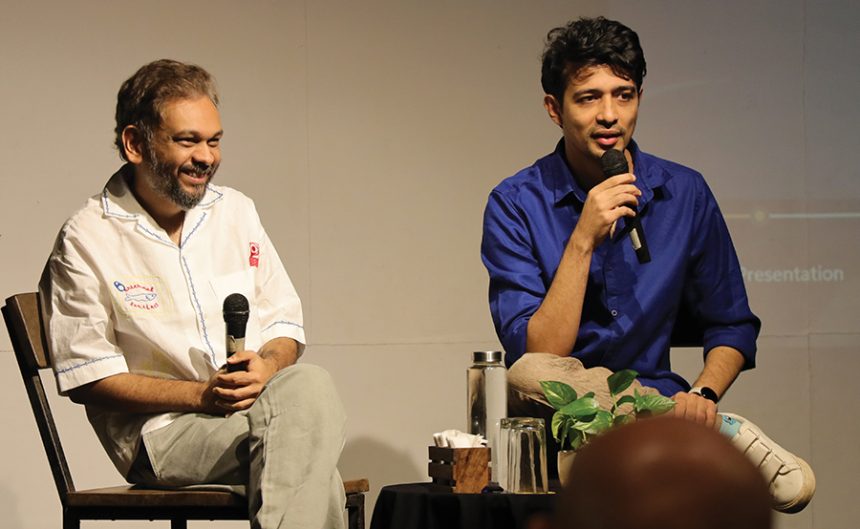
Filmmaker Anand Gandhi and game designer Zain Memon, co-creators of the Goa-based project MAYA, were speaking at a recent MOG Sunday Session at the Museum of Goa (MOG) in Pilerne.
“Storytelling in India is increasingly shifting from single films or books to multi-format narrative universes spanning film, games, and immersive media,” said the co-creators, who have been collaborating for over a decade.
Unlike traditional adaptations where films, games or books serve as extensions of one primary work, the creators emphasised that each MAYA format is designed as a complete cultural artefact.
“A film is not marketing a game, and a game is not promoting a film,” Gandhi said. “Each piece is imagined in its purest form, but all of them inherit from a shared canon.”
Having moved to the coastal state eight years ago, they described Goa as a space that allowed sustained focus and long-term thinking. “Goa gave us the soil to build this work,” Memon said, adding that the cultural fabric and open spaces made it possible to develop a project of this scale over time.
According to the creators, every character is developed with a detailed history, cultural background and internal logic, which is then adapted to the aesthetic and narrative demands of each medium. “Consistency comes from the lore,” Memon explained, noting that characters are not translated from one format to another but drawn from a common narrative foundation.
The project involves more than 170 contributors from around the world, including scientists, architects, evolutionary biologists, musicians and visual artists. Among them are architects Vinu Daniel and Shikha Parmar, as well as an international team of artists and researchers.
The creators also highlighted early audience engagement, pointing to a recent Kickstarter campaign for the first MAYA novel that drew support from readers across Europe, North America and Australia and Asia.

