

- LUIS DIAS
I’ll remember December 2025 as ‘the month of ballet.’ After a hiatus of many decades, I was able to watch not one but two live performances of western classical ballet of top-drawer quality on Indian soil.
I wrote a review recently of ‘Nutcracker on Ice’ featuring world-class skaters, the Imperial Ice Stars performing Tchaikovsky’s classic ballet story on a specially created temporary ice rink at Mumbai’s Nita Mukesh Ambani Cultural Centre (NMACC) last month.
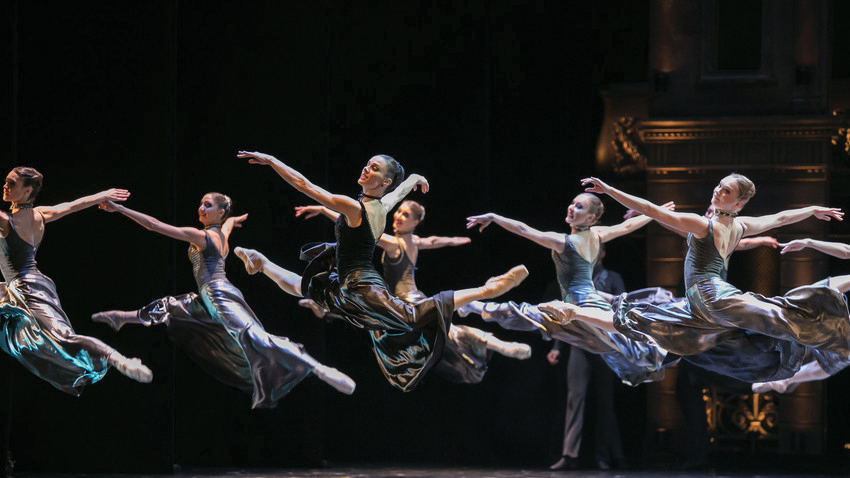
Just days later, I was back in the city at the NCPA (National Centre for the Performing Arts) for ‘Anna Karenina’, a ballet created by Russian choreographer and artistic director Boris Yakovlevich Eifman based on Leo Tolstoy’s eponymous 1877 novel.
It gave me the impetus to finish reading the revised Aylmer and Louise Maude English translation, helped along by the audiobook I found on YouTube. ‘Reading’ a book with one’s eyes closed can be quite pleasurable if one entrusts it to
a good narrator.
Which English translation one prefers is a matter of personal taste. Aylmer and Louise Maude lived in Russia for many years and were friends with Tolstoy, and I prefer it to some others (e.g. Peevar and Volokhonsky, 2000; Rosamund Bartlett, 2014) which while flowing more easily, seem a little too
watered-down to me.
Tolstoy called ‘Anna Karenina’ his “first true novel”, but in the later stages of writing, came to loathe it and apparently completed the work unwillingly. Divided into eight parts and 239 chapters, one can commiserate. It requires stamina and perseverance (I needed them, for sure) to get from the famous opening [“Happy families are all alike; every unhappy family is unhappy in its own way.”] to the very end, close to a thousand pages later.
As you can imagine, with at least 17 main characters, there are plots and subplots. Most film adaptations highlight the love triangle between Anna Karenina, her lover (cavalry officer Count Alexei Kirillovich Vronsky) and her cuckolded husband (Alexei Alexandrovich Karenin, senior statesman and 20 years her senior) and they end (spoiler alert!) with Anna’s death by suicide when she throws herself under a passing freight train. Indeed, trains are a motif throughout the novel, with several major plot points taking place either on passenger trains or at stations in Saint Petersburg or elsewhere in Russia. The train becomes emblematic of the rapid social transformations occurring in Imperial Russian society, causing as much upheaval then as the internet has wrought in our own time.
But the novel named after Anna Karenina carries on even after her stage exit.
I found another character, Konstantin “Kostya” Dmitrievich Levin, equally, if not more, interesting. It is widely thought that Tolstoy modelled Kostya on himself. The Russian surname Levin means “of Lev”, Lev being Tolstoy’s first name. Levin’s character is considered a semi-autobiographical portrayal of Tolstoy’s own beliefs, struggles, and life events.
I could relate to Levin’s soul-searching, his eventual coming to terms with his questions about faith. Tolstoy gives the novel’s parting shot to Levin: “I shall still be as unable to understand with my reason why I pray, and I shall still go on praying; but my life now, my whole life apart from anything that can happen to me, every minute of it is no more meaningless, as it was before, but it has the positive meaning of goodness, which I have the power to put into it.”
Eifman also centres the Anna-Vronsky-Karenin triangle (breath-takingly danced by Viktoria Mokrousova, Igor Subbotin and Dimtry Fisher respectively on the night I attended). I can understand why. It would have been well-nigh impossible to cram every subplot and character into a two-hour ballet.
As the programme notes put it, by setting aside all secondary storylines and focusing just on the three, Eifman “uses dance language to portray the drama of a woman being reborn” in “a burst of inner
psychological energy.”
Everything, from the gorgeous, lavish sets and costumes, to the grace and precision of the whole corps de ballet, the almost-magical seamless scene changes in the blink of an eye, were a delight to behold. Eifman’s hard-hitting choreographic depiction of Anna’s suicide will forever remain etched in my memory.
Eifman proved something that I had always suspected: that so much of Tchaikovsky’s music is inherently balletic, even when he wasn’t consciously writing for the medium. All the music used was from Tchaikovsky’s symphonic or chamber oeuvre: Symphony no. 2 in C minor Little Russian, Op. 17; ‘The Tempest’ symphonic fantasy, Op. 18; ‘Francesca da Rimini’ symphonic fantasy, Op. 32; ‘Souvenir d’un lieu cher’ Op. 42(Scherzo. Presto giocoso); Suite No. 1 in D major (Andante sostenuto, moderato e con anima, Intermezzo: part 3. Andante semplice); Serenade for Strings in C, Op. 48 (Andante non troppo, Allegro moderato); Suite No. 3 in G Op. 55; ‘Manfred’ Symphony in B minor, Op. 58; ‘Hamlet’ overture-fantasy, Op. 67a; ‘Souvenir de Florence’ string sextet in D minor, Op. 70 (Adagio cantabile e con moto); Symphony no. 6 in B minor ‘Pathétique, ‘Op. 74; ‘The Voyevoda’ symphonic ballad, Op. 78; ‘Romeo and Juliet’ fantasy-overture.
The timelines of Leo Tolstoy (1828-1910) and Pyotr Ilyich Tchaikovsky (1840-1893), two towering figures of Russian literature and music, overlap. So did their paths ever cross?
It turns out that they did, on a few occasions, in Moscow in December 1876, incidentally a visit Tolstoy made to the city to deliver the latest chapters of ‘Anna Karenina’ to his publisher. Tchaikovsky’s brother and biographer Modest recalled that Tchaikovsky loved Tolstoy “to much greater extent than all other writers” and imagined him to be “almost like a demigod”.
Tolstoy visited the Moscow Conservatory and demanded a meeting with Tchaikovsky. Tchaikovsky initially demurred, but relented when Tolstoy threatened that he would not leave the building until he had spoken to Tchaikovsky.
In a special chamber music concert, that the composer arranged for Tolstoy, the Andante cantabile movement from Tchaikovsky’s first String Quartet moved the writer to tears. They shared a common love of Mozart and Weber, but Tchaikovsky was appalled, as he wrote later, by Tolstoy’s “nihilism”, “ignorance” and “narrowmindedness” after the writer perhaps provocatively said that Beethoven had “no talent.”
Tchaikovsky thereafter went to great lengths to avoid further meetings with Tolstoy, even ducking out of sight if he saw the writer in the streets of Moscow.
Tolstoy for his part later called Tchaikovsky “an obvious artistic falsehood” after hearing another of his string quartets.
Nevertheless, they parted amiably in 1876. Tchaikovsky presented Tolstoy with piano duet arrangements of his First Symphony and The Tempest. We know Tolstoy liked the First Symphony; and The Tempest could have given Tolstoy the idea for the Shakespearean orchestral fantasia ‘King Lear on the Heath’ which Kostya Levin goes to hear at a concert in ‘Anna Karenina.’ It was only fitting that Eifman included these works in his production.
Tchaikovsky, after reading the early portions of ‘Anna Karenina’ and its description of Russian high society called it “disgracefully banal nonsense” but changed his mind later, saying he finished reading it “with an enthusiasm bordering on
the fanatic.”
My impression of Tolstoy’s ‘Anna Karenina’ lies between those two extreme views. But one feels Tchaikovsky would have approved of the use of his music to put Tolstoy’s epic novel ‘en pointe’.

