PTI
New Delhi
India and the United Arab Emirates (UAE) on Monday unveiled plans to have a strategic defence partnership and sealed an liquefied natural gas (LNG) deal as Prime Minister Narendra Modi and UAE President Sheikh Mohamed bin Zayed Al Nahyan set a $200 billion annual trade target by 2032 while laying out a broad agenda to shore up the ties.
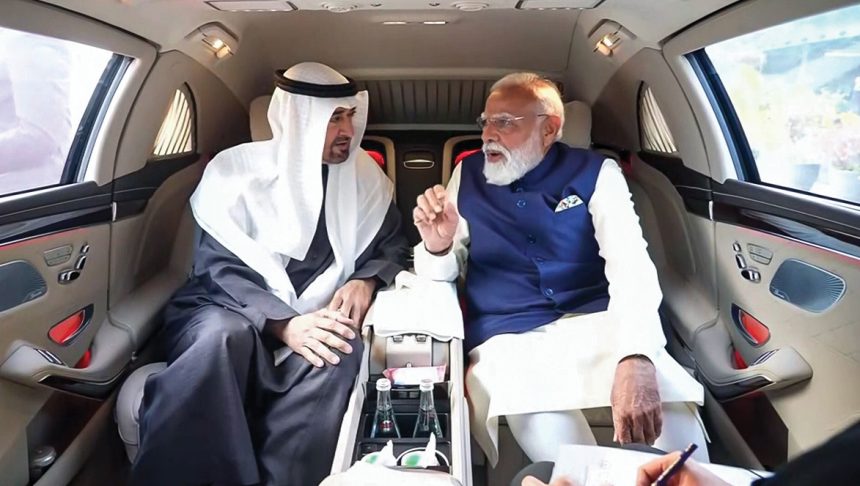
Modi welcomed Al Nahyan at the Delhi airport with a hug and then they travelled together in the same vehicle to the Prime Minister’s residence, where they held talks in the restricted as well as delegation-level formats.
Out of the five documents inked by the two sides, the most striking one was the letter of intent to establish a strategic defence partnership, a move that came four months after Pakistan and Saudi Arabia sealed a defence pact to strengthen their decades-long defence ties.
Under the defence partnership, India and the UAE are eyeing defence industrial collaboration and cooperation in advanced technologies, cyberspace training, special operations, interoperability of their militaries and counter terrorism.
Another pact was inked to provide for the purchase of 0.5 million metric tonnes of LNG by Hindustan Petroleum Corporation Limited (HPCL) from Abu Dhabi National Oil Company Gas over a period of 10 years starting 2028. The UAE is India’s second-largest supplier of LNG to India after Qatar.
The two sides also decided to explore collaboration in advanced nuclear technologies, including the development of large nuclear reactors and small modular reactors, as well as cooperation in advanced reactor systems, nuclear power plant operations and maintenance and nuclear safety.
“This has been a short, but extremely substantive visit,” Foreign Secretary Vikram Misri said at a media briefing.
The UAE leader’s nearly three-and-a-half-hour visit came amid increasing tensions in the Middle East and trade disruptions caused by Washington’s policy on tariffs.
Artificial Intelligence was identified as another priority area of cooperation and it was decided to collaborate on setting up a supercomputing cluster in India with the UAE partnership, Misri said, adding the Gulf nation will also look at investments for expanding data centre capacities in India.
The foreign secretary said the two sides also set a target of $200 billion in annual trade by 2032. In 2024-25, the volume of two-way trade between the two sides was $100 billion.
To boost trade ties, Modi and Al Nahyan directed their teams to work towards interlinking the national payment platforms to enable efficient, fast and cost-effective cross-border payments.
They also called for the expeditious implementation of key initiatives, such as the ‘Bharat Mart’, the ‘Virtual Trade Corridor’ and the ‘Bharat-Africa Setu’ to promote MSME products across the Middle East, West Asia, Africa and the Eurasia region, according to a joint statement.
“A letter of intent was signed between the two sides to work towards concluding a framework agreement for a strategic defence partnership between India and the UAE,” Misri said.
The joint statement said the two leaders highlighted deep respect for each other’s sovereignty and territorial integrity and the importance of strategic autonomy. It said Modi and Al Nahyan acknowledged steady and strong bilateral defence and security cooperation as a core pillar of the comprehensive strategic partnership.
Another letter of intent was also signed for joint work in developing space infrastructure. Under this initiative, both sides will look to set up new launch complexes, satellite fabrication facilities, joint missions, space academy and training centres, the foreign secretary said.
A separate document was inked to provide for the UAE’s participation in the development of a special investment region in Gujarat’s Dholera. This initiative will look at the establishment of an international airport, a pilot training school, an MRO (Maintenance, Repair and Overhaul) facility, a greenfield port, a smart urban township, as well as projects related to railway connectivity and energy infrastructure, Misri added.