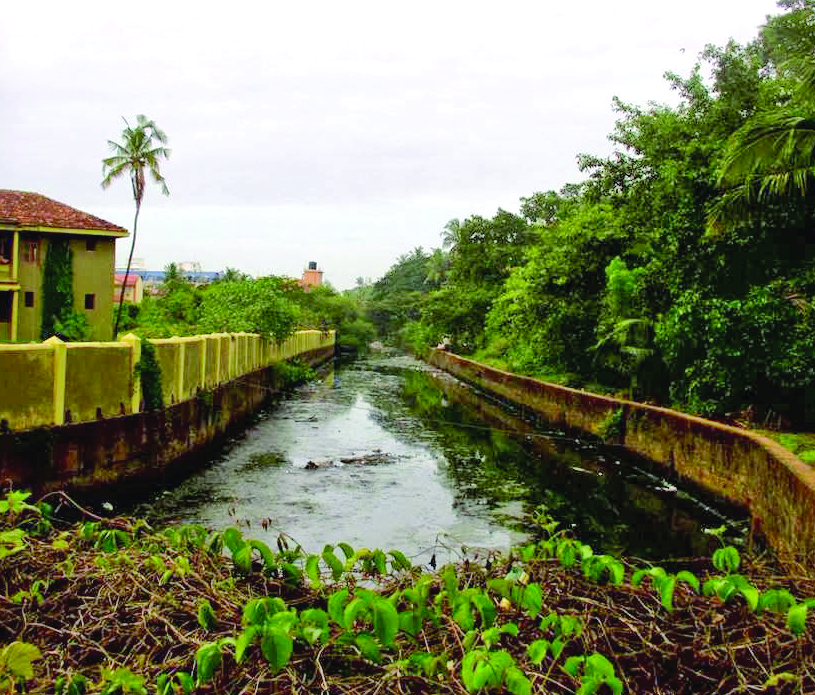
‘Waterbodies polluted by pathogenic bacteria’
Abdul Wahab Khan
Panaji : Sounding a serious warning on the quality of water in Goa, the State of Environment Report 2025 has revealed that while chemical parameters largely remain stable, widespread and persistent microbiological contamination is posing a threat to public health and ecological safety.
The report prepared by the Department of Environment and Climate Change drew on monitoring by the Goa State Pollution Control Board (GSPCB) between 2018-19 and 2024-25. It is based on data collected from 115 monitoring locations across rivers, lakes, creeks, canals, wells, reservoirs, nullahs, sewage treatment plants and coastal waters.
Sampling is carried out periodically under the National Water Monitoring Programme, analysing physicochemical parameters such as dissolved oxygen (DO), biochemical oxygen demand (BOD), pH, conductivity and nutrients, alongside microbiological indicators like total and faecal coliform.
“Recurring total and faecal coliform exceedances in both fresh (Classes A–C) and saline (SW-II) waters indicate contamination by pathogenic bacteria. Locations such as St Inez Creek, Bethora nullah, and multiple sites along the Mandovi and Zuari rivers consistently register coliform counts well above CPCB limits, elevating the risk of waterborne diseases,” the report has said.
The class-wise analysis has revealed a consistent pattern of decline. Class A waters, meant for drinking without conventional treatment, have repeatedly failed to meet bacteriological standards at locations.
These locations include the borewells in Sancoale, Bethora, Verna and Cuncolim industrial estates, primarily due to faecal coliform exceedances.
The report has said effluents from industrial estates (e.g., Kundaim, Verna and Bethora) and mining operations contribute heavy metals, oils, process chemicals, and suspended solids. Although effluent treatment plants exist, occasional bypasses or malfunctions lead to episodic parameter exceedances (notably pH and DO dips) in nearby borewells and river stretches.
Class B waters, used for bathing and recreation, including stretches at IFFI Jetty and Mandovi bridge frequently recorded coliform levels far beyond permissible limits, raising concerns over public exposure during religious and recreational use.
The stress intensifies in Class C waters, which are sources for drinking after treatment. Monitoring at Amona bridge, Borim bridge, Tonca-Marcel and Cortalim showed that although pH, DO and BOD values generally remain within acceptable ranges, repeated bacterial contamination compromises treatability and safety.
Class D and E water, largely lakes and stagnant waterbodies, reflected the worst degradation. The report has noted that 39 lakes have been categorised as Class E, fit only for irrigation or industrial cooling, and “are not suitable for outdoor bathing”.
Surface waters classified under SW-II, including estuarine and coastal stretches like beaches, showed similar trends. Despite acceptable salinity-related parameters in many locations, faecal contamination remained high near urbanised and tourism-heavy zones, indicating untreated wastewater discharge.
“Recurring and widespread microbiological contamination reflects systemic gaps in sewage collection, treatment and enforcement,” the report has stated. Rapid urbanisation, inadequate sewage treatment capacity, non-point pollution from settlements, and weak compliance mechanisms are identified as key contributors.
The document has warned that Goa’s water crisis is no longer defined by visible chemical pollution but by invisible biological risk. It has recommended urgent upgrading of sewage treatment infrastructure, strict monitoring of discharge points, protection of river buffers, and stronger inter-departmental governance.