‘Banks have fiduciary responsibility to alert customers’
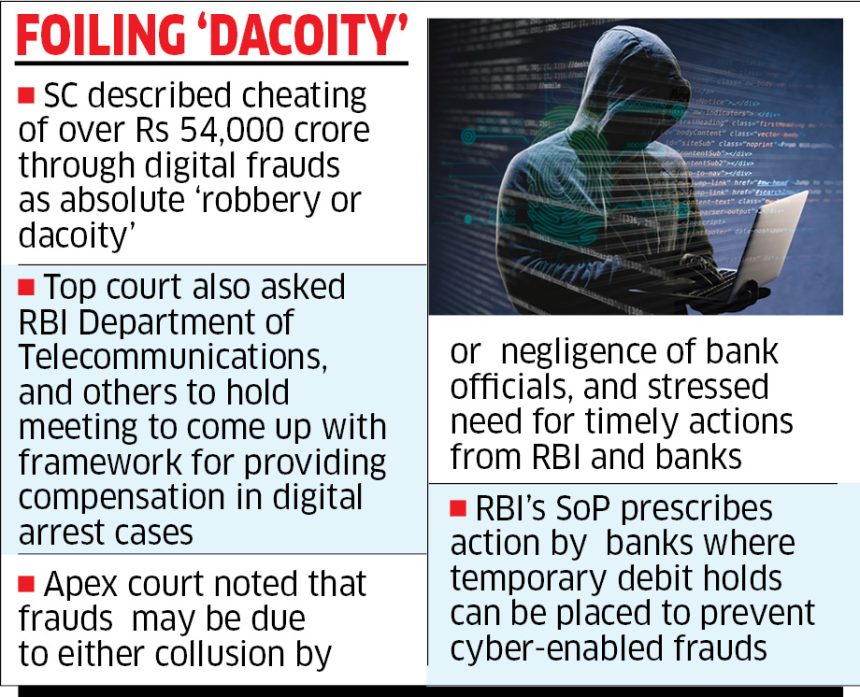
New Delhi: The Supreme Court on Monday described the cheating of over Rs 54,000 crore through digital frauds as absolute “robbery or dacoity” and asked the Centre to draft a standard operating procedure in consultation with stakeholders like RBI, banks and the Department of Telecommunications to deal with such cases.
The top court also expressed grave concern over the “menace” of digital arrest scams and said banks must play a proactive role in preventing cyber-enabled fraud.
A bench comprising Chief Justice of India Surya Kant and Justices Joymalya Bagchi and NV Anjaria observed that banks have a fiduciary responsibility to alert customers when unusual, large-scale transactions occur in accounts typically used for sending or receiving small amounts.
It said that when a retiree, who withdraws amounts in the range of Rs 10,000 or Rs 20,000, suddenly withdraws huge amounts, then the bank should issue an alert.
Observing that the amount siphoned off by digital fraud is more than the budgets of many small states, the top court noted that such offences may be due to either collusion by or the negligence of bank officials, and stressed the need for timely actions from RBI and the banks.
It directed CBI to identify digital arrest cases and asked the Gujarat and Delhi governments to accord sanction to the federal probe agency to proceed with the investigations in identified cases.
The Supreme Court also asked the Reserve Bank of India, the Department of Telecommunications, and others to jointly hold a meeting to come up with a framework for providing compensation in digital arrest cases.
A pragmatic and liberal approach is needed to deal with the award of compensation to digital arrest victims, the top court said, and posted the plea for further hearing after four weeks. It asked the authorities to file fresh status reports before the next date of hearing.
At the outset, Attorney General R Venkataramani informed the bench that RBI has drafted a standard operating procedure (SoP) for banks to deal with such cases and it, among other things, prescribes action by the banks where temporary debit holds can be placed to prevent cyber-enabled frauds.
Issuing a slew of fresh directions, the bench asked the Ministry of Home Affairs to formally adopt the RBI’s SoP and issue directions for its implementation across the country.
Senior advocate NS Nappinai, appearing as an amicus curiae, said banks should be asked to issue alerts to customers about suspicious transactions, and AI tools can be used for this purpose.
“If there is a business entity with crores of transactions, it may not raise suspicions. But there is a pensioner, who (generally) withdraws Rs 15,000-Rs 20,000; suddenly from his account, Rs 50 lakh, Rs 70 lakh, Rs 1 crore is being withdrawn, then why did your AI-operated tools in the bank not deem it fit to alarm him that this transaction is suspicious?” the bench posed.
The attorney general said that RBI will address the issue.
“The problem is banks are more into business mode, and naturally so. And in doing that, what they are becoming, either innocently or connivingly, platforms through which there is a swift and seamless transmission of stolen proceeds of crime,” the Supreme Court bench said.
Justice Bagchi said the MHA’s report itself flagged that over Rs 52,000 crores have been misappropriated between April 2021 and November 2025 through cyber fraud.