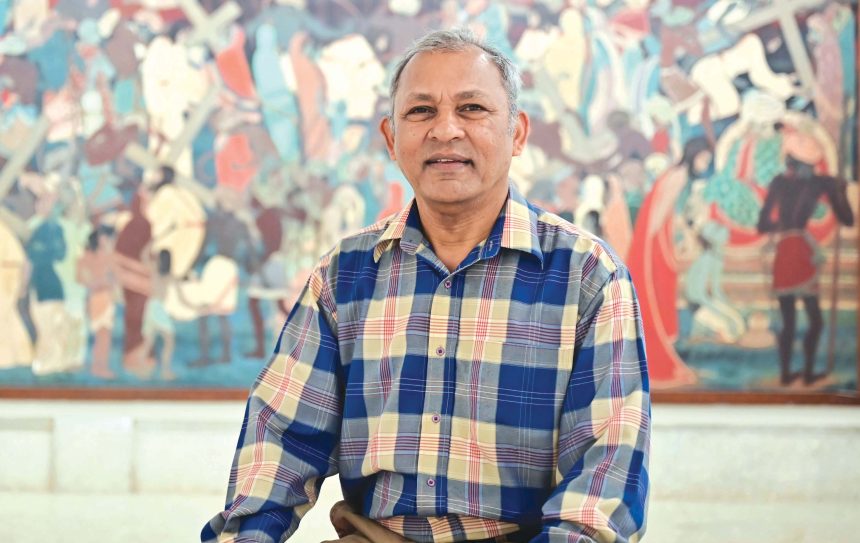
The new museum at the Xavier Centre of Historical Research, Porvorim, is a testament in perseverance driven by the deep desire to honour the artists and educate the public on the rich art history that the state possesses
CHRISTINE MACHADO
As Fr. Delio Mendonça leads one around the new museum at the Xavier Centre of Historical Research, Porvorim, while narrating the story behind the various exhibits, he is candid that he does not know everything there is to know about each piece. But by showcasing these various works, most prominent among which are the artworks of noted Goan artist late Angelo Fonseca, Fr. Mendonça (who has authored the book ‘Fonseca’) is hopeful that it will draw the attention of history and art experts to study these closely and provide the answers. In fact, this is one of the reasons why the art show (curated by Fr. Mendonça and writer Vivek Menezes) celebrating the opening of this space has been titled ‘There will be an answer: Hidden Treasures of the XCHR’.
Another compelling reason for the title is the story behind the museum finally coming to fruition. In 2006, Ivy Fonseca, the widow of the late Angelo da Fonseca, donated his entire collection of artworks to the XCHR to ensure the preservation and celebration of this legacy. Back then, Fr. Mendonça actively worked to try and set up space to display these masterpieces, but faced roadblocks along the way. After his long stint in Rome, he returned last year with renewed vigour to see this project move forward again. “This museum is the result of dedication and perseverance. My persistence finally paid off and with the support of many people, especially the present XCHR director Fr. Rinald D’Souza SJ, we finally managed to open this space. There was finally an answer,” he says.
The museum displays around 60 of the many works of Angelo. While many of them are themed around religion, there are also some of his secular paintings that have been put up. Apart from these, the space also has paintings by artist late Jose Pereira and a French nun Sr. Genevieve. Christian artifacts collected over the years by Fr. Mendonca also form a part of the museum. These include statues of Our Lady of Annunciation, St. Ignatius of Loyola, St. Francis Xavier, arms of saints which previously contained relics, and oratories.
While the XCHR is famed for its huge library collection which draws the interest of scholars from around the world, Mendonça is hopeful that the museum will provide another means of engaging and learning about art, history, and culture. Going forward, he would also like to have music performances at the space as another way of engaging with the works.
“This is still a work in progress. Much more still needs to be done,” says Fr. D’Souza. “We still need so much more funding for the restoration of some of the artworks for instance.”
Pointing to an artwork of Pereira which has a hole in it, he states that it was important that this was put on display nevertheless because the absence in it was also telling. “This work is a symbol of our cultural history of Goa. And this hole is telling us something about the state of things. Restoration is expensive and we are looking for people to partner with us in this,” he says.
Menezes for his part gives full credit to Fr. Mendonça and Fr. D’Souza for breaking the inertia which has extended for almost 15 years and for getting this space finally thrown open. “It is opening the vault of treasures for the first time, but it’s also looking for answers. Part of the answers they seek are funds and also expertise. These are priceless community assets, and I feel there needs to be a community response to it,” says Menezes, who has deep ties to Angelo Fonseca himself. Both his grandfathers, he shares, were close to the artist, while Ivy was his teacher. “So from the beginning I have been helping Fr. Delio, with the overall Fonseca project,” he says.
Over the last few years there have been a few exhibitions displaying some works of Angelo to the public. And this, says Menezes has led to people around India and the world showing interest in the late artist. “Twenty years ago, he was completely unknown, even by the people who were writing the history of modernism in India, but now many in India and around the world have any inkling about him. I believe that the internet and social media have also played a role in this,” says Menezes. But, he states, there is a long way to go. “Goa does not have any modern art collection even close to as good as this. This is one of the great treasure troves of the 20th century art period and I think that every Goan must see these works. They do not realise that there are these magnificent artworks which really speak to us and to our culture. For the first time, the priests have promised to keep these artworks available to the public from now on, and I hope that the public responds in a befitting way, which is to go see it, support it, and talk about it.”