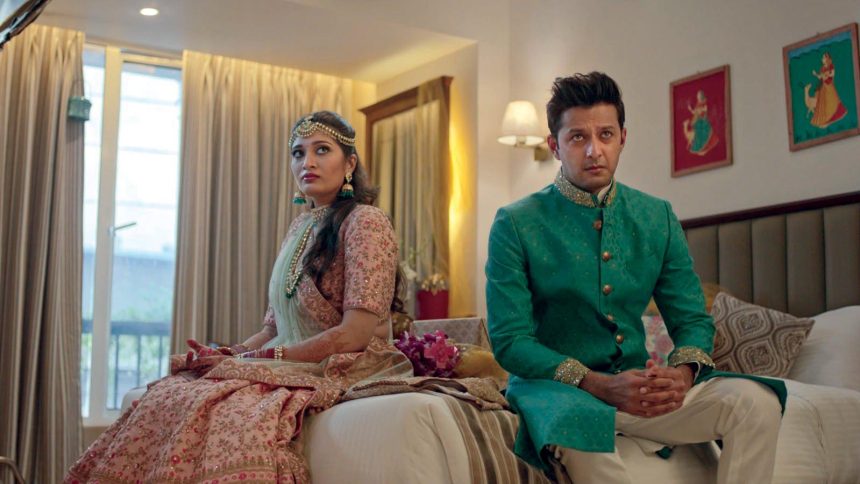
Vardhan Dhaimodkar has made a strong statement on personal freedom
through his latest Hindi short film ‘Kanyadaan’, which explores a woman’s
right to make her own choices after marriage
RAMANDEEP KAUR NT BUZZ
After travelling through film festivals and winning praise from viewers, ‘Kanyadaan’ has now found a wider audience on OTT platforms. Behind it is filmmaker Vardhan Dhaimodkar, who believes stories can change the way people think. An alumnus of St. Xavier’s College, Mapusa and the Film and Television Institute of India (FTII), Pune, Dhaimodkar, has worked as an assistant editor on projects such as ‘Fanney Khan’ and ‘Naal’ and as an associate editor on ‘Maharani’ Season 2 and Season 3 and ‘Nirmal Pathak Ki Ghar Wapsi’. He has edited Marathi films such as ‘TakTak’ and ‘Mooshak’, which is still in progress and two Konkani films, ‘Miranda House’ and ‘Claudia’. He has also edited documentaries, short films and advertisements. Beyond editing, he directed a short film titled ‘I Want My Daughter’, in 2011. The film was screened at the All Goa Film Contest and later won third place at the Chota Cinema Film Festival. He also directed several short documentaries for different organisations.
The idea for his latest directorial ‘Kanyadaan’, came from a casual discussion with a writer friend. During their conversation, they came across research showing that many women, even today, do not get the freedom to decide what they want to do with their lives after marriage. “This is not limited to rural areas or conservative families. It also happens in cities, among educated and financially well-off households that are often seen as modern. That stayed with me. I realised that this was something that needed to be spoken about and films have the power to reach people and start conversations,” says Dhaimodkar.
The 12-minute Hindi short film is about two people who are about to get married. Just 15 minutes before the wedding, the bride makes some unexpected demands. “The film then focuses on whether the groom, Punit, will accept them. The story is told in a light and friendly way but it carries a strong message about a woman’s right to choose,” says Dhaimodkar, adding that he hopes the film will especially connect with young people.
Most of the film crew came from his group at FTII. For the male lead, he already had a clear idea of how the character should look and behave. When he came across the actor Vatsal Sheth online, he felt he was perfect for the role. The actor liked the script and agreed to be part of the film. For the female lead, he wanted to cast a Goan actor. He met Rukma Prabhudesai while working on another project and was impressed by her acting and training. After her audition, he felt she was right for the role. He also praised her effort to speak Hindi well, which is not easy for many Konkani- and Marathi-speaking actors.
The shoot had a few challenges. He recalls, “One night before filming, there was a storm. The team was worried but the rain stopped by morning and the soft light actually helped the film look better.”
Another challenge was the film’s style. Short films are usually serious or made only for festivals but he chose to make a light, feel-good film. “It was a risk but the audience response has been positive,” he says, adding that for a filmmaker, the biggest reward is when people connect with their work. “If the film makes them think and talk about these issues, then it has done its job.” The film, now streaming on Amazon Prime Short TV, Editor’s Xtreme, OTTplay, Tata Play, Binge and Dish Watcho, has also been officially selected at several international film festivals. It is also available in Southeast Asia on Dens TV and Long TV. And Dhaimodkar is already working on new ideas. “I want to continue making films on varied themes and tell original stories that can bring positive change,” he says. “With the right producer and the right time, I wish to bring more such projects to the screen.”