Deepa George’s letter installation, part of the upcoming Goa Open Arts Festival, is a tribute to the lost art of letter writing and offers insights into some of the state’s noted personalities
CHRISTINE MACHADO
NT BUZZ
When Deepa George discovered a six-decade-old letter her father had written to her mother before their marriage, its emotional depth moved her deeply. It also made her nostalgic for the care once invested in letter writing, now largely replaced by quick text messages. This sparked her archival project of collecting treasured handwritten letters from Goans and those who have made Goa their home.
“Initially, I was unsure if I could manage it alone, as such projects are usually done by teams. But my journalism background helped me reach out to people,” she says.
Notably, George kept the use of digital tools to a minimum, choosing instead to call people and visit them in person. “We are so absorbed in the digital world today that we rarely meet people face to face. I wanted to break that,”
she explains.
As people searched through closets and drawers, she gathered letters in languages such as English, Konkani, Marathi, Hindi, and Urdu. Besides their historical and cultural value, the letters also reveal how language and handwriting have evolved.
After first exhibiting the project at Sunaparanta-Goa Centre for the Arts in July 2025 as part of the as part of the Sunaparanta Arts Initiator Lab exhibition, George is now showcasing it at the upcoming Goa Open Arts Festival. “Being selected gave me the confidence to expand my research and include some more letters of Goan icons, some well known and others almost forgotten,” she says.
Her collection spans figures from fields including literature, music, art, architecture and education. Among them are letters written by noted Konkani author Damodar Mauzo to his mother. “While studying in Mumbai in the 1960s, ‘Bhai’ wrote long, heartfelt letters in Konkani and Marathi. He traces the beginnings of his literary journey to this habit of letter writing,” says George.
Letters from the family of Manohar Rai Sardessai show exchanges with writers such as Bakibab Borkar and Pu. La. Deshpande. “One touching letter written by his wife Pramila in 1980 says she keeps his letters near her pillow because they comfort her,” George shares.
The collection also has letters written by artist Subodh Kerkar to his late son Satyajit (Pintu) while he was in Germany. “These letters are filled with playful drawings of aeroplanes, bicycles and Pintu’s favourite colourful balloons. They are tender traces of a beautiful father-son bond,” she says. Another highlight is a letter by F.N. Souza to Frederick Noronha, in which he quips, “When I want to annoy a Goan, I call him Goanese.”
Historical letters include one written by Francis Menezes to his brother Louis in 1955, urging him to reassure their mother about his plan to lead a group of 150 satyagrahis. Other letters come from advocate Norma Alvares by her father, one by educationist Nisha D’Cunha to a colleague, a letter from Ravindra Kelekar to classical singer Dr. Shakuntala Barne and photographer David D’Souza’s letter to his mother. There are also letters from Mother Teresa (which has a goosebumps-inducing story to it), Rabindranath Tagore, and Mahatma Gandhi.
A lesser-known but important figure featured is Naraina Ananta Bandorcar, a founding teacher at Escola de Almeida. George explains that he played an important role in securing legal exemptions for festivals like Shigmo and the Muslim festival of Alao and was instrumental in abolishing the ritual of ‘Xens’, which was similar to the Devadasi system. In her collection is a condolence letter in Portuguese, written in 1934 to the family after his passing, by Dr. Almeida, then president of Colegio
de Almeida.
The oldest letter dates back to 1889 and comes from the Sayyid family. Imran Ali Khan, who lives in Goa, shared a letter written by his great-great-grandfather Syed Ali Bilgrami, a scholar and linguist who authored ‘Tamaddun-e-Hind’ and ‘Tamaddun-e-Arab’ and taught Marathi at Cambridge University in 1901. “These letters helped him understand his family’s past. It shows how important such documentation is,” says George.
Each letter, she adds, tells its own story. “Even a simple note can reveal so much about a person’s life and emotions.” Although she is not a Goan, George, who now lives in Aldona, says she was amazed to discover so many hidden stories in the small state.
There were challenges too, especially damage caused by moisture and termites. “Yet so many people have preserved these letters with care,” she notes.
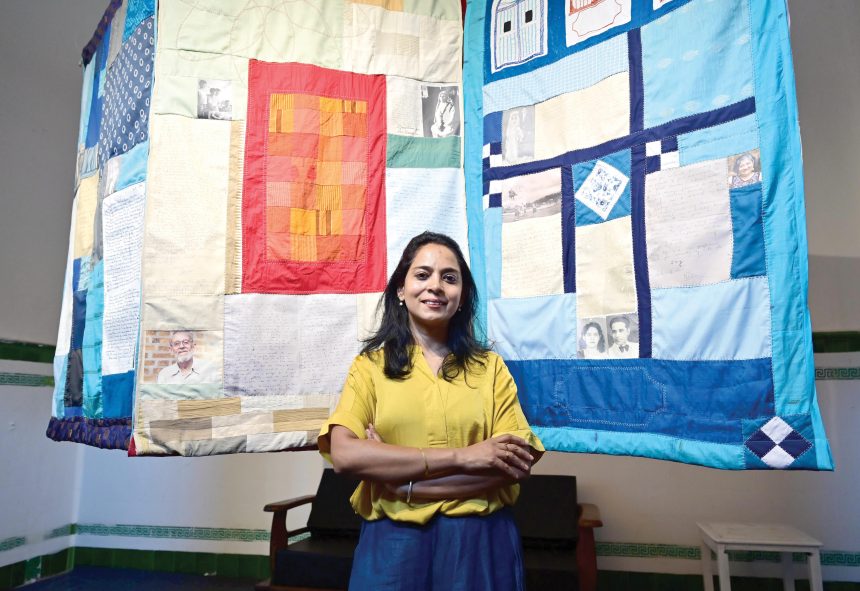
At the Goa Open Arts Festival, the letters will be presented as a memory quilt inspired by the ‘godhadi’, a traditional hand-stitched patchwork quilt, created in collaboration with Aathvan (meaning ‘memory’), founded by Ameeta Kunkolkar. “Godhadis are reminiscent with home and comfort. They are layered, just like the stories in these letters and they take time to make, much like writing letters,” says George.
The quilt will feature Goan motifs like the oyster shell window and the abolim flower, with a contemporary touch. Instead of full translations of letters in other languages, visitors will be given brief summaries.
George hopes the project will both honour these personalities and rekindle interest in handwritten letters. “Today, people save images and everything to the cloud. But it’s not the same as something that is physical. Or maybe I am just a sentimental fool,” she laughs. “I hope people realise the beauty of holding something tangible versus something that is just there on some ephemeral cloud.”
Looking ahead, she plans to create an online archive of the collection. “Maybe one day these letters can be exhibited for people to appreciate the beauty of language, emotion and handwriting,” she adds.
(The Goa Open Arts Festival will be held from February 20 to 25 at the Old GMC Building.)