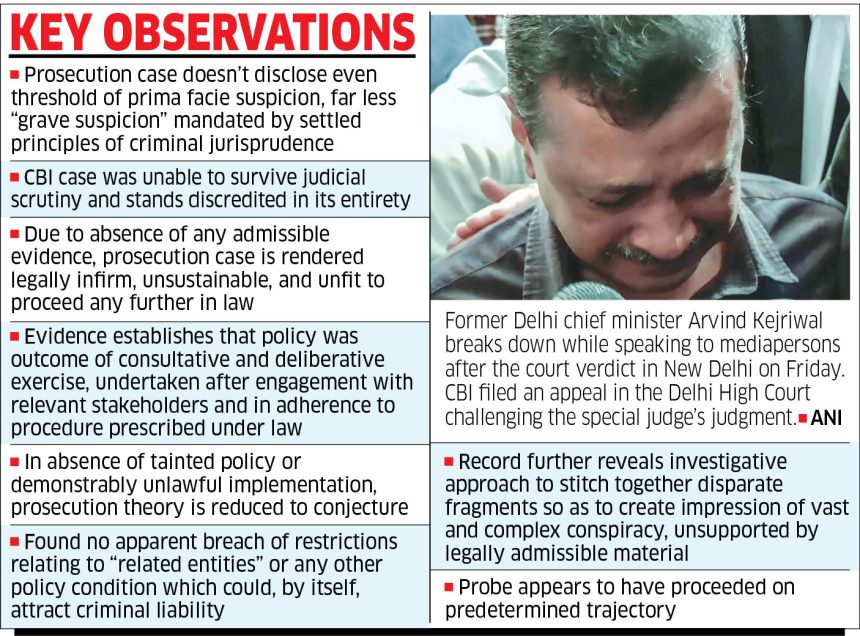
‘Endeavour to connect allegations to Goa Assembly elections over use of alleged proceeds of crime rests on inference’
New Delhi: Sharply pulling up CBI for pursuing a case “wholly unable to survive judicial scrutiny”, a Delhi court on Friday discharged former Delhi chief minister Arvind Kejriwal, his deputy Manish Sisodia and 21 others in the excise policy case instrumental in bringing down the AAP government.
Among the 21 people cleared in the case that became a political hot potato is Telangana Jagruthi president K Kavitha.
Hours after the verdict by special judge Jitendra Singh, CBI filed an appeal challenging it in the Delhi High Court. Several aspects of the investigation were either ignored or not considered adequately, a spokesperson of the agency said in response to the scathing criticism by the trial court.
As news came in of the clean chit in the case that sent him into virtual political wilderness, a relieved Kejriwal broke down and said the corruption case against him was the “biggest political conspiracy” in the history of Independent India.
“The court has proved that Kejriwal, Manish Sisodia and AAP are ‘Kattar Imaandar’,” the three-time chief minister said.
Addressing a press conference later in the day, he said they will file an application in a court for discharge in connection with the cases registered by Enforcement Directorate as well.
While Kejriwal was in jail for six months in the case, Sisodia was behind bars for almost two years.
CBI has been probing alleged corruption in the formulation and execution of the erstwhile AAP government’s now scrapped excise policy.
The Delhi court was unsparing in its criticism of the federal probe agency.
“The chargesheet suffers from internal contradictions, striking at the root of conspiracy theory,” Justice Singh said.
The judge said the endeavour to further connect such allegations to the Goa Assembly elections, to project, layering, and utilisation of alleged proceeds of crime, rests more on inference and assumption than on legally sustainable material.
Declaring that it found no “overarching conspiracy or criminal intent” in the liquor policy, the court said, “The excise policy case, as sought to be projected by CBI, is wholly unable to survive judicial scrutiny and stands discredited in its entirety.”
“Investigation appears to have proceeded on a predetermined trajectory, implicating virtually every person associated with the formulation or implementation of the policy in order to lend an illusion of depth and credibility to an otherwise fragile narrative,” it said in the 598-page judgment.
According to the judge, in the absence of any evidence, the allegations against Kejriwal could not be sustained and the former chief minister was implicated without any cogent evidence.
This, the judge said, was inconsistent with the rule of law.
This court, he said, has no hesitation in holding that the material placed on record does not disclose even a prima facie case, much less any grave suspicion, against any of the accused persons.
“Once the formulation of the (excise) policy is shown to be the product of deliberation, institutional scrutiny, and procedural compliance, any subsequent attempt to attribute criminality to its implementation becomes wholly untenable,” he said.
The judge said the case’s very foundation – the allegation of payment of upfront money and its purported recoupment – stands fundamentally eroded.
“In the absence of a tainted policy or demonstrably unlawful implementation, the prosecution theory is reduced to conjecture. Private persons who sought to derive commercial advantage from a policy validly framed and lawfully implemented cannot be compelled to face the rigours of criminal prosecution,” his judgment read.
“Though there was no statutory or constitutional requirement mandating the obtaining of suggestions from the lieutenant governor, the file notings unmistakably reflect that such suggestions were nevertheless sought, examined, and incorporated.
The procedural integrity of the policy-making process thus stands affirmed from the documentary record itself,” it said.
The court said the alleged conspiracy was nothing more than a speculative construct resting on conjecture and surmise, devoid of any admissible evidence.