Frederick Noronha
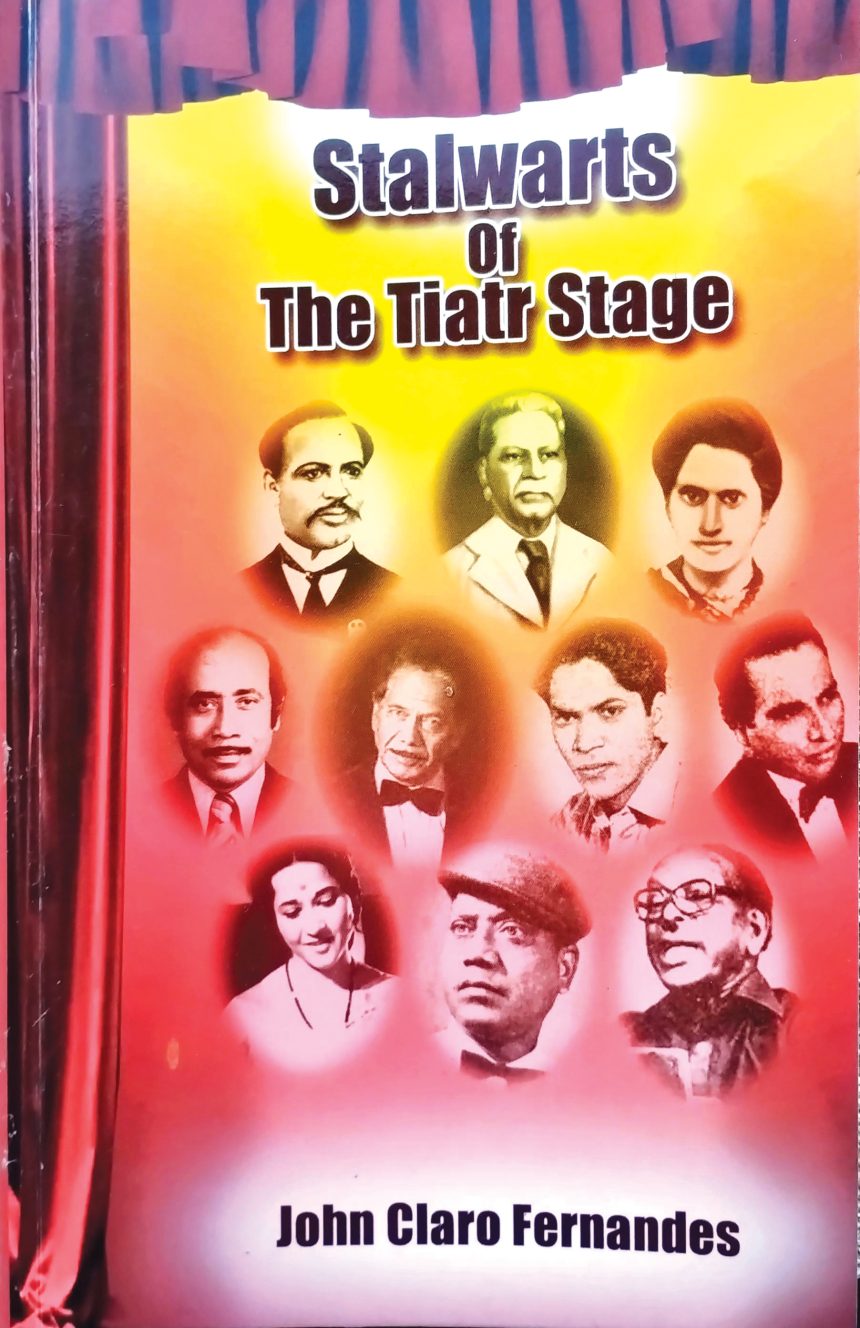
One more of those ‘pandemic books’ which was little noticed when first published in 2020, this is an important and useful work for some special reasons. ‘Stalwarts of The Tiatr Stage’ is a compilation of John Claro Fernandes’ earlier articles. It tells the story nicely of a hugely
popular stage form.
But tiatr’s huge success in terms of garnering audiences and popularity is only one part of the story. Tiatr is one of the more successful theatre forms nationwide arguably, but one which gets only grudging acknowledgement from Goan elites. It is still to be effectively noticed by non-Konkani
speaking audiences.
The second reason why this much-needed book is valuable is that it breaks the language divide. By opting to publish the book in English, it takes the subject to not just Konkani-speaking tiatr audiences but beyond; and thus avoids ‘preaching only to the already converted’.
Modestly priced at Rs. 200, this 218-page book contains 43 word portraits of the men and women of the tiatr stage. Quepem-born, Mumbai-educated and Goa-returned John Claro Fernandes obviously knows this often-forgotten subject well. He ends up telling us fascinating stories about the lives of those who shaped the
tiatr stage.
Tomazinho Cardozo, playwright and former politician who is also the publisher of this book through his Candolim-based Omor Prokashan, acknowledges the role of the author. He says that John Claro was his “primary source” for information about the early history of tiatr. Cardozo writes that they got to know each other well sometime around 1992, when the centenary year of the tiatr was being observed in Goa itself.
So, how well does it work to tell the ‘story of the tiatr’ through the lives of its protagonists and stars? In a sense, quite well. Though this doesn’t pretend to be a formal history of Konkani stage’s most popular form, it does narrate its contours through the many charming, colourful and comic events in the lives of its prominent figures.
The first two profiles are of the founders of this theatre form. Then, we move to early 20th century figures (like Saib Rocha). Much of the later profiles are names which many middle-aged folks would have heard of.
You can’t accuse tiatr stars of not having colourful stage names, which are far from their original ones. For instance, take Kid Boxer, Vincent De Saligao, Kamat De Assolna, Master Vaz, Chris Perry, Mohana, Roam Tony, Miguel Rod, Prem Kumar, M Boyerm, Alfred Rose, Rico Rod, Dod de Verna, H Britton, Bab Peter and even Jephsis Hitler… as if Goan names were not already colourful enough.
But they have sobriquets as well. One was The Lion of the Konkani Stage (which goes to Saib Rocha for “good plots, well written stories and
spicy dialogues”)
To compile his details, John Claro had to not only know many of the protagonists of the Konkani stage protagonists, but he seems to have been doing some thorough research on what was already published in the press
and magazines.
This book adds to a small but noteworthy set of writing about Konkani tiatr in English. (There’s a lot more in Konkani itself, but always space for more.) Andre Rafael Fernandes’ PhD thesis is long out of print, but the Tiatr Academy of Goa fortunately has an online version accessible. Late professor Pramod Kale’s long essay in the Economic and Political Weekly is accessible via academic networks (Jstor). The TAG has added to this genre of writing too
Still, making sense of a complex and fast-changing field is not so easy. One would need to find one’s way through a lot of text before comprehending aspects like Goan migration, the shifting trends in local theatre, Konkani song and HMV records in Mumbai, the sobriquets and stage name given to many, female impersonators on stage, and the colourful names of many tiatrs. Women entering the stage is a story in itself.
A small section could be written about the innovative ways tiatr used to advertise itself. This comes out in some essays here too. The connection between the press and the Konkani stage is legendary, if complex.
Mixed with sometimes tedious detail from the lives of the actors, there are also nuggets which tell us more about this stage form.
For instance, we learn that Souza Ferrao spent “all his life” in art—acting, fiddling the violin or painting. Dioguinho D’Mello of Candolim wrote 22 plays and over 100 poems. Many had connections with radio, and some wrote literally hundreds of songs. Dioguinho again composed over a thousand, and some 300 were recorded by HMV, Columbia and Twin.
Some like Kamat De Assolna (Ramacanta Babuso Camotin) walked the tightrope of creating theatre that was largely popular among Christian audiences. Lives of struggle that many lead, while feeding their passion for the stage, is telling too. This is a book rich in details.
Parents of some actors saw the stage as “below their dignity”. The uniqueness of each artiste comes out, largely thanks to the detail that John Claro adds. The comedians are an especially colourful lot; they’re remembered by many. Some singers even took to yodelling. John Claro does the favour of telling us aspects of their lives too, which otherwise would have probably not come to the fore. This is why local writing is important in helping us understand ourselves.
The link between tiatr and music is well explored, even if mainly through episodes and tidbits from the lives of many artistes. The only mind-numbing part might be to read sometimes longish lists of names of plays, which might not ring a bell for
contemporary readers.
One can’t help notice how the tiatr was born in Mumbai, matured there, and overlapped with Goa (maybe in a minor way) for many decades. Perhaps it was sometime around the 1980s that the epicentre of the tiatr shifted to Goa, for a number of reasons and developments that happened both in Mumbai and Goa.
We hear of names which get mentioned so often, but many of us in Goa might have only a hazy idea about—New Alfred Theatre, Skating Rink, Gaiety Theatre, Gama Hall, Royal Opera House, Wellington Hall, Globe Theatre, Princess Theatre-Bhangwadi, among many others. This was once home to the bold and beautiful, young and restless among the waves of migrants that left Goa.
Tiatr fans might find it hard to believe today, but in another era, Goa had its own tiatr venues. These were very different from the ones today. For instance: Clube de Harmonia Hall (Borda), Bramaji Sambaji Hall, Cine Olimpia, Cine Rex, Damodar Vidya Bhavan Comba, Cine Eden, Cine Teatro Nacional at Panaji, Cine Vasco, Bhairao Hall Mapusa, Cine Aisha in Ponda and Cine Prashant
in Curchorem.
Temporary pandals sat upto 2000 people in those times!
Incidentally, Claro is a popular name, whom many would have read in newspapers and magazines across Goa. There would be hundreds (if not thousands) of John Fernandes across Goa, but probably just one so prominent with his unique middle name, Claro. Not just that, this playwright made news in the late 1970s, with his catchy-titled Konkani play,
‘Portuguez Kolvont’.
Now, the man whom we learn (online) died not too long back, leaves behind another reason to remember him and his work. Don’t think twice before picking up this work, if even remotely interested in the tiatr or understanding wider aspects of Goa.