Bhiva Parab
Panaji
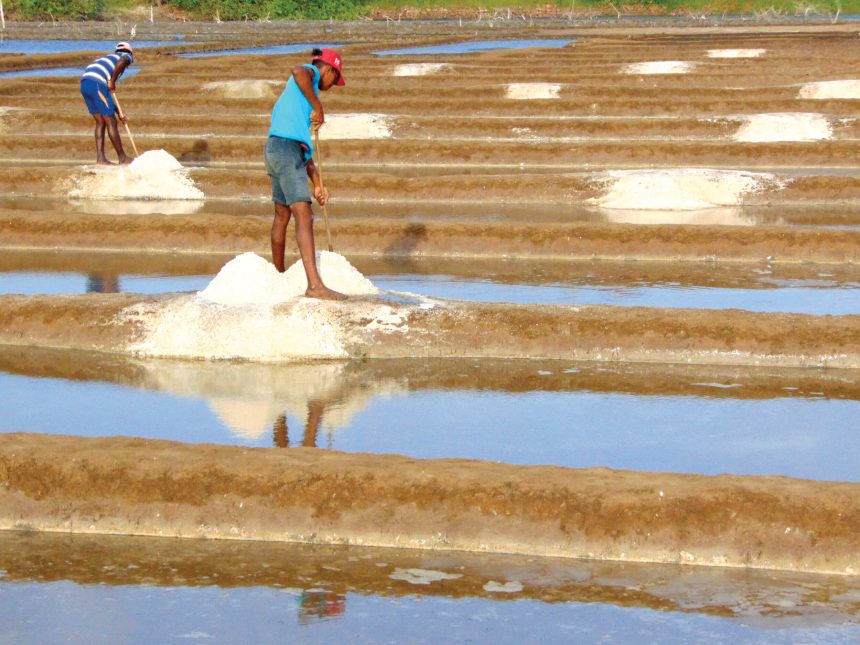
For nearly five decades, Vilas Shirodkar has walked the embankments of his ancestral saltpans in Korgao, Pernem, harvesting salt the way his forefathers did. Under the blazing sun, he continues a tradition that has survived for over a thousand years in Goa. Yet today, he stands at the edge of uncertainty — hopeful, but wary.
The state government has approved a Rs 95 lakh Salt Pan Conservation, Support and Revival Scheme for 2025–26, earmarking Rs 1 lakh each for 75 traditional salt farmers. For the first time, cultivators like Shirodkar feel officially acknowledged. However, while welcoming the initiative, they say financial aid alone will not rescue a dying occupation weighed down by structural problems.
Shirodkar said he learnt about the scheme only through newspapers and does not yet know the details. His immediate concern remains basic infrastructure.
“Hardly any approach roads are there to the saltpans and the salt has to be transported manually,” he said, pointing to rising transport costs that discourage producers from travelling long distances to sell their produce.
Storage is another challenge. Without proper facilities, unsold salt from one season becomes difficult to preserve safely for the next. Damage to embankments — critical for salt production — further increases costs, as regular maintenance is essential and repairs can be expensive when damage is extensive.
The economics of traditional salt production have grown increasingly unfavourable. Producers sell a 12-kg tin, locally known as a ‘lata’ or ‘dabo’, for around Rs 200 — roughly Rs 15 per kg. Labour costs, however, stand at about Rs 700 per day, amounting to Rs 21,000 per month. Farmers say that engaging labourers consumes a significant portion of their earnings. Local labour is scarce, and workers from outside the state demand accommodation facilities, adding to expenses.
Competition from industrially produced salt has sharply reduced demand for locally harvested salt. A local resident, Gaja Naik, said that earlier the salt produced in Goa would sell quickly, but now traditional producers often wait for buyers as industrial salt dominates the market. Though salt production once played a significant role in Goa’s economy, including during Portuguese rule, the non-polluting traditional industry is steadily declining. Farmers say that unless issues such as access roads, storage infrastructure, embankment support and market linkages are addressed, financial assistance alone may not be enough to sustain the centuries-old livelihood.
While the new scheme signals recognition and intent, traditional salt cultivators say what they need is not just relief, but long-term structural support to keep Goa’s salt pans alive.