NT Reporter
Panaji
Extolling the merits of frugal innovation, better known as jugaad in India, two senior academics have said that when we stop treating it as a mere desperate measure and start looking it up as a conviction, that is when jugaad becomes a sophisticated strategy for global impact.
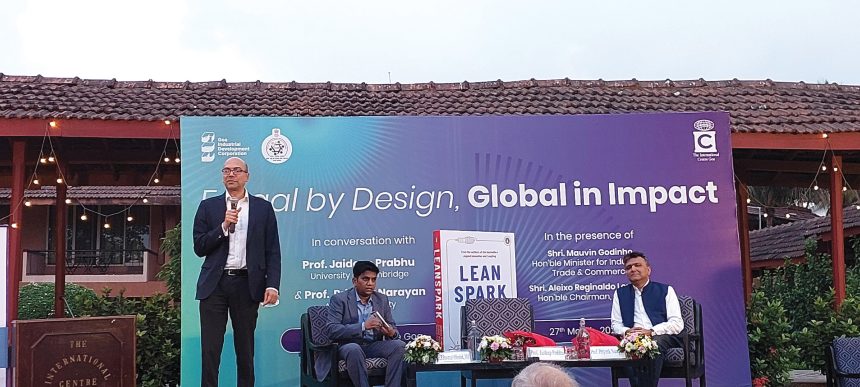
Professor Jaideep Prabhu of the University of Cambridge and Professor Priyank Narayan of Ashoka University on Friday delivered a lecture titled ‘Frugal by Design, Global by Impact’, organised by International Centre of Goa in collaboration with Goa-IDC, drawing on ideas from their co-authored book ‘Lean Spark’ to reposition frugal innovation as deliberate, scalable, and sustainable.
“Jugaad or frugal innovation is really a mindset of finding a solution to a problem with the given resources at that point of time. When you stop treating it as a mere desperate measure and start treating it as a conviction, that is when jugaad becomes a sophisticated strategy for global impact,” Prof Narayan said.
Challenging the notion that jugaad is uniquely Indian, Prof Narayan highlighted its universal nature: “We are naturally adept at problem solving. This mindset is for a large part, not just Indian. It comes from emerging economies.”
He traced this capability to childhood experiences, noting how mothers consistently emerge as the best problem-solvers in people’s lives, creating foundational patterns of resourceful thinking.
Using the ubiquitous shampoo sachet as an illustration, Prof Narayan revealed that “more than 50 per cent of shampoo in India is sold in sachets not in bottles” due to pricing innovation that made products accessible to wider markets that demonstrate how frugal innovation extends beyond products to processes and business model.
The Ashoka University professor positioned jugaad as “a strategy and not a stopgap,” challenging the prevalent “chalta hai” attitude.
“Jugaad is not ‘chalta hai’. Jugaad should mean ‘chalta rahega’,” he said, emphasising sustainability over compromise.
Addressing a persistent challenge, the professors tackled the contradiction where Indians excel at jugaad but often prefer foreign products, assuming they represent higher quality.
Prof Prabhu explained this isn’t contradictory but reflects smart consumer behaviour.
“Consumers will be demanding, especially if they have limited spending power. They want value for money, but they don’t just want something that’s affordable. They also want something that’s aspirational,” he said, noting how Indians now prefer Indian products over Chinese ones, suggesting that perception shifts are possible through sustained value delivery.
Prof Prabhu highlighted a key barrier: perception.
“People want an affordable product, but not the world’s cheapest product…we have to figure out a way to make affordable solutions aspirational,” he said, pointing to the case of the Tata Nano car as a lesson in design, branding, social desirability, and not engineering.
On India’s global standing, both were unequivocal. Aadhaar and UPI, they noted, represent exactly the kind of intentional, population-scale frugal innovation that other nations are scrambling to replicate.
“I think this is a space where India has really been pioneering globally,” Prof Prabhu said.
The discussion also touched on education, advocating hands-on learning to build “creative confidence” among students, and on the rising global interest in resource-efficient innovation.
“The world is no longer looking at a Silicon Valley model of throwing money at every problem… it is looking at solutions built with what we have,” Prof Narayan said.