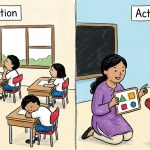
Families caring for disabled children face emotional, psychological, and financial challenges, highlighting the need for coordinated support systems
SWAMINI R. KAKODKAR
The Neurodevelopment and Autism in South Asia Treatment and Evidence (NAMASTE) project, initiated by SANGATH, aims to bridge the gap in care by identifying children with developmental disorders in communities across North Goa and providing free early intervention services to support their caregivers. It is implemented by SANGATH in collaboration with the Directorate of Health Services and the Department of Women and Child Development.
NAMASTE delivers two interventions, Parent-Mediated Autism Social Communication Intervention for Non-specialists Plus (PASS PLUS) for children who screen positive for autism risk and WHO-Caregiver Skill Training (WHO-CST) for families whose children have other neurodevelopmental difficulties. Screening is conducted by Rashtriya Bal Swasthya Karyakram (RBSK) doctors across the 17 Primary Health Centres (PHCs) in North Goa. Children experiencing challenges in social communication, thinking, reasoning, behaviour, or other developmental areas are screened and receive individual or group intervention sessions through the NAMASTE project.
During one of my assessments at a special school, I met a mother whose seven year old daughter has a multiple developmental disability and got a glimpse into the immense responsibility she carries each day. While the father runs a small business and manages the financial aspects, she described how she personally lifts and transports her daughter to school. She then waits there for five hours until the school day ends, just to take her back home. In addition, she ensures her daughter receives physiotherapy sessions at the school and manages follow-up appointments at the Goa Medical College. During her waiting time at school, she even asked whether there was any work she could do, such as a part-time job near the school, reflecting her desire to remain productive. Her story is an example of the quiet strength and resilience many caregivers show in the face of ongoing challenges. It also reminded me of how crucial it is to recognise and support the often-invisible labour that mothers, in particular, provide in the care of disabled children.
In another instance I interacted with a family who has a child aged seven years with speech delay and malnutrition. The parents have low literacy and are working on daily wages. The grandmother, despite only studying up to Class 4, guided the family to seek science informed interventions for their child.
With her support, the mother attended every intervention session, learning through observation, and the child showed remarkable improvement. Despite challenges related to the disability and superstitions within their community, the family worked together, proving that resilience and support can create progress even without formal education. They have now enrolled the child in a special school, where interaction with other children has brought visible positive changes in behaviour and communication. Though the mother cannot read, she manages by studying the pictures in the intervention manuals. Their extended family members helped them to obtain a disability certificate and supported them in the construction of their new house.
Another family comprises of an elderly couple with a seven year old child who has severe disabilities. The child has been diagnosed with hydrocephalus, marked by the accumulation of fluid in the brain, and also experiences speech difficulties, delayed motor development, and recurrent seizures. They live in a town with a nearby health centre and a special school, but for major treatments, they have to travel approximately 50 kilometres. The father works as a daily-wage helper, while the mother is employed as a community health worker with a limited monthly income. They also have an elder son and are concerned about how the demands of caregiving may affect his emotional, educational, and financial needs. Although the family accesses available government health services and welfare facilities, the support they receive only partially offsets medical related costs and is insufficient to cover all household needs.
In brief, families caring for disabled children face emotional, psychological, and financial challenges, highlighting the need for coordinated support systems. While parents often experience significant stress and require accessible counselling and mental health services, grandparents and extended family members who play a crucial caregiving role frequently remain unrecognised and unsupported.
When families are supported, it fosters sustainable care and leads to improved outcomes for both the child and the family. The lack of centralised access to education, therapy, and medical services increases time, physical, and financial burdens.
Goa has developed a relatively strong framework of medical, educational, and social support services for disabled children. The state is supported by several specialised medical institutions like Paediatric Neuro-Rehabilitation Centre (PNRC) and Institute of Psychiatry and Human Behaviour (IPHB) at Bambolim. District Early Intervention Services (DEIC) in both North and South Goa district, provide early diagnosis, intervention, and rehabilitation services. Various special schools and institutions across the state focus on individualised learning, skill development, and social integration.
Complementing these efforts, the Children with Special Needs (CWSN) scheme implemented by the Directorate of Education, Government of Goa, provides comprehensive educational support, including financial aid, specialised training, and resource rooms in various schools. The Government of Goa has also introduced various social security and welfare schemes to support families of children with disabilities. Among these, the Dayanand Social Security Scheme (DSSS) provides a monthly financial grant. While these initiatives are beneficial, it is often insufficient to meet the full needs of some families, particularly those facing high medical, therapeutic, and caregiving expenses.
As a way forward, strengthening welfare linkages by creating a one point coordinated service, improving financial support, and creating meaningful income generating opportunities and support groups for caregivers could greatly reduce stress and improve overall family well-being.
(The writer is a research associate for the NAMASTE Program of Sangath Goa)