While more people today are aware about autism there is much more that needs to be done
in terms of truly including autistic persons in the community
ANDRE VELHO
This year, the United Nations theme for World Autism Awareness Day on April 2 – ‘Autism and Humanity: Every Life Has Value’ – highlights an important idea: every autistic person deserves dignity, respect, and opportunity.
But it also asks a harder question: are autistic children simply present in our schools and communities, or are they truly part of them?
Beyond awareness
More people know about autism today. They have heard the word. They have seen posts about it on social media. When people understand autism, they are kinder. Families feel less alone.
But awareness means knowing autism exists. Inclusion means something more. It means a child can join a classroom activity, play with their neighbours, and feel like they belong. Think of Jyoti at a birthday party. Children are playing together, laughing, running around. She stands quietly near the wall. She wants to join in, but she is not sure how. The other children, caught up in the game, have not thought to invite her. Jyoti is at the party. But she is not part of it.
Inclusion is not about allowing Jyoti to be in the room. It is about making space for her to join in. Sometimes, this only takes something small – choosing a game she can play, asking her to be someone’s partner, giving her a little extra time.
Whether she joins in or stands alone often comes down to one person noticing and doing something. Sometimes it is a child who notices. Sometimes it is a parent, a teacher, an aunt who quietly says: come, sit here, join us. That moment costs nothing. But for Jyoti, it changes the
afternoon entirely.
Participation aids learning
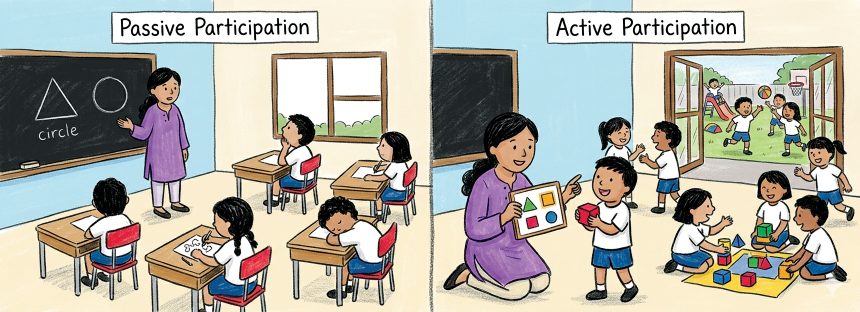
Children do not only learn in classrooms or therapy rooms. They learn by living – by playing, helping, communicating, trying things, making mistakes, and trying again. Autistic children are
no different.
Think of James helping his grandmother in the kitchen. He stirs the pot. He washes the vegetables. He sets the table. These seem like small things. But James is learning to use his hands, follow instructions, and communicate. He feels that he matters in his family. When James plays with his cousins, he learns how to share and take turns. When he spends time with children in his neighbourhood, he slowly becomes more comfortable with others. When his aunts and uncles let him sit nearby while they chat and laugh, he feels that he is welcome here.
When a child is left out, moments of learning are lost. A child who is often on the outside can grow less confident and less connected over time.
Not only a family matter
Participation is not something families can create by themselves. Children grow up in communities. They need their relatives, neighbours, teachers, and others to make space for them.
Goa has something that many places do not. It is a small, close-knit community where people know their neighbours, children grow up together, and families are part of the same schools, religious institutions, and local spaces for generations. That closeness is a strength. It means that when one person makes space for an autistic child, others notice. Small acts of inclusion spread.
Often, people do not realise when a child has been left out. A neighbour may not know how to speak to a child who communicates differently. A relative may think a child prefers to be alone. A teacher may not notice that a child is sitting through lessons without really taking part. These small gaps quietly
add up.
When a dance teacher gives a child a little more time to learn the steps, they feel encouraged to try. When a swimming coach shows the movements again patiently, without frustration, that child gains confidence. When a shopkeeper waits while a child slowly places items on the counter, the child feels welcome. When classmates learn to include someone who is different, they grow too – in kindness and in
understanding.
Participation does not require training or special knowledge. It requires noticing and doing something small. When autistic children are given a chance to participate, they discover what they are good at. They make friends. They feel connected. And something shifts in the community around them too. It becomes a little warmer, a little more human.
(The writer heads the autism program at Sethu, a social purpose organisation)