‘Mangoes and Meanings’ at Museum of Goa, Pilerne, will bring artists from across India together to examine the many layers of India’s most loved fruit through art, history, and lived experience
VINIKA VISWAMBHARAN | NT BUZZ
At the Museum of Goa (MOG), Pilerne, the mango will take on a life far beyond the familiar sweetness of summer. Open to the public from May 9, ‘Mangoes and Meanings: Histories, Ecologies, and Cultural Imagination’ brings together over 50 artists from across India to explore the fruit as a powerful cultural and emotional symbol.
The exhibition moves between history, mythology, ecology, and lived experience, presenting the mango not simply as food but as something embedded in everyday life.
Curator and MOG director Sharada Kerkar describes the starting point of the exhibition as something deeply familiar. “The mango is something almost everyone has a relationship with, through taste, season, or memory,” she says. “We see this familiarity as an entry point into art, enabling audiences to connect their lived experiences with broader cultural narratives.”
This sense of shared connection runs throughout the show. Kerkar points out that across India, people carry personal stories tied to mangoes. “Every state will say their mango is the best,” she notes. “Every child has a story, whether it is climbing a tree, stealing fruit, or waiting for the first mango of the season. We wanted to bring all of that into
the exhibition.”
The exhibition also traces the long history of the fruit. Mangoes have been cultivated in the subcontinent for thousands of years and appear in mythological narratives involving deities such as Lord Ganesha and Lord Hanuman. At the same time, their global journey through Portuguese trade routes is acknowledged, alongside the development of grafting practices that shaped many varieties known today.
With more than 1,500 varieties across India and over 80 in Goa alone, diversity is a central theme. The GI tagged Mankurad mango is given particular attention, reflecting its significance within Goan agricultural and cultural life.
Photography plays a key role in grounding the exhibition in contemporary realities with Indrajit Khambe’s work, as he documents the fisherwomen of Harnai in Maharashtra, focusing on a barter system where mangoes and other local produce are exchanged for fish. His images capture both a way of life and a disappearing practice.
“I started going to Harnai in 2018,” says Khambe. “What drew me in were the women. They are very strong and handle everything, from finance to family.” Over time, he began to notice the nuances of the marketplace. “This barter system is almost gone from everywhere, but in Harnai it still exists during the mango season. People bring fruits and exchange them for fish. It is a very unique tradition.” For him, the work is also about recognition. “My intention is to show these hardworking people as larger than life,” explains Khambe. “Success is not just about money or popularity. It is about showing up every day and doing the work.” Khambe will also lead a photo walk at Mapusa market on May 27, where he will guide people and share his experiece of shooting at a public space.
Personal memory also shapes the work of artist Bhisaji Gadekar. Although primarily known for sculpture and installation, this body of work revisits his early training in painting while drawing on deeply
personal experiences.
“As children, we would wake up early to collect fallen Mankurad mangoes. My grandfather was a farmer and trader, and I would go with my grandmother to sell them in the market,” he recalls. One of his paintings is a direct tribute to his grandfather. According to Gadekar, everyday objects hold quiet meaning. “They exist within our routines and become part of our subconscious,” he explains. “Through painting, I try to understand their presence and reveal their emotional and cultural significance.”
Artist Harshada Kerkar draws on personal and cultural memory in her work. Referencing efforts to protect old mango trees by Wendell Rodricks and her late husband Satish Sonak, she connects the fruit to care and resistance. In her drawings of Mapusa market, mangoes, and worn out carry bags become symbols of everyday life, capturing what she calls “the quiet sweetness of living”.
Mapusa-based freelance artist Chaitali Morajkar approaches the theme through material and form. Her exploration of mangoes began with the idea of fulfilment. “When you eat a mango, there is a sense of satisfaction,” she explains. “That is what the fruit symbolises for me.” As the work developed, new elements emerged organically, including references to mythology. “In the process, I started thinking of the story of Lord Hanuman mistaking the sun for a mango. Sometimes the work takes its own direction.” Rather than conveying a fixed message, Morajkar hopes for a sensory response. “I want viewers to feel enjoyment, positivity and a sense of fulfilment when they see the work,” she says.
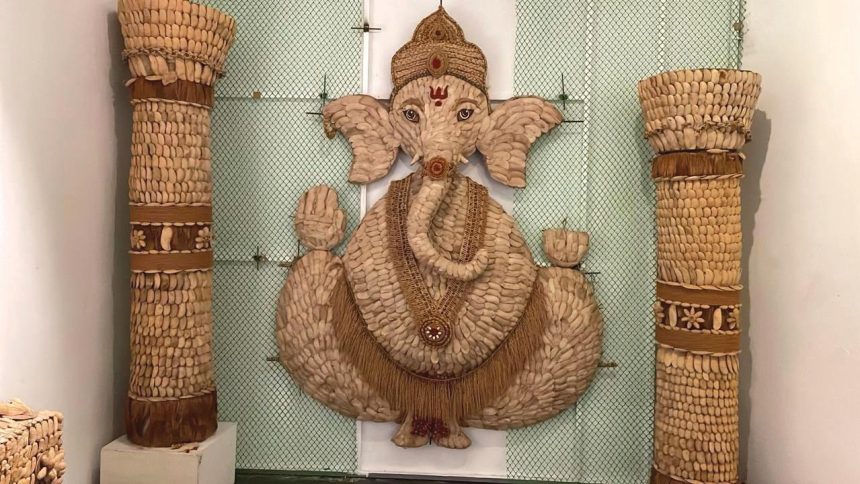
Among the striking installations is a work by Goan matoli artist Datta Naik from Priol, who has used over 1,500 dried mango seeds to create a large-scale image of Lord Ganesha, with even the supporting pillars constructed from the discarded shells. Naik says, “We often throw these seeds away without thinking, but they can be transformed into something beautiful and useful. I want people to see waste differently and understand its potential.”
Artist Kalidas Mhamal presents his work on terracotta plates, drawing inspiration from the dining table as a site of gathering and memory. “I wanted to display the food items as on the dining table, so the thought of plates came to mind,” he says.
His work references the Surati tradition of Keri Galo, a centuries-old seasonal feast that celebrates the arrival of mangoes. “It is a unique gathering observed by the local communities of the Khatris and the Ghanchis of Surat,” he explains, also noting how the fruit becomes a form of social glue. Held only at the peak of the season, the ritual brings families together with a fixed menu that balances sweet, savoury and spicy flavours, reinforcing bonds through shared food and time.
Alongside the artworks, the exhibition includes an interactive space where visitors can share personal memories, contribute recipes and engage with the diversity of mango varieties found in Goa.
The exhibition will also include a poetry night exploring themes of summer, mango, and memory on May 16, and a linocut relief printing workshop led by artist Mrinalini Sen on May 18.