Miguel Braganza
This weekend, Goa will celebrate its 38th Statehood Day and eight years since the coconut palm, Cocos nucifera, was notified in the ‘Official Gazette’ of Goa as the ‘State Tree’ in 2017. Goa has three main cultivars of coconut: Benaulim, Calangute and Nadora. Among its five variants, the green round Benaulim coconut has been identified as the best in terms of kernel content, and the yield of oil from the copra obtained from a single tree each year. The Benaulim variety of coconut is now a candidate for registration of a ‘Geographical Indication’ or G.I. tag for Goa.
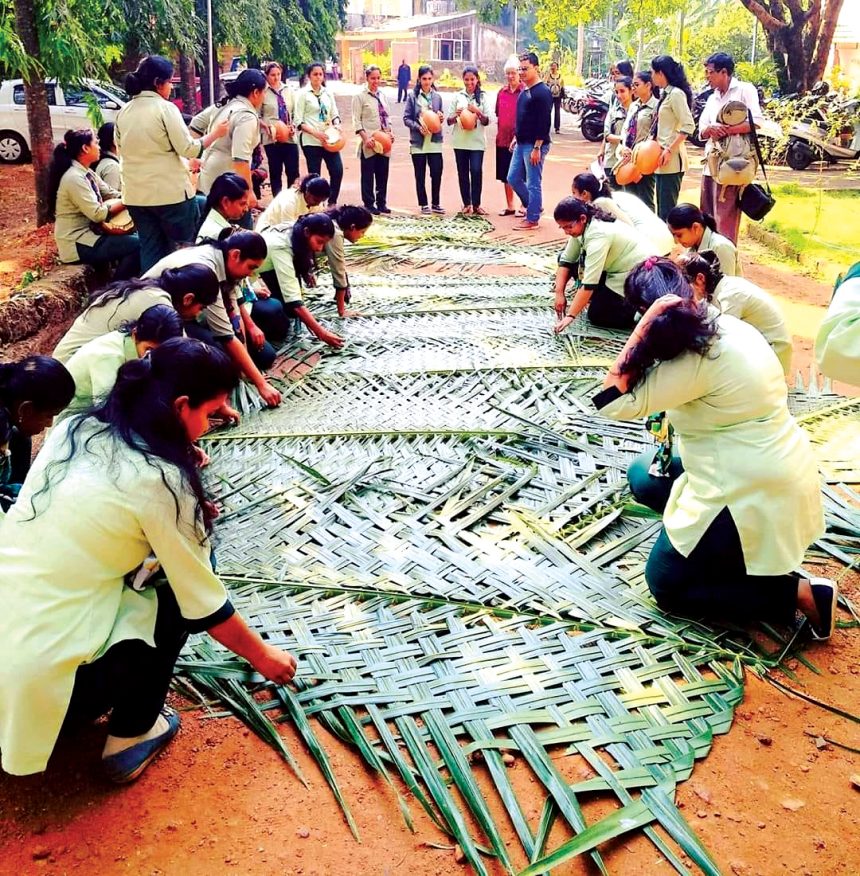
As in its native Polynesia, the coconut tree provides for all our needs: food, shelter and clothing. The trunk is used to erect instant bridges or as rafters for shacks and huts. The coconut fronds (compound leaves) are used as thatch. They may be used as whole frond or chuddit or samplle; or woven like a mat known as mollam. Suryakant Gaonkar and Sabina da Cunha have revived the art of making decorative mollam, hats using the mollam technique. The mollam are also used as side walls of a hut or khomp used for sheltering the canoes of the fishermen on the shore, and for storing firewood. Its modern application is as beach shacks that serve as restaurants for the tourists
in Goa.
We have already considered the tradition of coconut ‘Mother Palm’ and ‘Seed Nut’ selection in March. Now, the coconut seedling selection, planting and manuring needs attention to ensure higher productivity in coconut and thereby ensure its sustainability. There has been at least one heavy shower of pre-monsoon rain to wet the soil. It is now time to dig the pits for planting the coconut seedlings. Pits normally have length, breadth and depth of one metre each. On rocky ground, salt is applied at the bottom of the pit to soften it. Since Goa’s soil is poor in phosphorus and potassium, while re-filling the pit bonemeal, fish manure and wood ash are added to the soil. Disease-free and vigorously growing seedlings, with fronds splitting into leaflets, are chosen for planting. Care should be taken to ensure that soil does not fall into the centre of the coconut leaves as this may cause rotting of the apical bud and death of the plant during the monsoons.
Dig a basin about one metre in radius around the coconut tree as the monsoons recede in mid-August. Green leaves from the Uski, or Getonia floribunda, is put in this basin for each coconut tree. Add goborddem or a mixture of cow dung, kitchen waste, fish waste and ash. Due to the dwindling forest areas in the coastal talukas, the pink-flowered Glyricidia sepium trees, simply known as the Saareachem zaad, are cultivated along the boundaries of coconut gardens to provide the green leaves for manure. They have the added advantage of being a repellent for rats, a problem of coconut crop. The manure mix is then lightly covered
with soil.