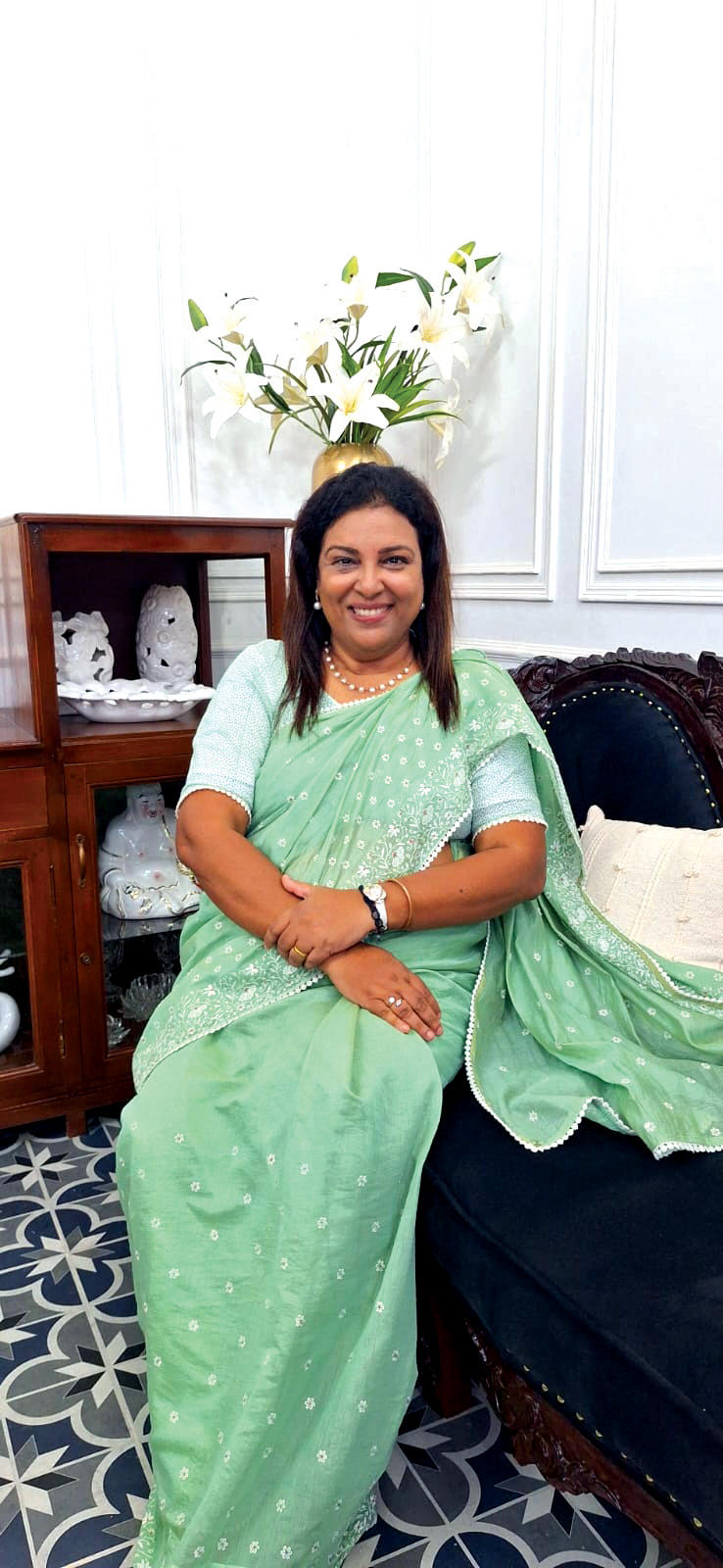
Associate professor and head of the Department of History at Rosary College of Commerce and Arts, Navelim, Rita Braganza, recently released her debut book ‘Church Archives’, which looks at the first five parishes in Salcete
CHRISTINE MACHADO
NT BUZZ
As an academician, Rita Braganza has always been curious about the state she lives in and about contributing to society through education. This interest first encouraged her to research ‘The Franciscans in Goa with special reference to the Capuchins’, which she shared at the Local History Seminar organised by the Directorate of Archives and the Department of History, Goa University in 1995. The paper received the Dr B. S. Shastry Memorial Award for Best Paper by a debutante.
Braganza later pursued research on ‘Goa-Karnataka Relations: 1763–1857, A Political and Economic Study’ for her PhD, which she completed in 2002.
This time, she has focused her attention on the churches of Salcete, a region she became familiar with during her 30 years as a professor at Rosary College of Commerce and Arts, Navelim.
She shares, “I encountered various villages in the taluka during study visits with students from neighbouring areas. As a research scholar, my goal was to learn and incorporate my experiences for the betterment of the student community.” She later applied for sabbatical leave to study and analyse various Indo-Portuguese churches and document her findings in book form.
Her recently released book ‘Church Archives: Indo-Portuguese Oral, Written and Visual Sources in Salcete, Goa’ is structured across seven chapters and traces the historical origins of Christianity in Goa, the role of St Francis Xavier, and the art and architectural forms found in Goan churches. It also dwells on the impact of the Church on Goan society, particularly its socio-cultural development, an area she notes has not been extensively researched. The book aims to address this gap.
Her research drew from sources such as the Historical Archives of Goa, Ribandar; the Xavier Centre of Historical Research, Porvorim; the Pissurlencar Collection at the Goa University Library; Rachol Seminary; Saligao Seminary; Clergy Home, Margao; priests from various parishes; souvenir publications; villagers; and research scholars.
For Portuguese translations of earlier records, she was assisted by former principal of St Xavier’s College, Mapusa, late Fr Dr Nicolau Gracias Pereira, and historian, author and former lecturer late Vasco Pinho.
While historical accounts often vary, Braganza emphasises that history is an interpretation of the past. She says, “The methods used to analyse and reconstruct may not determine absolute truth but they certainly help us understand multiple perspectives that existed in the past.”
During her research, she also came across several lesser-known details, including the role of Francisco Aranha in the architectural expansion of churches in Salcete. “He oversaw the construction of churches in Margao, Orlim, Mormugao, Verna, Colva, Cortalim and the iconic Church of Our Lady of Snows in Rachol, the first stone-and-mortar church in Salcete,” she says, adding that his contribution is commemorated through a stone inscription at the Rachol Church.
Another interesting finding was the origin of Orlim’s deep devotion to St Roque. “According to local tradition, a deadly cholera epidemic struck Orlim, killing around 80 people. One of those affected was Clemente Vaz, who fell into a coma. His cousin Joao Gomes, then administrator of Salcete, brought the image of St Roque and placed it on Clemente’s chest. Moments later, Clemente recovered miraculously,” narrates Braganza. Today, annual processions and public veneration of the saint continue in the village.
Braganza says the Church has left behind a rich legacy preserved in archives, oral traditions, architectural heritage and community rituals. These sources, she adds, help reveal how deeply intertwined religion and society were in Salcete’s Indo-Portuguese history. Going forward, she plans to focus her research on the socio-cultural heritage of Goa.