The Human Library Goa by Alina Kunji aims to create a space for people to connect beyond names and professions
CHRISTINE MACHADO
Every person has a story worth telling and it is these stories that Alina Kunji hopes people will listen to and perhaps learn from in her new project, The Human Library Goa.
Although not a new concept, Kunji, a student of Srinivassa Sinai Dempo College – Autonomous, Cujira, was inspired by a blind dating event that she heard of at a local cafe. “They had this cool concept where for every part of your meal, you had a new person to talk to,” she recalls.
That experience stayed with her and when she was later asked to host a workshop at a venue, she decided to create her own version of it. “I didn’t want it to revolve around dating, but I felt it would be nice to just have a platform to meet people,” she says.
She explains that most of her networking happens through corporate events with the Toastmasters club or Rotary Club, along with college activities that are often management-related. “In Goa, social life tends to revolve around clubs and parties. I wanted to create a space where people could connect without the pressure of work or nightlife,” she says. And thus, The Human Library Goa was born.
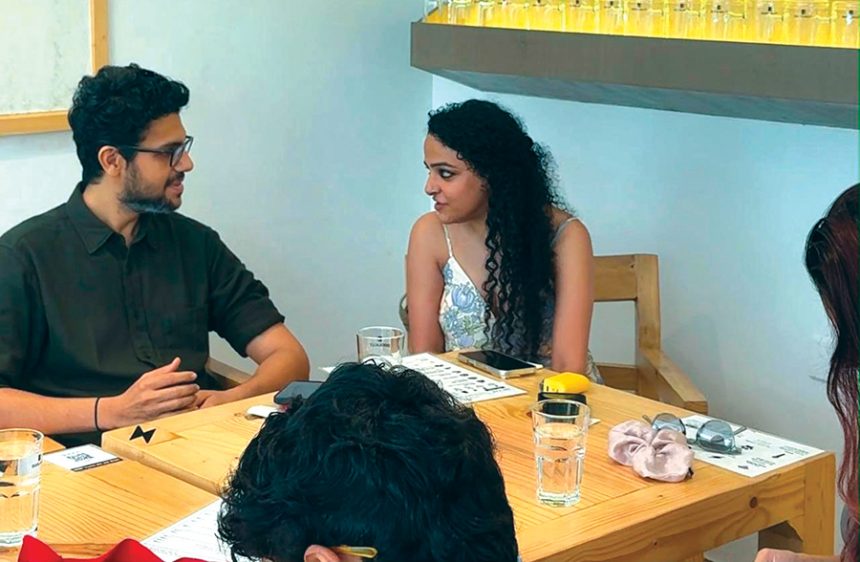
In the first session, held recently, participants introduced themselves through an identity of their choice instead of name or profession. For example, one could be the Queen of England or the Prime Minister. “You can be whoever you want to be. In this way, you are not judged by your profession, name, religion, etc.,” says Kunji, adding that she drew inspiration from the Bollywood film ‘Tamasha’.
Participants were then given ‘mission cards’ with tasks such as “Make three people smile” or “Find a fun fact about someone”. They were later blindfolded and seated back-to-back in pairs to talk on a given topic. After the interaction, they removed the blindfolds and had to identify the person they had spoken to. For this activity, Kunji says she was inspired by the film ‘Aankhon Ki Gustakhiyan’, which explores life without sight. The idea, she explains, was to understand how perception changes when visual judgment is removed. She also took inspiration from her experience as a volunteer at the Serendipity Arts Festival, where during a training session they were made to wear blindfolds to understand the challenges faced by specially-abled individuals. Kunji believes the blindfold activity also helped reserved participants open up more easily.
This was followed by a circle discussion and a yarn activity, where a thread was passed from one person to another while sharing a positive thought about the recipient. “The purpose was to show that everyone is connected.”
Kunji says she was surprised by the response to the first session. “We had to close registrations early as I wanted to keep the group small and ensure personal interaction,” she says. She adds that managing participants older than her was initially challenging but her experience with Toastmasters and public speaking helped her handle the session.
But she admits that running the initiative alone has been difficult, with much of her time going into marketing. “I would prefer to outsource that so I can focus on the experience, but I don’t have the funds yet. If it grows, I will definitely do that,” she says.
For now, she is limiting participation to around 30 people to maintain a more personal experience. For the next session on July 12, she is planning to incorporate new themes and updated mission cards to keep the format fresh.
The main goal, says Kunji, is for The Human Library Goa to grow into a community where participants feel included. “All these people are so different from each other, but they are all part of the Human Library,” she says. “I want everyone to feel that despite our differences, we are the same and I want this to be a space where everyone is heard and accepted for who they are.”