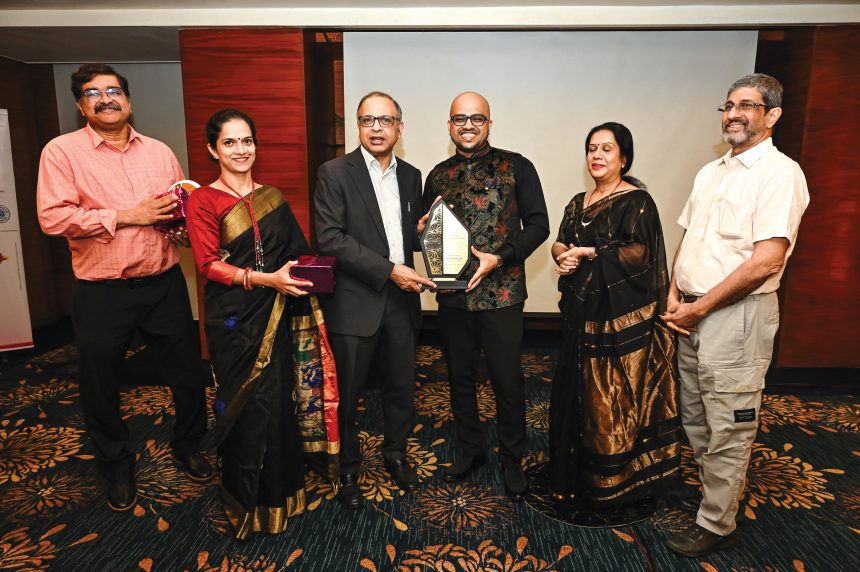
Gynovate AI by Dr. Vikram Dukle combines clinical support, documentation tools, and a mental wellness companion for doctors
VINIKA VISWAMBHARAN
NT BUZZ
Artificial intelligence is steadily finding its place in healthcare, not as a replacement for doctors but as a tool to ease the growing administrative burden that comes with modern medical practice. Candolim-based gynaecologist Dr. Vikram Dukle believes that is precisely where his new platform, Gynovate AI, can make
a difference.
Launched in Goa earlier this year, Gynovate AI is an AI-powered clinical co-pilot developed exclusively
for gynaecologists.
Dr. Dukle says the idea stemmed from the realities of everyday clinical practice. A practising laparoscopic, robotic and reconstructive pelvic surgeon and cosmetic gynaecologist for the past 15 years, he says, “Patients arrive with a lot of concerns, reports and expectations. Consultations are very quick. Decisions have to be made quickly and once the patient is leaving, the patient has to be communicated with clearly.”
The work, he stresses, does not end there. “Documentation takes a lot of time. Plus, we often work in small clinics or private set-ups where there is a shortage of staff. That is the first reason I felt Gynovate AI would really help because it reduces the time a doctor spends documenting, communicate better with patients, and even explains complex conditions in simple terms.”
Unlike publicly available generative AI platforms that many people use to search for symptoms or possible diagnoses, Gynovate AI has been developed only for doctors. Dr. Dukle says the platform work follows guidance issued by bodies such as the Federation of Obstetric and Gynaecological Societies of India (FOGSI), along with other national and international clinical guidelines. “It becomes a one-stop solution,” he says. “Doctors do not have to go to 20 different apps. They can get information based on recognised guidelines and then use that as a blueprint to discuss the case further.”
The platform can be used during outpatient consultations to generate case summaries, prepare prescriptions, create patient communication, and suggest points that require further clinical assessment. In the operating theatre, doctors can also dictate notes while scrubbed, allowing operative summaries to be prepared almost immediately after surgery. “By the time you finish your procedure, you already have a summary of the
whole operation.”
Patient privacy, he stresses, remains a key consideration. “We never put the patient’s name or personal details,” he says. “We only enter the clinical condition. We also advise people never to put their private concerns and personal details into public AI platforms.” He explains that patients first complete a paper questionnaire covering their medical history and concerns, particularly for sensitive consultations. “It is easier for many patients to write than to say everything aloud,” he says. “We read it during the consultation and then tear it after the review. We maintain the same confidentiality that we would for any other
medical record.”
Dr. Dukle also sees the platform as a way to support doctors in smaller towns and rural areas, where immediate access to senior specialists is often limited. “Around 400 users are from small towns and Tier III cities,” he says. “Sometimes there is only one resident doctor managing deliveries, emergencies and all the documentation. It is really helping them.” He says the idea is shaped by his own experience of working for two years in rural Maharashtra. “I know how taxing it is to work round the clock without any backup. You have to manage patients and document everything properly,” he says.
The platform also supports voice input and more than 60 languages, including Konkani, allowing doctors to use it in the language they are most comfortable with.
Beyond clinical support, Gynovate AI also includes GIA, an anonymous mental wellness companion developed specifically for gynaecologists. Dr. Dukle says the feature was created after recognising the emotional pressures many doctors carry throughout their careers. “Every outcome may not be very good and we normally do not share it to our family or our friends. We wanted doctors to have a companion,” he says.
The feature has already seen encouraging uptake, with around 700 users engaging with it since the platform was launched. “That itself tells us it is really helping because the concerns are real. We as doctors do not tell our deep insecurities to anyone,” says Dr. Dukle. The platform is currently undergoing evaluation with hundreds of gynaecologists across the country, with preliminary findings expected to be presented at a national conference early
next year.
Developing the platform alongside a full-time surgical practice meant years of work outside hospital hours. “Every night from midnight to three in the morning I have been working on this for the last five to six years,” he says. “I always wanted to understand technology, so I learned Python. Today AI has made many things easier, but doctors also need to understand technology if they want to build solutions for healthcare.”
While artificial intelligence continues to raise questions about its role in medicine, Dr. Dukle believes it should remain an aid rather than a substitute for clinical judgement. “It is to augment the skills that we already have. If we do not adapt, then we will definitely be left behind.”
Although Gynovate AI was developed in Goa, Dr. Dukle says it is beginning to attract international attention. “We have already been recommended by some hospitals in the UAE, Austria and Germany.” He adds that the platform is currently free for gynaecologists, unlike many AI tools that require monthly subscriptions. “We wanted to make it accessible to our colleagues,” he says.
Looking ahead, Dr. Dukle says his wider ambition remains to encourage more doctors to become innovators. “If doctors do not become innovators, it is very difficult for technology people to solve our problems,” he says. “Healthcare should not wait for the future. It should be built now, with doctors leading the way.”