PTI
New Delhi
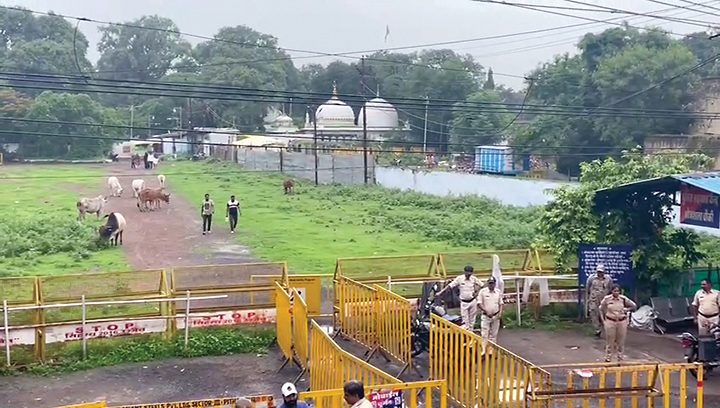
Observing that both Hindu and Muslim sides must have patience due to the “sensitive” nature of the Bhojshala matter, the Supreme Court on Tuesday directed that a separate open space be provided adjacent to the disputed site in Madhya Pradesh’s Dhar for offering namaz on Fridays between 1 and 3 pm till the case is decided.
The top court said it was ready to hear the matter on a day-to-day basis and resolve the issue, as it took up appeals from the Muslim side challenging a Madhya Pradesh High Court order which had said that the disputed Bhojshala complex was a temple dedicated to Goddess Saraswati. This order had nullified the April 2003 ASI order that permitted Hindus to worship on Tuesdays and Muslims to offer namaz on Fridays.
The Hindu community considers Bhojshala a temple dedicated to Goddess Saraswati, while the Muslim side calls the 11th-century monument the Kamal Maula Mosque. The disputed complex is protected by the Archaeological Survey of India (ASI).
A bench comprising Chief Justice Surya Kant and Justices Joymalya Bagchi and V Mohana, however, clarified that the arrangement for prayer space for Muslims shall be ad hoc, subject to the final outcome of petitions. The top court also directed that the Archaeological Survey of India (ASI) shall not carry out any structural changes on the site without its permission.
While admitting the petition filed by the Muslim side, the apex court issued notice to the Madhya Pradesh government, ASI and others. The court said it has to be very careful about every expression used.
“These are very sensitive matters and both sides must have patience. What is being said in court can unnecessarily create controversies or send a wrong impression. We have to be very careful about every expression used.”
“This is the first time that the issue relating to the interim arrangement is coming before us. The High Court’s order and the helplessness of the State in maintaining law and order are also being taken note of,” the court said.
“Our view is that whatever arrangement is presently in place, the matter can be listed before an appropriate bench within 10 to 15 days,” the CJI observed orally.
During the hearing, senior advocate Huzefa Ahmadi, appearing for the Muslim side, submitted that the High Court has passed an erroneous order and argued that a status quo which existed for about 800 years was disturbed.
Ahmadi stated that the earlier arrangement existing since 2003, which allowed Hindu and Muslim worship to continue prayers on the site on designated days, must be allowed to operate in the meantime.
Senior advocate Abhishek Singhvi, also representing the Muslim side, submitted that namaz was being offered on the site for at least 700 years, as per the available evidence, which was an excellent example of “communal harmony” as both Hindus and Muslims were allowed to worship.
Solicitor General Tushar Mehta, appearing for the Madhya Pradesh government, told the court that several developments have taken place after the High Court’s verdict.
Opposing restoration of status quo ante (situation that existed before), Mehta said, “Once you come after two months and seek status quo ante, administrative problems will arise.”
On May 15, the Madhya Pradesh High Court ruled that the disputed Bhojshala-Kamal Maula Mosque complex in Dhar district is a temple dedicated to Goddess Saraswati. It simultaneously quashed a decades-old ASI order that had allowed the Muslim community to offer Friday prayers at the site.