FILM REVIEWS SACHIN CHATTE
Film: Batwara1947
Cast: Sunny Deol, Preity Zinta,
Shabana Azmi
Directed by: Rajkumar Santoshi
Duration: 2 hours 25 minutes
Rating: * *
Based on Asghar Wajahat’s play Jis Lahore Nai Vekhya, O Jamya E Nai, like most films on Partition, Batwara 1947, has its heart in the right place. But, much like Main Vaapas Aaunga a couple of months ago, when it comes to cinematic storytelling, the film gets a bit muddled. The obligatory songs and romance unnecessarily dilute its essence, leaving you desperately wanting the story to move on.
At its core, though, there is a strong message about values and respecting humanity. And Sunny Deol proves yet again that there is much more to him as an actor than being the man who can uproot a hand pump. This is one of his finest performances, one that goes beyond the dhai kilo ka haath and bashing up half a dozen people in an action sequence.
Beyond its central message of Hindu-Muslim unity, however, the plot doesn’t have a great deal going for it. If you are going to rehash familiar ideas, they need to be presented in a way that makes the scenes genuinely powerful. Unfortunately, such moments are few
and far between.
One of them comes when a Hindu lady dies in a Muslim locality. The people who gather for the last rites don’t know how to go about it. Someone suggests that “Ram naam satya hai” should be chanted as the body is taken to the funeral pyre. The predicament is written all over their faces. It is easily the most powerful moment in the film.
What ends in Pakistan begins in Meerut, on the eve of India’s independence. While the country is in a celebratory mood, Hindu-Muslim riots are also looming large on both sides of the border. Sikander Mirza (Sunny Deol) is an entrepreneur and as patriotic as they come. Along with his wife Hamida (Preity Zinta), mostly referred to as Begum, and their two children, he is preparing to celebrate India’s Independence when riots cut short the jubilation. The family is forced to board a train to Pakistan, hoping to return home soon.
Once at a refugee camp in Lahore, they begin looking for a place to stay. A kind-hearted poet (Ali Fazal) gifts them a haveli, except that they discover an old lady already living there. Mai (Shabana Azmi), as she is eventually called, is a Hindu woman and the owner of the house. With no kith or kin around, she continues to hope that her son will return someday.
So far, so good. The film shifts gears smoothly, but the trouble of getting stuck is just around the corner. Sikander is established as a kind-hearted man, yet, for some reason, he and his family want to throw the old lady, who is simply minding her own business, out of the house. The screenplay takes this detour so that Sikander can eventually have a change of heart and begin treating her like his own mother.
Meanwhile, the local goon and aspiring politician (Abhimanyu Singh) wants to get rid of Mai so that he can take possession of the property. The rest of the film revolves around this conflict, which is stretched out far more than necessary. Sikander’s son (Karan Deol) also joins hands with the bad guys, and you know almost immediately that he will eventually have a change of heart and support his father in the climax.
The characterisation is inconsistent. The son gets separated from his family in India, only to be reunited with them in Pakistan—and before they can even celebrate, he has decided to join the evil forces. The poet disappears for a while and then suddenly makes a comeback to talk at length about his love life, seemingly just so that we can have another song (the music is by A.R. Rahman).
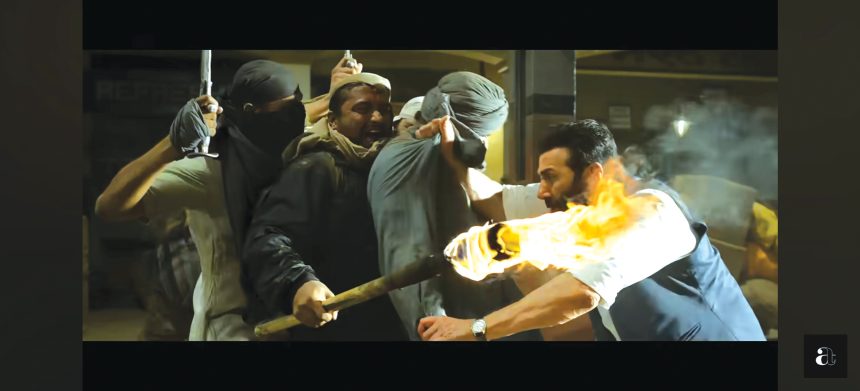
There is also a fair bit of lecturing about the role of a mother and a constant clamour for unity. Preity Zinta is largely relegated to playing second fiddle, while Sunny Deol carries the film. Whether in action or emotional scenes, he is convincing. He even manages to keep his white shirt spotlessly clean after beating up a mob. Batwara 1947 leaves you with mixed feelings. You appreciate its emphasis on humanity and the values that bind people together, but the storytelling needed to be much crisper. The film has the right message; it just takes too long to get there.
Jurassic Suburbia
Film: The End of Oak Street
Cast: Anne Hathaway, Ewan McGregor
Directed by: David Robert Mitchell
Duration: 1 hour 39 minutes
Rating: * * * 1 / 2
Produced by J.J. Abrams and directed by David Robert Mitchell (of It Follows, one of the better horror films of the century), The End of Oak Street is an old-fashioned survival thriller with a clear tribute to Steven Spielberg and his groundbreaking dinosaurs. Producer Abrams himself did a Spielberg pastiche with Super 8 (2011), a cross between E.T. (1982) and Close Encounters of
the Third Kind (1977).
David Robert Mitchell moves forward in terms of Spielberg’s filmography, but the film is set in 1982, and it is no coincidence that this was the year of E.T. Set in the Oak Street neighbourhood, the Platt family is going through a crisis of sorts. Greg (Ewan McGregor) and Denise (Anne Hathaway) are having a rocky time as far as their marriage is concerned, while their teenage son Brian (Christian Convery) and daughter Audrey (Maisy Stella) have more than a whiff of what is going on. Greg has a job, or so he says, but he also delivers pizzas on the side, something Denise is not exactly proud of. Denise, meanwhile, is an aspiring novelist who sits in the basement and keeps herself busy
at the typewriter.
The build-up is nice and steady; it is the calm before the storm. One night, the family wakes up to bright lights and an ear-deafening sound. Even the family dog senses that there is something out there. There is no evidence of what caused it, except for a massive pile of poop on the neighbour’s lawn. It takes a couple of nights for the same thing to happen before the whole neighbourhood is transported back in time to a prehistoric era, with dinosaurs roaming around the hood.
A bit like what Spielberg did with Jaws (1975), David Robert Mitchell shows the menace without revealing exactly what is causing it — at least for a while. But then we see all those savage creatures, along with a few vegetarian ones (which the characters identify with great confidence), leaving the residents with nowhere to run or hide. The whole neighbourhood is isolated, with forests
covering its borders.
When you dig a hole that deep, getting out is not going to be that easy. The plot bites off just enough of what it can chew, and it is a touch-and-go affair. A little bit of science fiction, a little bit of fantasy, and we are out of the woods.
There are no extraordinary moments as such in the film. It plays things by the numbers, but it plays them fairly decently.
It is fun while it lasts.