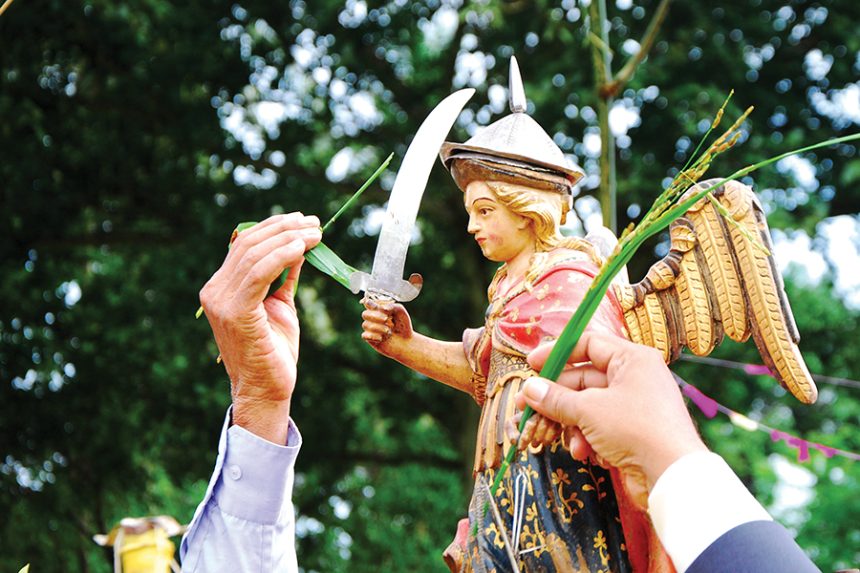
As the village of Taleigao prepares to celebrate Konsachem Fest on August 21, NT BUZZ learns more about this centuries-old tradition
It is celebratory time in the village of Taleigao as the villagers prepare to celebrate their harvest festival. Known as Konsachem Fest, this thanksgiving for a bountiful crop is also known as Festa da Espiga or Novidade and has a history that dates back to nearly five centuries ago.
In 1510, when the Portuguese arrived in India and set forth to conquer Goa, the fleet, owing to the monsoons got suck in the Mandovi River. Their exit route was blocked by a sand bar that had formed at the entrance of Aguada Bay.
Forced to take shelter on the rafters at the edge of the Mandovi River at Britona, the Portuguese troops soon ran out of provisions. On learning of their plight, the fishermen from Taleigão informed the people of Taleigão. The ‘gauncars’ of the village (early village settlers who had control over the agricultural land) then took the initiative of supplying provisions to the troops in the dead of the night by risking their lives from the Muslim troops and inclement weather.
After three months, reinforcements arrived and the Portuguese eventually captured Goa from the Bijapuri rulers on December 10, 1510.
In recognition of this help rendered, Afonso de Albuquerque later granted them the privilege to cut the first sheaves of rice on August 21, prior to the other villages in Ilhas. This decree has been described in the Foral of Portuguese writer Afonso Mexia dated September 16, 1526, Article 54.
Taleigão is the only village in Goa where the Novidade is celebrated traditionally for four days (21–24 August). The feast is celebrated in rotation among the ‘gauncar’ families in the following order: Mendonça, Viegas, Martins, Luis, Gomes, Faria, Almeida, Falcão, and Abreu. This year, the Gomes family will be the main celebrants of this traditional feast
Earlier, as a tradition, on August 24, the president of the feast and the representatives of ‘gauncars’ would present the first sheaves of rice to the Portuguese Governor who was the custodian of the Communidade land. The then ‘gauncars’ who were Hindus offered these sheaves and sought blessings from the village deity. After embracing Christianity, they continued these traditions with Eucharistic celebration in church and dedication of the sheaves to the patron of the village – São Miguel Arcanjo. This explains why the ‘gauncars’ have the privilege of celebrating the Festa da Espiga and the feast of the patron São Miguel Arcanjo.
The festivity traditionally begins with cannons (fosné) fired at noon, during the pealing of the Angelus bell on the previous day to convey to the neighbouring villages that Taleigão is all set to celebrate the Novidade.
On August 21, the ‘Alvarado de Música’ played at dawn in the village lanes heralds the celebration. At 8.30 a.m., president of the feast marches under the cover of a colourful ceremonial umbrella to the São Miguel Arcanjo church to the beats of brass band. From the church, the parishioners proceed in a procession to the field at Tolliant earmarked by the Comunidade for cutting of the sheaves.
In 1990’s the procession used to be led by ‘dhol caxia’ (drum) and a trumpet, followed by ‘adao’ representing the village tribes dressed in colourful costumes and dancing with bamboo sticks and swords. They are followed by flag of Holy Trinity (previously it was the Portuguese flag) and the parishioners, the Confrades carrying the statue of the patron São Miguel Arcanjo on Charol, the feast president, the parish priest, and the brass band playing religious tunes.
The procession proceeds along the Estrada de Santos Passos which joins to Rua de Novidade. This one kilometre long route is traditionally decorated with 24 arches of bamboo shoots. After a short prayer, the parish priest blesses the sheaves by sprinkling holy water and burning incense. The feast president then cuts the sheaves with a silver sickle and carries them in a silver tray to the church.
While returning to the church, prayers and sheaves are also offered at the São Miguel Arcanjo chapel en route. High mass is celebrated at the church at 10 a.m.
After the mass, the parishioners participate in the Quermés (games) organised by the parish youth. In the afternoon, coconut breaking competitions are held and the football finals of Sao Miguel trophy is organised at Dr. Alvaro Remigio Pinto ground by the Clube de São Miguel de Taleigão. In tune with Goan cultural traditions, the day ends with a tiatr in the late evening.
The following day, with the boom of cannons in the background and accompanied by the traditional band, the feast president sets out to distribute ‘fov’ (beaten rice) to the nine ‘gauncar’ families. This represents sharing of joy and happiness of the rich harvest.
On August 23, at 4 p.m., the president of the feast accompanied by traditional band and the boom of cannons proceeds to the church and offers ‘fov’ at the altar of São Miguel Arcanjo. After prayers by the parish priest, ‘fov’ are presented to him at the parochial house.
On the last day, the male representatives of the nine ‘gauncar’ families and three members of the Comunidade managing committee carry the blessed sheaves, ‘fov’, and flower bouquet to Sé Cathedral. Old Goa was the capital of Goa until the 18th century and the Sé Cathedral was the main church back then. The group is received at the church entrance by the parish priest of Sé Cathedral with the pealing of the golden bell and playing of the traditional band in the background.
A special mass is celebrated on the occasion which is also attended by devotees residing around Old Goa. The blessed sheaves are then distributed by the priest during the mass. After the mass, ‘fov’ is distributed by the president of the feast to the congregation and the resident priests.
Later, the group presents ‘fov’ and sheaves to the Archbishop at Paço Patriarcal and to the Governor of Goa at Raj Bhavan. At Raj Bhavan, the feast president reads out a short speech highlighting the various difficulties faced by villagers in cultivating the fields, drainage system, etc. In the afternoon, the group is treated to a sumptuous lunch consisting of 12 dishes at the feast president’s residence. It is customary to play a game of cards for entertainment.
In 2010, the Taleigao Communidade completed 500 glorious years of keeping alive the tradition of harvesting the paddy crop and the first corn of rice.