DR. LUIS DIAS
I named my column ‘On the Upbeat’ when I began writing it some 13-odd years ago, I’ve lost count. It was a pun, on the ‘upbeat’ (also called anacrusis) in music, but also the more general meaning of the term, of being optimistic despite so much doom and gloom.
It has not been easy; from Goa to Gaza to the global, there often seems little to be
‘upbeat’ about.
And then like a Godsend, a welcome wind of change, enter Neha Bora. This Neha, whose name means ‘love’, ‘affection’, ‘downpour’, ‘rain’, does justice to all of them.
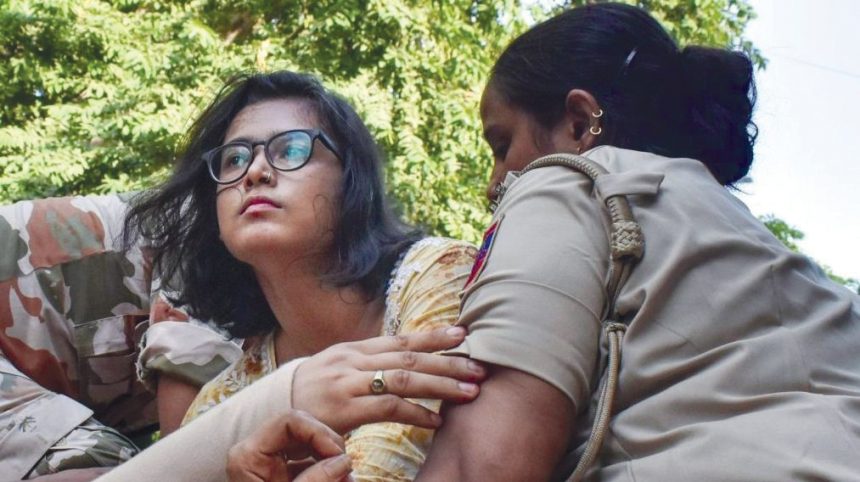
By now, Neha Bora is a household name not just in India, but across the world. Bora uses “they” and “them” as personal pronouns, so I shall respect that wish here.
At a time when all one sees of Gen Z (the demographic cohort succeeding Millennials and preceding Gen Alpha, roughly people born between 1997 and 2012) is the raucous partying and vapid pursuit of hedonism in the vicinity of my home, and their virtual absence (barring very few notable exceptions) in social activism against the casino lobby and other issues plaguing our tiny state, the lazy assumption might well have been to dismiss their potential as a force for change, as a demographic to seriously reckon with.
Bora and their colleagues have shown what Gen Z are capable of when provoked, when an invisible threshold is crossed. Born in 1997, Bora epitomises their generation perfectly.
What is playing out in India today, most visibly in Delhi, but is silently seething in the rest of the country, is a chasm of misunderstanding between a much older, doddering, autocratic, corrupt, ineffective and ineffectual political and bureaucratic class, and this young, hope-filled generation Z, the future of the country, who are not content to let that future be toyed with or snatched away from them. This is something truly worthy of celebration, something ‘on the upbeat’, a glimmer of hope after seemingly interminable darkness and depression.
This generation that has been stirred into action is unfazed by slurs whether cockroaches, termites, anti-nationals, Naxalites, dimagi Naxals, ‘tukde tukde’, Khan market gang, or any other label hurled at them.
Bora’s clarity of vision and purpose, the ability to speak to crowds and reporters, to field extempore questions without flinching or stuttering, is what completely bowled me over. They need no pre-prepared speeches or teleprompts.
That confidence was undoubtedly honed from years of their background in street theatre, a genre so inextricably intertwined with
activism.
Actor, author and educationist Tanveer Qaidi wrote in a social media outlet that the theatre exposure was “a gateway to political awareness.” It shaped Bora’s public persona, and “completely defined how [Bora] speaks, leads and connects with people.”
In an interview to Reuters last month (‘From theatre to streets, Gen Z protester Neha Bora a new face of India’s youth unrest’), Bora said joining the theatre group made them learn to inhabit the lives of people much different
from themselves.
“There might be a character that if you meet in your real life, you will disagree with, you will not like. But to do theatre is to understand where that person comes from.”
This is a powerful endorsement of the true essence of theatre as a formative character-building tool for the youth. We sorely need that here in Goa.
I watched a video interview featuring Nidhi Razdan, a journalist and television presenter I greatly admire and whose absence after her resignation from NDTV I missed very much, with Bora (“Detained, challenged and still protesting. What is driving India’s young protesters to return to the streets?”).
Bora called the experience of the activism in the past few months “very tiring, but also simultaneously very hopeful. It seemed like, for the longest time, we had forgotten how to breathe, we had forgotten how to not be afraid, how to not watch out just for ourselves and nobody else; we had forgotten that feeling. In the past few months, somehow or the other we had learned that feeling once again. And we have learned what constitutional guarantees we as citizens of a democratic country have. Slowly, gradually, the entire country is learning once again what it means to be a citizen, what it means to have the Constitution on your side, how to have history on your side. It is the common people and their democratic protests, not just the government, that has the power now.”
Elaborating further, Bora said, “Citizens are coming out onto the streets again and again. Despite watching protestors being beaten up the previous night by police, watching them being detained, being roughed up, clothes being torn, sexual harassment complaints from female protestors, the next morning, the next afternoon, they again come onto the streets. Ideally, this [the use of force] should be inspiring fear, right? It should be discouraging, for us. But we see that it is not. It is not that for all these years, that nothing like this was happening. But for all these years, we did not have the permission to say anything. We did not have the permission to call state violence, violence. We did not have permission to assert our right to democratic dissent. And now that this mass movement has given us this courage, that space for breathing does not necessarily mean that democracy is flourishing. It just means that people in this country have the courage to take the step towards democracy flourishing in our country.”
When Razdan asked what brought this change, Bora answered that “there was no one tipping point.” Although the protests erupted earlier this year, “all of this anger and deep dissatisfaction with the system that we were existing in, had been bubbling just under the surface, and not rising to the surface, because people were so scared. But the kind of protest we are witnessing in the country’s streets today, the courage of being detained and still showing up again and again, is no individual extraordinary courage, no miracle of time. It is simply the force of an idea whose time has come.”
In 2024, Bora had cited this quote from Arundhati Roy: “Another world is not only possible, she is on her way. Maybe many of us won’t be here to greet her, but on a quiet day, if I listen very carefully, I can hear her breathing”. Bora called Roy’s work a “bridge to the possibility of a different or better world”.
Bora embodies for me the essence of the timeless Rabindranath Tagore poem with which I’ll end this column:
“Where the mind is without fear and the head is held high; Where knowledge is free, Where the world has not been broken up into fragments By narrow domestic walls; Where words come out from the depth of truth; Where tireless striving stretches its arms towards perfection, Where the clear stream of reason has not lost its way Into the dreary desert sand of dead habit, Where the mind is led forward by Thee Into ever-widening thought and action. Into that heaven of freedom, my Father, let my country awake.”