With healthy flowering and favourable weather so far, farmers across Goa are pinning hopes on a strong cashew harvest to revive incomes hit by last year’s poor yield.
Bhiva Parab
After a disappointing harvest last year, cashew growers across Goa are looking at the current season with renewed optimism, as healthy flowering and favourable weather conditions raise hopes of a strong yield that could
stabilise farm incomes.
The cashew season has begun in the state, though there has been a delay of around eight to ten days, attributed to extended rains until the end of November and a lingering chill in the air. Despite the late start, farmers say the crop condition so far appears promising.
For many in Goa, cashew is not just a crop but a primary source of livelihood. Introduced by the Portuguese nearly five centuries ago, cashew has evolved into one of the state’s most important commercial crops. Thousands of families, particularly in rural and hilly talukas, depend heavily on the seasonal income generated from the sale of cashew nuts and apples.
Last season, however, brought disappointment. The yield was significantly lower than expected, leaving farmers worried and financially strained. For those who rely almost entirely on cashew income, a poor harvest translates directly into hardship, affecting household expenses
and basic needs.
“This season, the climate till now is normal and there is still chill in the air. We are at least expecting a good cashew yield in the coming days,” said Nandkishore Nhanji, a farmer from Pernem taluka. “If the climatic conditions remain favourable, we will get good returns.”
According to agricultural sources, the average local variety of cashew tree produces around three kilograms of nuts per season, while high-yielding grafted varieties can produce up to 10 kilograms per tree. The collected nuts are typically sold to wholesalers, with prices depending on market demand and nut quality.
Over the years, cashew production in the state has increased, but experts point out that productivity in older plantations can decline due to soil erosion and the lack of nutrient application. To address this, the Agriculture Department provides assistance in kind, including neem cake, rock phosphate, and support for gap filling with improved grafts. Soil conservation measures such as contour bunding and trenches are also undertaken to prevent erosion, especially in hilly plantations.
Large tracts of land across Goa remain under cashew cultivation, and more land is gradually being brought under the crop. There is also considerable scope to improve productivity without expanding the cultivated area. In many hill plantations, the spacing between trees is wide, and additional grafts could be planted to increase plant density per hectare. This would enhance output without requiring more land.
Despite its economic importance, cashew cultivation faces several challenges. Forest fires during the summer months remain one of the biggest threats, particularly in hilly areas where most plantations are located. Fires can quickly spread and destroy trees, leading to heavy
losses for farmers.
Traditional fire-prevention practices such as ‘Aagist’—once common in cashew-growing regions—are now rarely seen. The method involved selecting a strip of grass about one to two metres wide, roughly three metres from the plantation boundary, and carefully burning it in sections before extinguishing the flames. This created a protective fire belt around the plantation, reducing the risk of uncontrolled fires spreading to cashew trees. Farmers say reviving such practices could help mitigate losses.
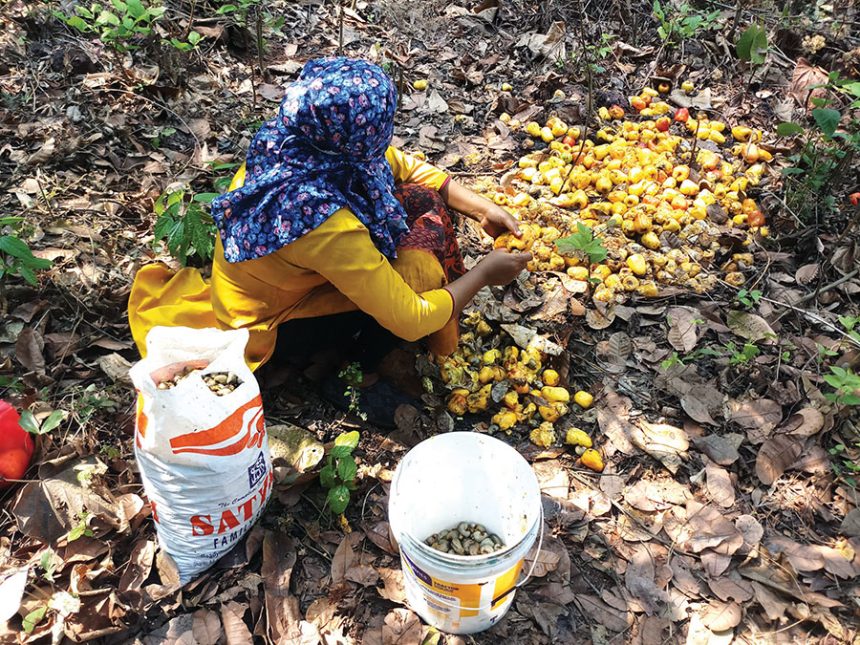
Beyond nuts, the cashew apple plays a vital role in Goa’s rural economy, particularly in the production of feni. The apples are collected by hand from plantations, most of which are located on hillsides. After separating the nuts, the apples are taken to a ‘Kolambi’—a naturally formed rock basin traditionally used for crushing them.
“A Kolambi is a natural rock shaped like a basin, with a narrow channel to allow the juice to flow into a container,” said Sainath Parab, a cashew farmer. “Nowadays some farmers build artificial Kolambis, and those producing feni in large quantities even use machines. But preparing feni is hard work and a tedious process.”
Fresh apples are essential for feni production. Once crushed, the juice begins to flow into a container. After about half an hour of crushing, pure juice known as ‘Niro’ trickles down from the Kolambi. Niro is in high demand during the season, with many buyers visiting plantations
directly to purchase it.
During the peak cashew months, bottles of Niro can be seen for sale along roadsides in several parts of the state. Prices vary by location, typically ranging from Rs 100 to Rs 200 per litre.
For growers, however, the focus remains firmly on the nut yield, which determines the bulk of their annual earnings. With flowering reported to be good this year and no major climatic disruptions so far, expectations are running high.
A strong harvest would not only provide financial relief after last year’s losses but also reinforce cashew’s enduring role in Goa’s agrarian economy. As the season gathers pace over the coming weeks, farmers will be watching the skies closely, hoping that favourable weather holds and the crop fulfils its promise.