

Goa’s kitchens are discovering new energy in food scraps. As LPG prices climb, biogas plants are helping restaurants, resorts and families transform waste into cooking fuel, offering savings and sustainable solutions for households and businesses alike, reports Shahin Bepari Lambe
As rising fuel costs and LPG shortages continue to affect homes and businesses in Goa, biogas is moving beyond composting and entering the energy sector, particularly among commercial kitchens that generate large amounts of food waste daily. Many households, resorts and restaurants are now turning kitchen waste into cooking fuel through biogas plants, creating financial relief and a sustainable solution.
Industry estimates suggest that 10 kilograms of food waste can generate gas equal to one kilogram of LPG. A restaurant producing 10 kilograms of food waste daily can save approximately one industrial LPG cylinder of 19 to 20 kilograms every 20 days. Samruddh Hegde Dessai, co-founder of AlterEnergyZ, said biogas is one of the few waste management technologies that provides a direct financial return on investment.
“In the current economic conditions, the payback period for a commercial biogas plant is estimated at two to three years through savings on LPG expenses and reduced waste handling costs,” said Dessai, adding that commercial kitchens are becoming one of the biggest focus areas in the shift towards waste-based fuel systems.
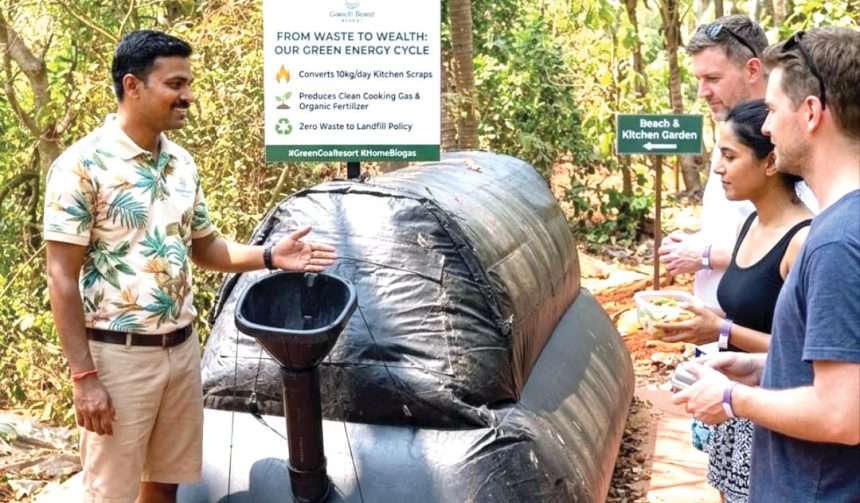
He said space constraints in urban areas, especially for restaurants, remain a challenge. “However, portable tubular and barrel-style biogas systems are becoming popular as they are transport-friendly and can be assembled or shifted when required,” said Dessai.
Government departments are encouraging adoption through subsidies and incentives. The Goa Energy Development Agency (GEDA) is providing subsidies for domestic users and mid-sized restaurant units. GEDA offers a subsidy of around Rs 24,000 for a four-cubic-metre plant. Apart from reducing dependence on LPG, biogas systems also generate liquid organic manure for gardening and plantations.
“If commercial establishments across Goa begin processing waste through biogas systems, the burden on municipal waste collection and transport could reduce by nearly 50 per cent, creating both an energy and waste management solution for the state,” Dessai said.
At Cabo Serai Resorts, biogas helped operations continue during LPG shortages. General Manager Sreeram Sarath said, “At Cabo Serai, we have always believed that true luxury goes beyond comfort. It is about doing things the right way. When LPG shortages began, our biogas plant kept the stoves burning and spirits high.”
He said food waste generated at the resort is transformed on-site into clean and reliable biogas. “Nothing is wasted. Everything has a purpose. That is the Cabo Serai way,” he said, adding that the resort remains committed to sustainable hospitality.
At Casa Jaali, owner Kate Abramovitz said biogas became an important backup during the LPG shortage. “We have been using biogas for the past year to cook all our staff food. When the LPG shortage hit, we were very thankful to have it as a backup. While we have mostly moved to induction cooking, we continue to rely on biogas every day as well. It has been a huge advantage for us,” she said.
For families in rural Goa, biogas is reducing household expenses and supporting farming. Vijaykumar Natekar from Bicholim, who installed a 1.5 cubic metre plant four years ago, said his annual LPG cylinder usage dropped from 10 cylinders to three.
“I am saving Rs 7,500 yearly on LPG cylinders. Plus, I am not adding solid waste to landfills. The slurry generated from kitchen waste is used in my field as organic manure, where I grow coconut, betel nut, mangoes and flowers. I am also saving more than Rs 5,000 annually on chemical fertilisers,” Natekar said. He advised against putting meat bones, eggshells and lemon into biodigesters.
“GEDA gives a 30 per cent subsidy for domestic customers and the Agriculture Department gives a 75 per cent subsidy for farmers. I recommend a biogas plant for everybody as it helps save money, protects the environment and benefits health since it supports organic farming,” he said.
Kishori Patil from Dharbandora, who installed a one cubic metre facility earlier this year, said food cooked using biogas is both tasty and economical. “My LPG consumption has started reducing. In the long run, I will benefit much more,” she said.
Sahil Kalangutakar from Pernem, who installed a biogas plant at his home in March, said that apart from financial savings, he can also use the slurry for his areca nut and coconut plantations.
A GEDA official said, “GEDA is committed to driving Goa’s transition toward energy self-reliance by accelerating the adoption of innovative renewable energy technologies and sustainable waste-to-energy solutions across the state.”
Environmentalist Rajendra Kerkar said biogas is beneficial if used properly. He said waste generated in homes can be used to produce gas, while slurry can be used as manure for trees and plants.
Kerkar said biogas plants were widely used earlier in Goa’s interior talukas, especially in homes with cows, but declined after LPG was introduced. He said there is now a need to promote biogas on a larger scale, while ensuring rules, regulations and safety protocols are followed.
“We cannot dump any kind of waste into the pit. We have to be mindful. Even the construction of the biogas plant and laying of pipelines should be done properly, as it can be harmful to the environment. Release of methane gas into the environment is not good, so the system should be properly maintained depending on how it is being used,” Kerkar said.

