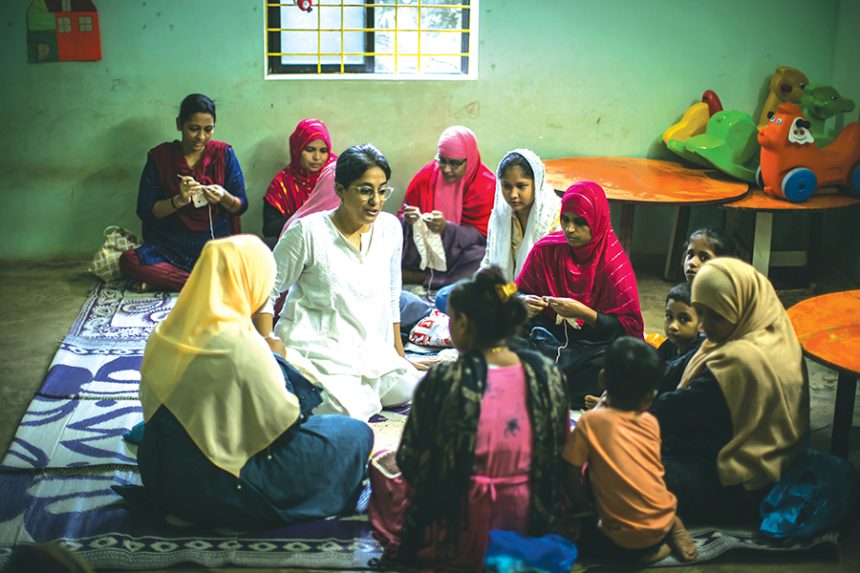
The Mango House, Merces, a design-led non-profit enterprise creates livelihood for local women by providing training and upskilling for traditional skills like crochet, writes Shahin Bepari Lambe
The Mango House, a Panaji-based enterprise working towards women empowerment is creating income opportunities for local women by combining traditional Goan craft skills with entrepreneurship. The handcrafts products developed by the non-profit organisation are rooted in Goa’s cultural identity.
More than 70 women have been trained through the initiative, with many becoming first-time income earners. The enterprise is founded by Rupinder Renee Kaur, who spent more than a decade in Goa and began exploring how her background as an educator could be used to support local women artisans. While observing local markets, Kaur noticed a gap in the craft ecosystem.
“When you go out in the market or in the ecosystem, just as an observer, there is nothing in the name of craft,” she says. A visit to a community stitching centre further highlighted the gap for Kaur, as many women were being taught skills that were not translating into income. Learning a skill without income became one of the factors that shaped The Mango House.
Kaur said the problem is not limited to Goa but linked to the way skill development programmes were designed. “What I realised was that the quality of skilling which exists in Goa, or rather, not just in Goa, in any skilling programme, is so average that it is not designed towards that individual becoming independent very quickly or earning an income quickly.”
Drawing on her experience as an educator, she developed The Mango House around practical skills that could help women earn an income. Here local women artisans create handcrafted products inspired by Goa’s traditions and craft practices.
For Kaur, the impact of the initiative goes beyond the sale of the products. “It’s certainly not the product sales. It’s the stories of impact on ground where the skill that you have taught them is helping them earn.”
She recalled the example of an artisan who was able to provide her child with special needs experiences that she could not afford earlier. Other women are also supporting their families, paying school fees and earning their own income.
“They are all first-time income earners which is a huge milestone by itself. With own income a women can spend the money as they want to. You don’t have to ask your husband for it,” Kaur said.
A significant opportunity came when The Mango House was selected to showcase its work at the Serendipity Arts Festival. The festival provided a platform to artists and the opportunity to be shortlisted. It presented an important moment for the enterprise.
“I’ve been attending the Serendipity Arts Festival, and the kind of amazing work that they’re doing gives a platform to so many artists in this community. So, to be shortlisted, to be even present there was a spotlight moment for us.”
The festival became the launch pad for The Mango House’s Amche Goa collection. The collection features handcrafted souvenirs inspired by Goa’s sea life, traditions and local craft. It includes a crochet Kunbi doll that celebrates two local craft traditions.
The association with Serendipity Arts continued through the inaugural The Brij Incubator Foundry, a five-day programme held in Goa for early-stage cultural and creative entrepreneurs and organised with the support of the French Institute in India.
The Mango House was selected as the only Goan-based creative startup among 10 ventures chosen from across the country for the inaugural cohort of the programme. Kaur said the programme came at an important stage for enterprise as it moved to its next phase of growth.
“The Brij has come at the most amazing time for us to bridge to the other phase of The Mango House,” Kaur said. “Everything was in my head, and I had nothing on paper,” she added.
The programme helped Kaur create her first pitch deck and also encouraged the participating founders to question their assumptions and approach to their work. “What was most fascinating was that everything was taught to us in the most interesting format. They did not tell us how to do it, but made us question and think.”
Going ahead, Kaur hopes to work with more traditional Goan craft practices, including coconut shell work, Chitari art, terracotta, azulejos and Kunbi textiles. She said the challenge was to take traditional craft forms that have remained in a particular form and develop them in ways that can appeal to present-day travellers and consumers.
“The products that they are making or the form that they exist in are frozen in a certain time. So how is it that you can bring it out of that time and bring it to a format that the current traveller can buy happily and also use it?”
Through its work with local women artisans, The Mango House is seeking to create income opportunities while developing handcrafted products based on Goa’s traditions and craft practices. Its association with Serendipity Arts and The Brij Incubator Foundry has also provided opportunities to showcase its work and support its next phase of development.