What began as an effort to give back to the community led Caesar Fernandes to set up Kafmar Environmental Services, a company that provides environmental solutions and undertakes cleanup projects for water bodies, with a focus on simple solutions, long-term maintenance and community awareness, writes Diana Fernandes
It was during a gram sabha meeting in his village that Caesar Fernandes realised discussions and blame games were aplenty, but there was little to no action on the ground. That pushed him to do something different — to fight for a cause and become the change he wanted to see in society. One of the key issues he wanted to address was the condition of the river in his village.
While continuing to run his business, Wooden Homes, which he set up in 2010, Fernandes decided to establish Kafmar Environmental Services Pvt Ltd, which initially began as an LLP. Over the years, the company has taken up several notable projects, including the cleanup and restoration of the Maimollem lake and the Tolleband-Khareband stretches of the River Sal.
Today, Kafmar focuses on environmental engineering solutions that combine modern technology with long-term maintenance and public awareness to help sustain cleaner surroundings.
“There’s always opposition when you fight for a cause and people don’t want to do something productive. There are always challenges when you want to do something good. So I decided it is better to go out and be the change that I wanted to see. And I started with the river in my own neighbourhood, because it has seen better days,” he says.
At the time, the river surface was choked with weeds. Fernandes began researching solutions being used in other countries and came across amphibious machines used in Sweden. Procuring the expensive equipment, however, became the first major challenge. The first machine was procured in 2016, after which the process of formally setting up the company began.
Before that, Fernandes and his team had already begun organising cleanup drives and beach cleanups, besides taking up awareness campaigns by painting conservation messages on bridge walls and promoting environmentally friendly initiatives. Fernandes also worked with like-minded individuals such as Afroz Shah, known for spearheading the Versova beach cleanup.
The company’s name itself reflects the thought behind the initiative and its focus on future generations.
“Kafmar represents my kids: K stands for Kay, the youngest one; A stands for Angelica; F stands for Faustina; and MAR stands for Marcelino, my son. So that was the whole idea: for the posterity of the future generation, to get the perspective right, get the heart in the right place. It is not only business for us here at Kafmar, it is about doing something more,”
says Fernandes.
Consistency, Fernandes believes, is key to any environmental effort, and he says the impact becomes visible over time.
“Throughout the projects I’ve worked on, I’ve noticed when you keep doing certain things like this and keep making efforts in keeping it clean, people really appreciate it and those people who really want to litter or create a mess or who are habitual litterers also reconsider dumping the garbage,” he says.
Every year on World Environment Day on June 5, team Kafmar identifies two locations that have become black spots and undertakes cleanup drives, often involving schools from the neighbourhood. In an effort to create a sense of ownership after the cleanup, students are encouraged to plant saplings and take care of them.
“They get great satisfaction and one thing I’ve also learned when we do this kind of drive is that the kids pick up the message and they don’t want to throw garbage,” he says.
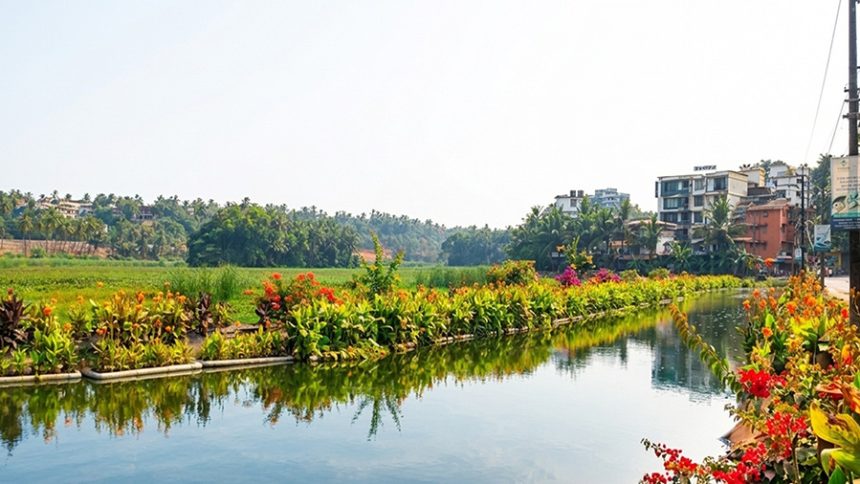
A similar strategy has also been adopted during the Khareband River Sal cleanup project, where colourful bougainvilleas have been planted to bring, in his words, “some value to the area”.
Another challenge the company is trying to address is reducing the use of plastics and encouraging environmentally friendly alternatives.
“In our cleanup drives, we have noticed a large number of straws, sachets and plastic cups; all these things are completely avoidable. On the beach, one of the biggest polluters is straws. We are working on creating campaigns and content to encourage people to stop the use of these things,” he says.
Maintenance is another aspect that Kafmar strongly focuses on. Fernandes says that once a cleanup project is completed, maintaining the area can be done at minimal cost. In the case of the River Sal project, for instance, he says regular maintenance after removing the weeds will help maintain water quality over the coming years. One of the engineering solutions the company uses is trash booms — floating barriers designed to stop plastics and other waste from spreading
across water bodies.
“These are simply engineering techniques that help in barricading the waste from going to other parts of the river. And when you put in workers to regularly clear the waste, it will help stop the spread of the waste,” he explains.
At the same time, Fernandes says addressing the source of pollution remains equally important.
For Fernandes, the monsoon season itself plays a vital role in restoring nature.
“The monsoons are one of the most wonderful things that God has given us. It helps to clean and flush water bodies. If there were no rains, people would die and perish,” he says.
The larger message he hopes to share with both people and the government is the need to adopt simple lifestyle changes, reduce plastic use and take responsibility for keeping neighbourhoods clean.
He says people must be willing to stop using items such as plastic straws, plastic cups and plastic sachets, while also taking the initiative to clean and maintain the areas around them.
Recent projects undertaken by Kafmar Environmental Services
Maimollem channel restoration
Cleared silt, invasive weeds and solid waste choking the channel
Used amphibious machinery to restore water flow
Stabilised banks to reduce erosion and define channel edges
Installed trash barriers to stop floating waste and weeds
Introduced floating reedbeds for natural pollutant treatment
Improved water clarity, flow and ecological health
River Sal restoration at Khareband
Cleared floating weeds and unmanaged solid waste along river stretch
Used amphibious excavator for systematic weed removal
Installed floating barriers to prevent incoming vegetation
Stabilised banks using geo-fabric and plantation
Added floating gardens for natural water polishing
Installed lighting and fencing to improve safety and deter dumping
Restored cleaner surroundings and improved visual appeal
Toleband restoration work
Removed dense floating weeds affecting water flow
Restored degraded shoreline conditions using amphibious excavator
Created and stabilised banks to prevent erosion
Installed floating reedbeds for phytoremediation
Improved water circulation and surface cleanliness
Enhanced overall ecological balance of the lake