

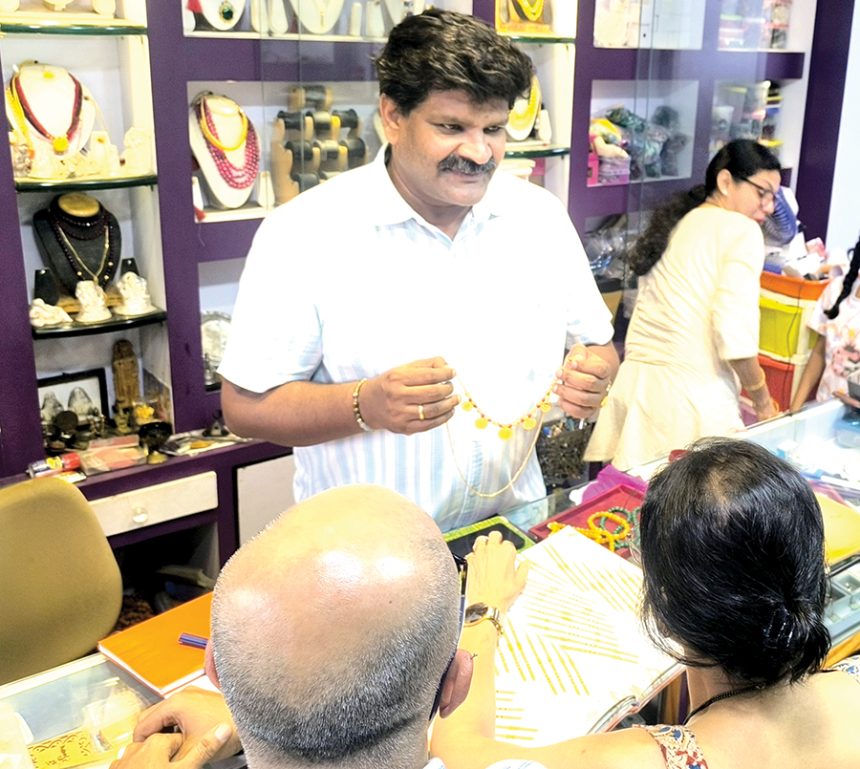
The jewellery industry in Goa, which is worth over `1,000 crore, is witnessing a steady transformation, blending traditional craftsmanship with modern standards of quality and transparency. With gold continuing to be regarded as a reliable asset class, the Goa Jewellers Association believes the future of Goa’s jewellery sector remains strong and promising, writes Arpita Srivastava
Gold has always held a special place in Indian households, not just as an ornament but as a symbol of wealth, security, and cultural heritage. In Goa, this sentiment runs deep, and despite market fluctuations, the demand for gold jewellery remains resilient.
Speaking on the industry’s outlook, Sameer Ratnakar Kudtarkar, president of the Goa Jewellers Association, said that gold will always remain a trusted asset. “Gold is not just a luxury product—it is an investment. No matter how markets fluctuate, people continue to rely on gold as a stable asset class.”
Hallmarking Brings Trust and Transparency
One of the most significant developments in recent years is the introduction of mandatory hallmarking, which has improved the purity and quality of gold available in the market.
Kudtarkar said that over the past four years, the association has actively worked to ensure that all jewellers adhere to hallmark standards. “Today, every jeweller is dealing strictly as per hallmark norms. When a customer buys 22-carat gold, they are getting exactly that purity. The same applies to 24-carat, 23-carat, 20-carat, 18-carat, 14-carat, and 9-carat jewellery, all of which are certified under BIS standards.”
He further added that standardisation has been carried out by the state government to bring uniformity across the industry so that branded shops, corporates, and local jewellers are on one platform and to increase consumer trust. As a result, business has seen a noticeable boost and there is trust among customers.
A Growing Goan Industry
The jewellery sector in Goa comprises approximately 250 shops, contributing to an estimated turnover of around Rs 1,000 crore. Earlier, the Goan industry operated in a largely unorganised manner, with limited awareness about gold purity among customers. However, with the advent of new technology and regulatory reforms, the Goan industry has evolved into a more organised and transparent marketplace. Mapusa has turned out to be a hub of jewellery manufacturing in Goa, with a significant number of workshops and skilled artisans based in the area. Margao follows closely as another important centre for jewellery trade.
Commenting on the impact of hallmarking on the Goan industry, Kudtarkar said that earlier jewellers struggled to afford expensive hallmarking machinery, which could cost between Rs 40 lakh and Rs 50 lakh. To address this, the government introduced a standard hallmarking charge of Rs 54 per piece, making the process accessible to all.
“This move has helped bring branded shops, corporates, and local jewellers onto the same platform and also strengthened customer trust in local businesses,” Kudtarkar said.
Speaking on the challenges customers faced earlier, he said that when jewellery made by local artisans was taken to branded stores for resale or exchange, it was often undervalued. Branded shops would test the jewellery at points where the gold purity was slightly lower—such as joints or shouldering points—leading to inaccurate assessments.
“As a result, jewellery that was actually 85–90 percent pure would be shown as lower purity, confusing customers and affecting their trust in local jewellers,” he added.
Thriving Local Sector
Despite the growing presence of national and international jewellery brands, local jewellers in Goa continue to hold their ground.
Harish Nasnodkar, secretary of the association, believes that competition has, in fact, benefited the industry. “Healthy competition always leads to better business practices,” he added.
He said that local jewellers have an advantage when it comes to pricing. “Since we manufacture our own jewellery, we can offer more competitive rates. Our making charges start at around 10 percent, whereas branded stores charge anywhere between 17 percent and 35 percent depending on the design.”
Nasnodkar also highlighted differences in pricing strategies. “Branded shops may offer slightly lower gold rates to attract customers, but they compensate through higher making charges. Every player has their own marketing strategy, and we respect that.”
Consumer Preference
Consumer preferences in Goa are also changing. While 22-carat gold was once the dominant choice, there is now a growing demand for lightweight jewellery made from 18-carat and 20-carat gold.
“Earlier, customers preferred heavier 22-carat ornaments, largely influenced by branded shops and government emphasis. But today, people are opting for lighter, more stylish designs that are easier to wear and have a better finish,” said Nasnodkar.
Interestingly, e-commerce has not made a significant impact on Goa’s gold jewellery market. According to Kudtarkar, the online gold segment or e-commerce remains negligible in the state.
“Customers in Goa prefer to physically see and feel the jewellery before making a purchase. They cannot trust online platforms, as they love to see 20 necklaces and then buy one; hence, e-commerce platforms are not working in Goa,” added Kudtarkar.
Goa’s jewellery industry is also known for its unique craftsmanship, particularly the work of local artisans or karigars. These craftsmen possess skills that have been passed down through generations, making their creations distinct.
Unique Goan Craftsmanship
Nahush Lotlikar, the treasurer of the association emphasised the uniqueness of Goan craftsmanship. “The jewellery made by Goan karigars cannot be replicated by others. It’s like the taste of fish curry—only a local can get it just right.”
Unlike metropolitan cities, where jewellers often act as traders, many Goan jewellers are involved in the entire manufacturing process and are fully aware of the entire process right from scratch.
“Even today, around 30 to 40 percent of local jewellers continue to operate from home-based setups, working closely with artisans on finishing and detailing,” added Lotlikar.
One of Goa’s most distinctive jewellery styles is filigree work, an intricate craft featuring delicate, lace-like patterns made from twisted gold or silver wires. Influenced by Indo-Portuguese artistry, this form of jewellery was traditionally popular among the Catholic community and foreign buyers.
The demand for filigree jewellery has declined in recent years. “Earlier, foreigners loved filigree designs, but now that demand has reduced significantly,” Kudtarkar noted. “It is also a time-consuming process, which makes it less commercially viable.”
“Currently, only about 20 to 30 percent demand remains for such traditional designs. While efforts have been made to train artisans from other regions, the authenticity of Goan filigree work remains unmatched,” added Kudtarkar.
Despite its growth, the industry faces several challenges. One of the biggest concerns is the fluctuation in gold prices.
“Price volatility affects customer confidence. Gold prices have seen significant swings—from Rs 19,000 down to Rs 14,000—and customers are unsure about future trends,” said Kudtarkar.
He further added that Goans remain loyal to gold, as they do not prefer alternatives like one-gram or gold-plated jewellery.
Security and Cybercrime Concerns
With increasing digitalisation, jewellers are also facing new-age challenges such as cyber fraud. Kudtarkar said that incidents involving payment reversals and fraudulent transactions have been reported.
“In the past term, around 40 such cases were cracked by the police, with full recovery achieved,” added Kudtarkar. To enhance security, the association has issued standard operating procedures (SOPs) to all jewellers, including the installation of CCTV cameras and proper data storage systems.
Carrying Local Traditions Forward
Another pressing issue is the declining interest among younger generations in taking up goldsmithing as a profession. Kudtarkar said that “if this trend continues, it will have a serious impact on the industry. We may see a situation where external players dominate the market, reducing the share of local jewellers.”
“Compared to earlier times, running a jewellery business today is much easier due to digitalisation and technological advancements,” Kudtarkar said.

