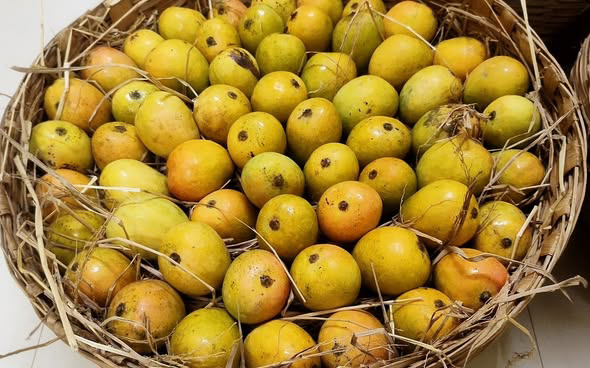
Mango season has arrived in Goa, bringing with it the unmistakable aroma, colour and anticipation that define summer in the state. Yet, amid the variety of mangoes filling market stalls, it is the Goan Mancurad that continues to command attention, holding on to its position as the most sought-after fruit despite its steep price, reports Bhiva P Parab
Across markets in Panaji, Margao and other parts of the state, vendors have begun displaying an array of mango varieties. Local types such as Musharad, Fernandin, Malgesh, Godo Amo and Bhisam are available alongside mangoes sourced from neighbouring Maharashtra, including Hapus, Neelam, Totapuri, Pairy and Mankur. Even so, for many Goans, the season truly begins only when Mancurad arrives in the market.
Known for its distinct sweetness, rich flavour and soft texture, the Mancurad has long been regarded as the ‘king of mangoes’ in Goa. Its popularity has endured over the years, with buyers willing to pay a premium to savour what is widely considered the finest of the local produce.
Prices this season reflect that demand. A single large, good-quality Mancurad is currently selling between Rs 90 and Rs 120, while smaller fruits are slightly cheaper. By comparison, Alphonso or Hapus mangoes are priced at around Rs 50 per piece. In terms of dozens, large Mancurads are selling between Rs 1,000 and Rs 1,400, while smaller ones range from Rs 800 to Rs 1,000. Alphonso mangoes are priced between Rs 600 and Rs 900 per dozen.
In Panaji, the price trend over the past few weeks highlights the dynamics of supply and demand. In early March, Mancurads were selling at as much as Rs 5,500 to Rs 6,000 per dozen, reflecting the limited early arrivals. With increased supply in April, prices have dropped to between Rs 1,200 and Rs 2,000 per dozen, with some lots even available at Rs 800. Vendors attribute the fall in prices to higher arrivals and a noticeable increase in the number of sellers in the market.
“Earlier, only two or three vendors stocked Mancurad mangoes, but now many more are selling them,” a vendor said, pointing to the growing availability of the fruit as the season progresses. Despite this, he maintained that the demand remains strong, driven largely by the fruit’s taste and quality.
Vendors insist that while several varieties are available, Mancurad continues to stand apart. Its unique flavour profile and consistency in quality have helped it retain its status over the years, even as consumers are exposed to other popular varieties from outside the state.
At the same time, concerns over artificially ripened mangoes have begun to surface once again. With chemically ripened fruits entering the market, some consumers are choosing to purchase only from known and trusted vendors. The difficulty in distinguishing between naturally ripened and artificially ripened mangoes remains a challenge for buyers.
A customer, Nandkishore Nhanji, said that Mancurad mangoes remain in demand due to their taste but are priced high, especially at the start of the season. He said it has become increasingly difficult for the common buyer to identify naturally ripened fruit, adding to concerns about quality.
While Mancurad dominates the local market, traders point out that preferences vary outside Goa. Ratnagiri Hapus, for instance, enjoys strong demand in other parts of the country. Mangoes that are close to ripening are carefully plucked to avoid damage, sorted for quality, and packed in wooden boxes before being transported. From Goa, consignments are often sent to Mumbai, where they are either sold locally or exported to international markets.
The pricing pattern, traders say, is typical of the season. At the beginning, limited supply pushes prices higher. As more mangoes arrive in the market, rates gradually decline, making them more accessible to a wider section of consumers. Mangoes with minor blemishes or spots are sold at lower prices, finding buyers who are less concerned about appearance.
For farmers, the season holds both promise and concern. Many are optimistic about a good yield this year, but there is a growing worry about the declining interest of the younger generation in agriculture. A farmer said that while mango cultivation continues to be in demand, younger people are reluctant to take up farming, preferring other professions.
Farmers also pointed to the availability of government schemes aimed at supporting agriculture, urging greater participation and awareness. They said there is scope to improve mango cultivation practices, including the introduction of intercropping in mango plantations to enhance income.
The economics of Mancurad cultivation remain attractive, particularly for owners of traditional trees. Traders often pay lump sum amounts to tree owners for the right to harvest mangoes for the entire season. The income earned depends on factors such as the quality, size and yield of the fruit, with well-maintained trees fetching higher returns.
As the season gathers pace, the presence of Mancurad in markets continues to signal more than just the arrival of summer. It reflects a tradition, a preference and a taste that remains deeply rooted in Goa’s cultural and culinary landscape, even as the market evolves with changing trends and challenges.