

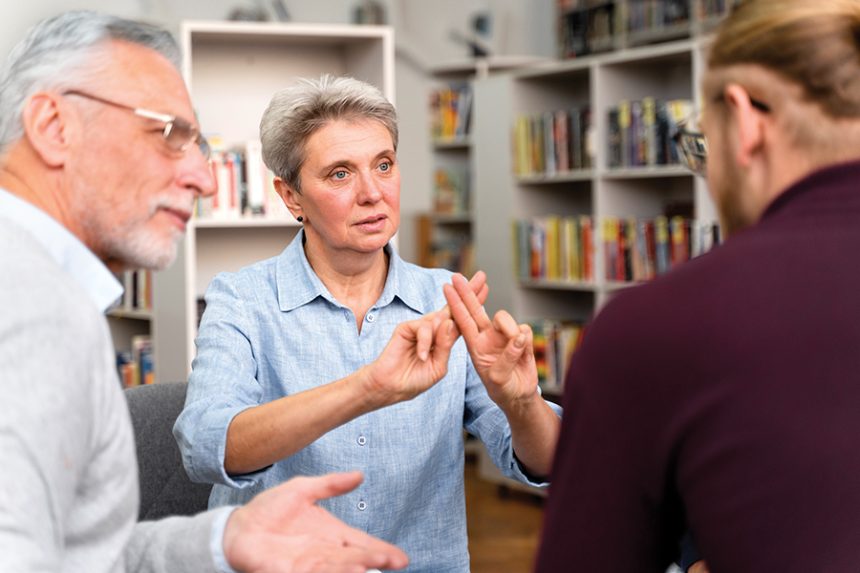
With World Sign Language Day observed today, September 23, voices from Goa reflect on its language, communication, and inclusion
VINIKA VISWAMBHARAN | NT BUZZ
Sankrit Naik knows what it is like to be present in a classroom but still struggle to access what is being taught. The third-year BFA student from Ponda, who is deaf, uses gestures and text to communicate with classmates and relies on a special educator who knows sign language to follow lessons.
Theory lectures, however, become difficult when no sign-language support is available. “Correct language support is needed for us,” he says.
Naik’s experience also points to how communication changes when Indian Sign Language (ISL) is part of the interaction. That change is something Sujata Devi Passi knows personally. The 25-year-old deaf ISL instructor from Dabolim was around 17 when she first encountered ISL. “Before that, I felt I lived in darkness,” she recalls.
During the COVID-19 lockdown, she came across ISL videos on YouTube before joining the Indian Deaf Bilingual Academy in Indore to pursue a Diploma in Teaching Indian Sign Language (DTISL). There, she interacted with other deaf people and learned from deaf teachers. “My life changed a lot, positively,” she says.
Rahul Kuncolienkar, 28, from Ponda, has had a similar experience. He studied at a deaf school from Classes 1 to 12, but says the signs used there were not clear or developed enough for him to fully understand ISL as a language. It was only later, when he received formal training in DTISL in Indore that he developed a stronger sense of deaf identity and became more comfortable communicating through the language.
“Communication became easier with my deaf group,” he says. “With hearing people, however, communication is still largely through gestures.”
Kuncolienkar also points to something hearing people often overlook. He says, “Facial expressions are an important part of ISL grammar and one common mistake is to leave them out while signing.”
The distinction between gestures and a language is also something ISL interpreters regularly have to explain. “ISL is a complete language, with its own grammar and structure. It is not just gestures,” explains Josefina Fernandes, a special educator and certified ISL interpreter. Fernandes began focusing on interpretation after seeing how often deaf people were expected to navigate important conversations without adequate language support. “Language is a human right. Sign language also should be equally respected,” she says.
Fernandes interprets between spoken languages including Konkani, Hindi, Marathi and English and ISL. She is one of only two certified ISL interpreters in Goa. While she covers much of North Goa, Muskan Shaikh primarily works across South Goa. Both are called upon for work across different settings, including hospitals, police stations, courts, government events, and public programmes. The shortage becomes particularly serious when communication involves matters that cannot afford misunderstanding.
“In a court, an error in interpretation can have serious consequences,” says Shaikh who works at the Composite Regional Centre of the Ali Yavar Jung National Institute of Speech and Hearing Disabilities (AYJNISHD) at Goa University. “Medical settings require the same level of accuracy, so that there is no wrong medicine or wrong diagnosis.”
She notes that when an interpreter is unavailable, deaf people may have to wait, seek help from a special educator or depend on family members. “Written communication can help, but it does not always provide the same access to a conversation, particularly during meetings or when detailed information has to be explained,” she adds.
The need for language support is being addressed through training. Director, Caritas Goa, Fr. Maverick Fernandes, says the organisation uses ISL at St Xavier’s Academy, Old Goa, which caters to children with different disabilities.
“We build up this resource within families first,” he says, referring to the training provided to parents and siblings of children and young adults with disabilities. The organisation has also conducted three-month courses for college staff and students and trained staff at Taj Hotels in Goa.
Caritas also works with people with deafblindness at their Saligao centre, where communication requirements differ. Fr. Maverick explains that the organisation uses American Sign Language (ASL) in its institutions because it is a one-handed system, while ISL uses both hands. For deafblind people, this is combined with tactile sign language, where signs are understood through touch.
He also highlights the shortage of staff supporting Caritas’ home-based services, which currently reach around 300 children and young adults in Goa. “Because of this, we are not able to reach out to them on a daily basis,” he says. He has also raised the need for greater support with the government.
The problem also extends beyond individual institutions. Senior journalist and member of the Goa State Advisory Board on Disability, Prakash W. Kamat, describes the state’s accessibility for deaf people as “average”. “It is not available in public spaces, functions, events. At bus stands, etc, more signage is needed. More videos with sign language inset must be installed,” he says, adding that public awareness about the need to include deaf people remains limited.
He points to hospitals, government offices, police stations, educational institutions and public transport as areas where communication barriers continue. Kamat says the Rights of Persons with Disabilities Act, 2016, provides for accessibility measures and points to the need for departments to have systems through which sign-language support can be made available when required.
Founder and president of the Disability Rights Association of Goa (DRAG), Avelino D›Sa also highlights accessibility in public services. “We have been promoting the importance of sign language and demanding sign language at all government functions.”
He believes the existing legal provisions are not being implemented properly and wants sign-language interpreters to be available across government departments.
The same applies to news and public broadcasting. Kuncolienkar notes that news channels are not always accessible in sign language, while Kamat says local television newsrooms in Goa are not adequately equipped with such facilities.
The shortage of interpreters has also raised another question: what happens to the people who are being trained to provide this support? Goa now has programmes aimed at training deaf ISL instructors, while courses for professional interpreters have also been introduced. Shaikh says the DTISL course is currently being conducted at the Composite Regional Centre, while a course for interpreters has struggled with insufficient applicants.
At the same time, trained deaf instructors have faced limited employment opportunities. Kuncolienkar, who is actually a trained deaf instructor, now works as a lower division clerk in a government department. Fernandes says Goa has qualified deaf instructors but there is a shortage of suitable teaching posts. She also points to an upcoming group of DTISL students who will need employment opportunities once they complete their training. State Commissioner for Persons with Disabilities, Guruprasad Pawaskar says the issue requires coordination between training institutions, government departments, and employers.
“At present, dedicated and regularly sanctioned posts specifically designated for ISL instructors may not be available across every institution where such services could be beneficial,” he says. “This should not be understood as an absence of need.”
Pawaskar says qualified deaf people can be considered for appropriate roles, subject to recognised qualifications and recruitment requirements. “Disability should not become a reason for excluding a qualified candidate,” he says.
He also suggests assessing the number of deaf students in institutions, their communication requirements and the availability of trained professionals before deciding how such services should be provided. “We need to assess whether the requirement is for regular sanctioned posts, contractual or project-based engagement, shared services or empanelment,” he says.
Learning ISL can also help open up communication between deaf and hearing people, making inclusion more meaningful, says Passi. “We live in the same society,” she says. “We cannot remain isolated just because of language differences.”
Communication at home
Gia D’Souza, 15, a Child of Deaf Adults (CODA), whose parents, Cedrick and Filomena D’Souza, are both deaf, uses sign language with them every day. “I first learned it from a deaf friend of my mother’s and later through observing and communicating with my parents,” she says. When her parents meet people who do not know sign language, D’Souza sometimes helps them communicate. She believes hearing people should learn ISL not only when they have a deaf person in their family, but as a basic form of communication. “If I’m not there then it will be difficult for my parents,” she says.
A different family experience comes from that of Sailee Potasserry, a Sibling of a Deaf Adult (SODA), whose younger brother is deaf. “In my family, complete sign language is not used. We usually rely on gestures, writing, pictures and sometimes lip-reading,” she says.
Potasserry notes that her brother communicates more easily through sign language with his deaf friends. While she has occasionally interpreted for him, he generally tries to handle situations independently. “We do not have interpreters at every place,” she says, arguing that learning basic sign language can help bridge that gap.

