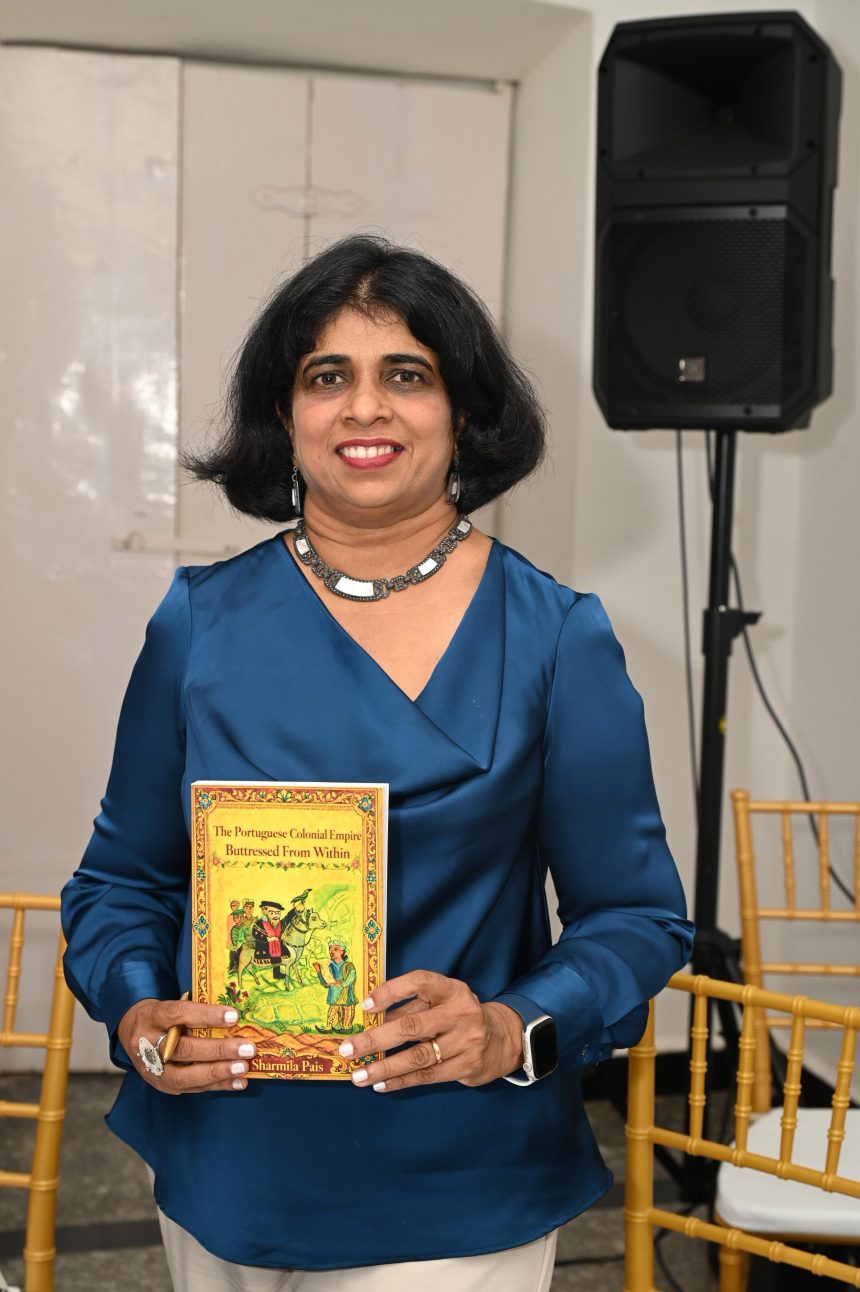
‘The Portuguese Colonial Empire: Buttressed From Within’ by associate professor of history at St. Xavier’s College, Mapusa,
Sharmila Pais, explores land grants, titles, language diplomacy and gift exchange in colonial Goa
RAMANDEEP KAUR
NT BUZZ
Recently released at Fundação Oriente, Panaji, ‘The Portuguese Colonial Empire: Buttressed From Within’ is the fourth book by Sharmila Pais. Her earlier book focused exclusively on elections in Goa during the colonial period. Other works include an anthology of 60 folk stories and a co-authored book, ‘Quest for Goa’, which surveys Goan history from the pre-Portuguese period to 2004.
Excerpts from the interview:
‘The Portuguese Colonial Empire: Buttressed From Within’ looks at colonial history differently. How did the idea come about and what brought you to this subject?
My family has an ecclesiastical (religious) coat of arms. Generally, civil coats of arms were given to people for their work and service, both among Hindus and Catholics, along with various titles. When I came to know this around five years back, I was intrigued. I wanted to understand how such coats of arms were granted. Titles and land ownership were also linked to these systems. Looking at Gaunkari land, I wondered how people acquired so much of it. There would have been systems through which Portuguese authorities granted land.
Can you elaborate on language diplomacy and translators in the colonial system?
Individuals who were versatile in languages, especially local languages, or those of neighbouring kingdoms involved in trade, had access to wider networks. Some translators mastered Kannada, Persian and other languages. Some Shenvi translators, for example, were also proficient in Kannada, while Konkani and Marathi were widely known.
When dealing with neighbouring rulers for trade or diplomacy, Portuguese authorities relied on these translators. Gradually, such linguistic expertise gave them visibility and access to higher positions, sometimes evolving into family professions. This system was part of the broader Indian Ocean world, where Arabic, Persian, and other languages influenced trade and diplomacy. Language skills were therefore an important
administrative resource.
You also discuss gift diplomacy in the book. What did your research reveal about it?
I realised that gifts were not merely symbolic gestures but an important part of diplomacy. Colonial powers exchanged gifts with Indian rulers as part of established protocol. While this was a common practice, it also had political significance in the local context. Gifts were used to negotiate and secure cooperation. Those who carried them were local envoys, often accompanying colonial representatives and acting as intermediaries between different rulers
and authorities.
Your book discusses land issues, privilege, and the New Conquests. Can you explain the New Conquests aspect?
There is very little consolidated information on it compared to the Old Conquests and what exists is fragmented. There are three chapters on the New Conquests that focus on how its administration differed from the Old Conquests and how colonial rule functioned in these territories.
Initially, colonial authorities adopted a pragmatic strategy, maintaining a give-and-take relationship with local elites. Landholders benefited and existing structures were largely preserved.
Later, however, as governance became more assertive, resistance grew from some stakeholders. Colonial rule was driven by its own interests but it operated through local intermediaries and existing
power structures.
Who were the local groups involved in this system?
Broadly, there were two regions: the Old Conquests and the New Conquests. In the New Conquests, influential groups included Desais, Sardesais and Gaunkars. The Desais exercised significant authority and often functioned with considerable autonomy, while the Sardesais and Gaunkars held important positions within
local society.
In the Old Conquests, multiple communities interacted with the administration, including Hindus and Catholics. Among Hindus, the Shenvis were prominent due to their expertise in language and translation.
From the 17th century onwards, the Portuguese formally recognised sections of the Catholic elite, integrating them into administrative and military roles in return for titles of nobility. These titles followed a hierarchy, ranging from fidalgo to higher ranks such as baron and viscount for
leading families.
Did caste, class, and religion influence relationships with the colonial administration?
Upper castes tended to benefit more from proximity to the administration, while lower castes generally remained in subordinate positions. On the religious side, Catholics sometimes received state-related privileges, but they were not exempt from racial discrimination. There are instances where members of the Catholic clergy resisted Portuguese authority due to such discrimination. Colonial rule was far from uniform; it included periods of tension, negotiation, and conflict.
Overall, the system functioned through a combination of authority and dependence on local participation across different levels
of society.
Beyond political support, how did the Portuguese rely on local communities for economic and cultural survival?
The Portuguese depended heavily on local merchant communities, who served as agents, revenue farmers and intermediaries in trade
and administration.
They also wanted to leave their imprint on the territories they controlled. However, over time, their approach changed. By the 18th century, changing ideas in Europe had begun to influence colonial policy. They gradually realised that governing from a distance required the cooperation of local stakeholders, military personnel and other groups. As a result, there was less interference in certain cultural and religious matters than in earlier periods.
What challenges did you face
during research?
I did not face difficulties in language or archival work since Portuguese is spoken in my home and my father was also a Portuguese writer. The main challenge was time. I live in Margao and work in Mapusa, so travel and workload made sustained research difficult.
How do you approach differing views on Portuguese rule in Goa?
I believe history should be approached as impartially as possible. If something happened in the past, it should be acknowledged as it is. I do not take sides. If something was wrong, it was wrong; if something was right, it was right. People are entitled to their interpretations but my approach is to keep a rational and evidence-based perspective.
Why is it difficult to look at history objectively?
Many people interpret history through present-day perspectives. However, the circumstances, ideas and frameworks of the past were different and cannot always be judged by
contemporary standards.
History, for me, is about understanding events in their context and drawing lessons from them, rather than using the past to create division in the present.
Are you working on any new
research projects?
I am interested in exploring the carceral (prison) system in Goa, including military, civil and religious prisons and the reasons for punishment. I am also researching the history of Portuguese theatre in Goa, which existed well before the better-known Konkani theatre or tiatr that emerged in the 19th century.