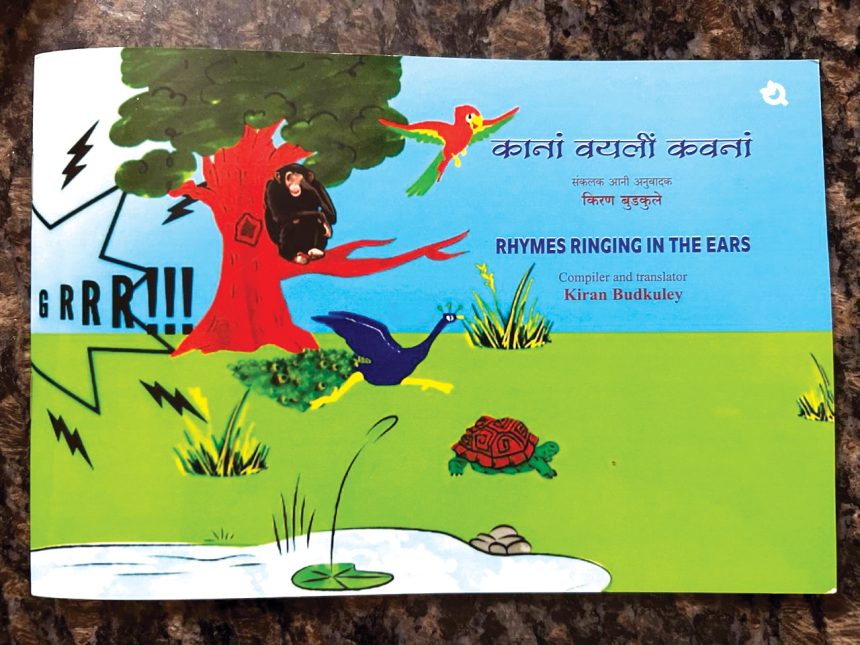
A bilingual collection of traditional Konkani nursery rhymes, ‘Kana Vayli Kavna’ by Kiran Budkuley seeks to reconnect children with the language that once echoed through
Goan homes
VINIKA VISWAMBHARAN
NT BUZZ
The idea for ‘Kana Vayli Kavna’ emerged from a grandmother watching her
grandchildren grow up.
As children increasingly navigate a world shaped by English-medium education, digital media and global influences, former head of Department of English and then dean of the Faculty of Languages and Literature at Goa University Kiran Budkuley began reflecting on the songs and rhymes that once formed an integral part of Konkani childhood. The result is ‘Kana Vayli Kavna’, a bilingual collection of traditional Konkani nursery rhymes that seeks to preserve a fading oral tradition while introducing it to a new generation of young learners.
Passed down through generations, these songs were rarely written down or formally taught. Instead, they survived in kitchens, courtyards, and family gatherings, carried by
memory and repetition.
“The project was lying dormant in my mind for about 40 years,” says Budkuley. “These were the rhymes I used with my own children. But when my grandchildren came along, I saw how quickly they were adapting to English and other languages.”
According to Budkuley, multilingualism is not the problem. The concern is what gets left behind. “It should not happen at the cost of losing their mother tongue.”
The book presents each rhyme in Devnagiri Konkani alongside an English version for children between roughly 18 months to six years of age. Budkuley describes the English text as a paraphrase rather than a direct translation, intended to help parents who may not be fluent
Konkani readers understand and engage with the material.
Part of a larger series being developed by Aksharpath, a collective of teachers, researchers, translators, and language enthusiasts dedicated to promoting Konkani, the book follows an earlier publication of lullabies for infants. Future volumes will cater to children at different stages
of development.
Many of the rhymes in ‘Kana Vayli Kavna’ involve movement, rhythm and play. Some encourage hand-holding, swaying, rolling or simple actions that mirror a child’s physical and emotional growth. Selecting the material, however, was not straightforward. Because the songs originate from different regions, Budkuley encountered variations in dialects, particularly in areas influenced by neighbouring linguistic traditions. “Getting the authentic version was important,” she says. “Some songs reflected Malvani influences while others came from regions closer to Karnataka or Kerala. I tried to remain as faithful as possible to the original.”
One of the most revealing aspects of the project came during preparations for the book launch. Parents were invited to share videos of their children singing traditional rhymes from home. Budkuley recalls one young participant who had recently arrived from overseas. When asked to record a rhyme, the child confidently performed an English song learned at school. “It was beautifully sung, but it wasn’t the kind of song we were looking for,” says Budkuley. “So we shared videos of other children singing Konkani rhymes. After watching them, she immediately recorded a Konkani song of her own.”
The experience reinforced an important lesson. “Children today have minds of their own,” she says. “You cannot force them. You have to gently expose them to things and allow them to discover them.”
Budkuley believes the future of Konkani depends on precisely these small, everyday efforts. She believes language preservation cannot be left solely to schools or government policy. “It’s not like sending a child to a Konkani school alone will help,” she says. “Until we have the right kind of educational environment, we have to do our bit. We cannot wait for the government to take all the steps for us.”
At the same time, she rejects the idea that promoting Konkani means opposing other languages. “We have to teach children to love languages in general. There should be no hostility towards any language. Languages are not our adversaries.”
Budkuley argues that preserving Konkani begins not in institutions but in everyday life at home. “Without knowledge of my own language, I am a rootless kind of person,” she says. “Children should grow up multilingual, but they should also know where they come from.”
(The book will be launched on
June 2, 5 p.m. at the Thomas
Stephens Konkani Kendr
auditorium, Porvorim.)