Miguel Braganza
Fish curry and rice is the staple diet of the people in Goa, Konkan and most littoral countries. The fish breeds in the safety of the estuaries, away from the big fish but in familiar waters. The mangroves and the screw-pines along the river banks along the coast give the fish clearer water and also food from decaying plant material. Heavy metal pollution is in the news now while screw-pines are receding from our sight and consciousness. The screw-pine can grow in fresh water, brackish water and in sea water. It is a plant that deserves fresh interest.
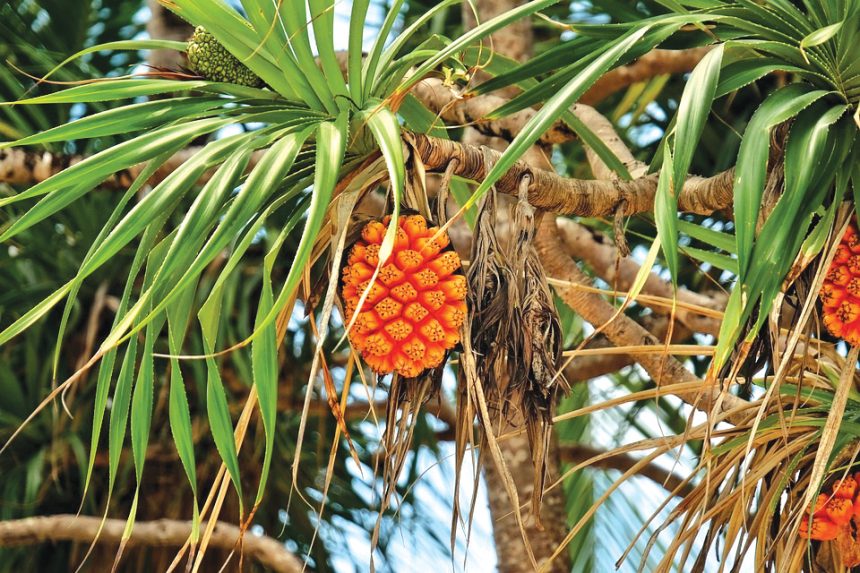
From a distance, the plants that appear to be overgrown sugarcane clumps are actually quite a different tree. Their oblong or spherical fruits look like pineapples or breadfruits. The screw pines, or screw palms, are none of these. Botanically known as Pandanus species, the P. tectorius and P. odoratissimus are common in Goa. We are at the fag-end of the Bondgueshwar or Bodgeshwar zatra in Mapusa. The deity is actually based on the Bonddgi or screw pine, Pandanus tectorius, that once abounded along the river Mapusa and the streams of fresh water that fed it from Khorlim, Verla, Canca, Guirim and Bastora. The plants and the streams are now a part of forgotten history. The shrine has grown into a temple and from a one-day zatra it has now grown to an
11-day festival.
The fragrant male flowers of the Kevda or Kewri, Pandanus odoratissimus, look like a golden spear-head and the whole inflorescence is known in Konkani as ‘Antho’. It is commercially exploited and its cultivation has expanded in the Kulaghars of Priol and Mardol due to the demand for flowers. They are available now and may last till Valentine’s Day or Carnival, but not much longer after that. The whole inflorescence is offered to Shree Mahalsa at Mardol while individual spathes are worn in the hair bun by women. It is a natural deodorant like the flowers of Vonvllam or Bakul, Mimusops elengi, as the days get warmer and we get sweaty. A related plant, Pandanus amaryllifolius, is known as basmati leaf and is added while cooking to make ordinary rice acquire the basmati aroma.
The Pandanus species are collectively referred to as Ker or Kewri and have lent their name to villages known as Keri, Kerim or Querim in Pernem, Sattari and Ponda; or Sinquerim/Sikeri in Bardez and Mayem-Bicholim; Naquerem in Quepem; Conquerem in Sanguem and wards of villages elsewhere, like Kerant/Keriant in Caranzalem-Tiswadi and Marcela-Ponda. The plants are disappearing from Caranzalem and pollution is increasing. The plant is also known as Kegdi in Konkani. A sandy beach with screw pines near Betim-Reis Magos was known as Kegdi-veller and got rechristened with an unrecognisable name of Quegue-de-Velim.
Fortunately, screw pines are still a familiar sight on Goa’s beachfront from Keri-Tiracol to Palolem, though their population has been highly reduced to make space for the hotels at Sinquerim and Aguada beachfront.