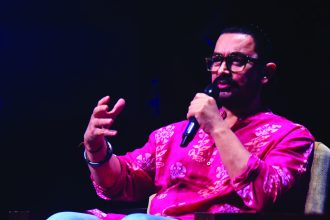
Reflections from the recent Bhopal Literature & Art Festival
JANEITA SINGH
I felt privileged to be invited by the Bhopal Literature and Art Festival for a discussion on my book, ‘F. N. Souza: The Archetypal Artist’. The invitation carried an added frisson, for the venue was none other than Charles Correa’s architectural masterpiece, Bharat Bhavan.
This venue occupies a singular position in India’s cultural landscape. Not only for its compelling architecture, it was here that indigenous art was accorded pre-eminence, not as a marginal or ethnographic category, but as a living, thinking, contemporary practice. Jagdish Swaminathan, the founder-director of Bharat Bhavan, was radical in both vision and method. He anchored the arts in an Indian philosophical framework by rejecting Western models of linear time and periodisation. Instead, he allowed artworks and objects to exist in a shared space and time—what he termed ‘contemporaneity’: the simultaneous coexistence of diverse cultural practices, embedded within a matrix of infinity.
This idea finds a compelling echo in Souza’s own thinking. In his address at the symposium ‘Modern Art in India’ (Mumbai, 1960), Souza famously remarked: “Of course we did have an ancient heritage, a great culture and a great civilization, which alas, we can no longer inherit, because between the ancient and the contemporary there is too wide a breach, an unbridged gorge, a hiatus. The invaders, missionaries, conquistadors, and Victorians castrated our aesthetic potentialities, or we just dwindled on our own and became culturally impotent. In this crater remain ignorance, intolerance, philistinism, vulgarity and bad taste, alien imitations, apart from the rubble of stupas, rusty cannon balls, brass buttons, helmets, and remains of old boots and dead cats.”
Against this backdrop of cultural rupture, the Bhopal Literature and Art Festival feels like an act of cultural resurrection. It seeds hope and enthusiasm for the retrieval of roots, and for the renewal of a sound foundation upon which a world-class literary and artistic tradition might be built in contemporary times.
Under the leadership of Raghav Chandra and his team, the festival is spearheading a revitalisation of cultural discourse with remarkable breadth and ambition. Sessions ranged from Adi Shankaracharya and Gita Govindam to tribal art and classical theatre, alongside urgent contemporary themes such as climate and ecology, defence and geopolitics, AI and cybersecurity, startups, and management. This year, tribal artists from 10 states participated at the museum, lending the festival a lived, embodied plurality rather than a tokenistic diversity.
What struck me most was the festival’s inclusive knowledge ecosystem. The dedicated and enthusiastic involvement of college students, tribal participants, members of the diaspora, cultural commentators, and domain experts created a space that was both wide-ranging and deeply engaged.
Students spoke emphatically and confidently, offering cogent arguments on topical themes connected to India and the wider world. Discussions around rebellion, feminism, and shifting consciousness—triggered by my book on Souza—generated animated exchanges. The exchange felt alive, rooted, and unapologetically situated within the Indian heartland, even as it spoke to global concerns.
I was also thrilled to encounter a vibrant group of women from Bhopal, along with extempore Hindi poets whose linguistic agility was a joy to witness.
While one can only conjecture how Souza might have responded to his work being situated within conversations on folk and tribal art, he would no doubt have been surprised—and deeply gratified—by the enthusiasm with which his perspective has been received and celebrated by voices from the Indian heartland.
I wish the Bhopal Literature and Art Festival continued power and agency in the years ahead. Its trajectory holds promise and hope for a robust, inclusive, and progressive Indian thought, one that is confident enough to look inward, even as it speaks outward, in contemporary times.
(The writer is an author, researcher, and art critic)