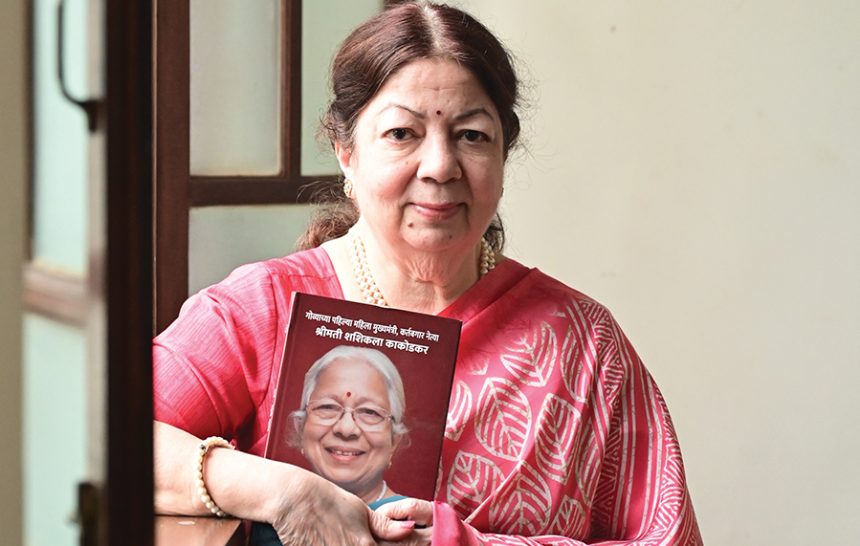
Jyoti Bandekar talks to NT BUZZ about her latest book, ‘Tai – Smruti Sugandh’, which shares memories of her elder sister, late Shashikala Kakodkar, the first woman Chief Minister of Goa
RAMNATH N PAI RAIKAR
French novelist George Sand had observed that “Memory is the perfume of the soul”. Memories, with their lingering presence in our life, evoke a nostalgic feeling. Long after the precious moments have passed into the shadows of the past, the memories, like a scent, continue to spread unseen fragrance over our existence.
‘Tai – Smruti Sugandh’, a memoir by Jyoti Bandekar – the youngest daughter of the first Chief Minister of Goa, Bhausaheb alias Dayanand Bandodkar – presents her memories of her elder sister, Shashikala Kakodkar, who had the unique distinction of being the first woman Chief Minister of Goa. The personal recollections in the book not only generates interest but also becomes a document for posterity and presents diverse facets of the first political family in Liberated Goa.
“Shashikala Tai or ‘Tai’, as everyone fondly called her is the only women chief minister of Goa till now! She was a highly capable and competent politician as is clearly visible from her illustrious career in politics. Therefore it was natural that people revered her and she, in turn created a place of respect for her in the hearts of the Goans. However, human memory is very short and people need to be reminded of the glorious past. I wrote this book with the main purpose of informing the future generations about the life and times of Tai,” says Bandekar, adding that she wrote the book in Marathi as it is the language read by both, people in urban and rural areas of the state.
“I admit that the book should have come much earlier. However, as they say, better late than never!” Bandekar says. “It so happened that after the death of ‘Bhau’ many things occurred; my brother Siddharth passed away, I got married, my family life continued and so on. Finally, during the COVID-19 pandemic in 2020, I had time on my hands to retrospect and write,” she says.
‘Tai – Smruti Sugandh’ is adorned with a number of rare photographs allowing readers a glance into the life of Kakodkar and her family as well as political journey, including her interaction with iconic leaders. The snaps also cover the foreign trips of this political figure. Readers also get an opportunity to see Kakodkar during her school and college days.
The book also has many anecdotes featuring the two sisters. “One of them dates back to the time when she was the Chief Minister. Due to my nudging, she had agreed to accompany me to a film. As we entered the darkness of the theatre, a mischievous youth sitting behind with his group of friends uttered the name of Tai in an insulting and derogatory manner,” recalls Bandekar. An irate Kakodkar, she continues, told the security officers to take down the names of the boys. “Finally, one of them stood up from his seat and profusely apologised to Tai. She then told the group that such an unruly behaviour was not only an insult but an offence towards the post of the Chief Minister,” says Bandekar, adding that she was amazed to see this facet of Tai. “She always followed a disciplined lifestyle and was of the opinion that the young generation should always display good behaviour.” she says.
The book, besides the personal recollections of Bandekar about her sister, also includes the post-chief ministerial life of Tai, and discusses her social life, her dedication to art and culture, her views on the importance of Marathi language and her participation in the Bharatiya Bhasha Suraksha Manch, a linguistic and political pressure group that campaigned for primary education to be conducted in regional languages rather than English.
Bandekar recalls that she also had the opportunity to travel with Tai in and outside India, on many occasions. During these travels they used to focus on the people belonging to those places, especially their customs and traditions. “Once we were in Switzerland and while returning from shopping, I forgot my bag at a Hop-On Hop-Off bus stop. We even travelled in the bus to the next stop without being aware of it. Then suddenly Tai saw my bag missing and she literally walked briskly in the opposite direction to the previous stop to find my bag there. She was certainly no longer young then, but the way she walked back to the bus stop was amazing and commendable. And then she was neither angry nor irritated at my folly,” remembers Bandekar.
Speaking about the Bandodkar-Kakodkar political legacy, the author says, “It entirely depends on the later generations of the Bandodkar political family whether they should join politics or not. However, had they opted for politics, it would have been a welcome step. I would have definitely been happy if that had happened.”
Having previously written a book on her eminent father titled ‘Bhau, Aathvancha Parijat’, besides a collection of poems, the author states that if she finds an interesting topic, she may take up writing another book in the future.
From the book…
When the first ever assembly election in Goa approached, Tai was helping ‘Bhau’ in replying to the letters received by him, besides assisting him in other activities. In short, she was a Personal Assistance (PA) to him. While continuously staying with ‘Bhau’, she focussed on his work closely and inculcated his habits. Tai always felt that if women had to be made financially independent then, they first needed to be taught to live with self-respect. She had ingrained in her mind that dependency was bad in all respects. She had decided to do all that was possible towards social commitment. At the time of travelling around the rural Goa with ‘Bhau’, Tai had closely seen helplessness, poverty, and families caught in the web of vices. She was of the opinion that their penury needed to be eliminated and hardworking women were required to be liberated from the agony inflicted on them by their husband. When she became the chairperson of Social Welfare Board, she made up her mind about things to be done in this direction.
When Tai turned 32 in 1967, she was elected from the Ponda constituency. In 1971, Bhausaheb appointed her as the state minister in his four-member cabinet. She was concerned that the people would blame him for nepotism. However, Bhau was firm in his decision – he felt that she was competent enough for the post by way of her merit and capability.
In 1973, she accepted the post of the Chief Minister of Goa as a successor to Bhausaheb. She later paid a courtesy visit to Prime Minister Indira Gandhi. At that time, Ms Gandhi asked her, “What experience have you got for holding this post”? She innocently replied, “I have the same experience as Ms Gandhi, when she had succeeded Pt Nehru.” Ms Gandhi however did not get upset over this sharp response.