

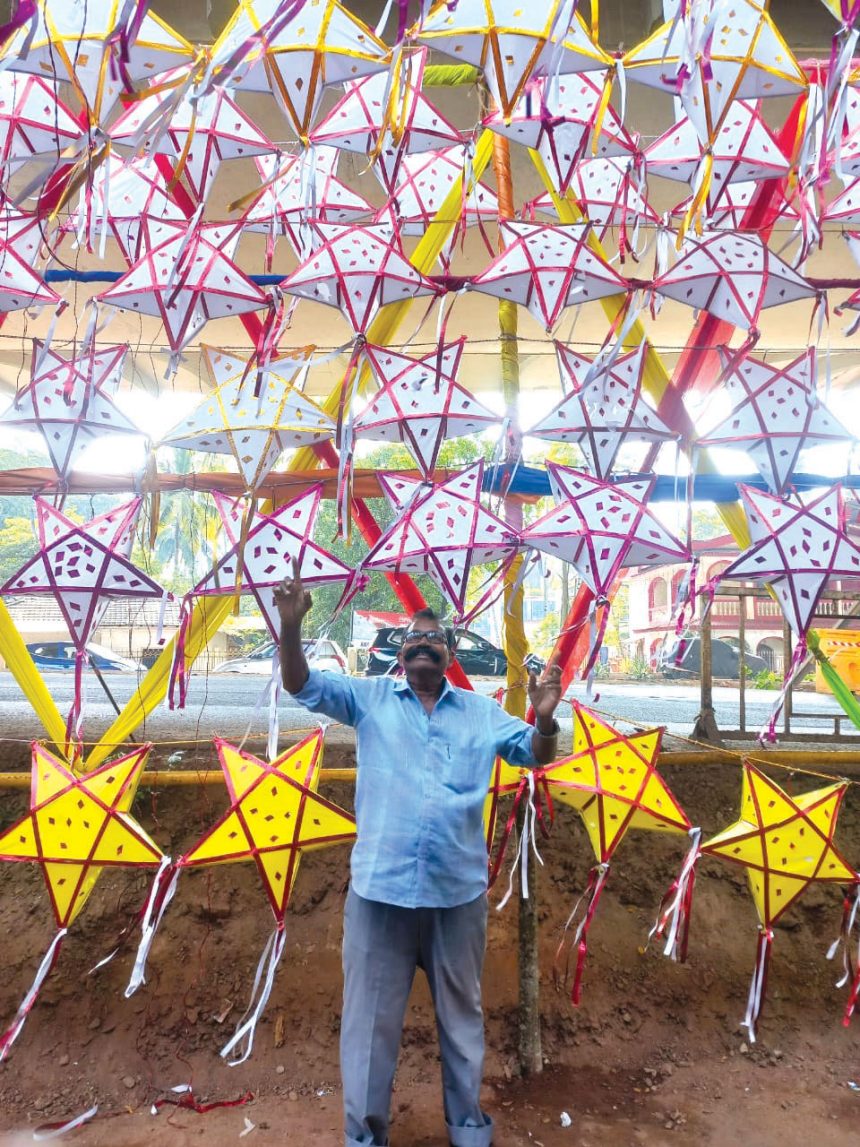
Exploring Goa’s evolving Christmas traditions, NT NETWORK takes you from the aroma of sweets and sounds of carols to cribs and glowing stars, where faith and togetherness still light up the season
In Goa, Christmas never arrives quietly. It announces itself weeks in advance through the scent of coconut and jaggery, the cleaning of homes, the sound of carols and crib making and the glow of stars outside houses. And though some of the preparations have changed with time along with busier lives, its heart remains rooted in togetherness, faith, and belonging.
Beyond memories and schedules
For many Goans, older Christmases were remembered not as events but as experiences that stretched across time. Alu Gomes Pereira, who grew up in a close-knit environment in Fontainhas, recalls how the season was
once unhurried.
“Christmas was not just one day,” he says. “It was a feeling that began with Advent. Houses were cleaned, repaired, sometimes even lime-washed. Everything was done
slowly, together.”
According to Pereira, the preparation itself created excitement. After the cleaning came the the sweets making, then the decorations. By the time Christmas came, you felt ready in your heart.”
Jovito Lopes from Fontainhas echoes the same sentiment, pointing out that Christmas was once deeply participatory. “Everyone had a role,” he says. “Children helped with small things, elders guided, neighbours dropped in. It was impossible to feel alone.”
Today, Lopes acknowledges, life moves faster. “Christmas is different now,” he says. Nuclear families, work commitments and urban living have reshaped how people celebrate. “Now we plan Christmas around leave days and traffic. Earlier, life itself slowed down for Christmas.” “Regardless, the feeling people want is the same,” he says.
Today, many families have members living abroad, and their absence is felt deeply. “Streets are quieter, and the kitchens are less crowded. Children miss the excitement of cousins and friends around, and the sense of shared labour that once made Christmas so lively is not the same,” says Pereira. “It can feel lonelier, even amid the decorations and sweets, because part of what made the season special; the family coming together, that is missing.”
Faith built in miniature
Perhaps no other tradition captures the spiritual and artistic soul of Goan Christmas like crib-making. The Christmas crib goes beyond the Nativity scene. It is a miniature landscape, often depicting not just Bethlehem but elements of Goan village life.
“Crib-making was an annual family project” says Nizal Fernandes from Borim. “Old cardboard, clay, sawdust, moss, stones, and scraps of cloth were repurposed to create the nativity. Figurines were either bought or handcrafted, with some families preserving and reusing figures passed down through generations.”
Over time, crib-making has evolved. “Space constraints in modern apartments and busy schedules have led to simpler set-ups” says Fernandes. Yet, in many Goan homes and parishes, elaborate cribs continue to be a point
of pride.
Competitions and public displays have helped sustain interest, turning crib-making into both an art form and a community activity. “In our time, Francisco Martins of Sao Pedro and Timotio of Panaji were known for their competitive crib making endeavours. It was a blast!” reminisces Pereira. “People from all over Goa would come to Panaji and take a look at their large cribs, all sorts of innovative stuff without extreme mechanisation, just pure wonder and talent!”
The materials used in cribs have also seen some changes. “There was a time when materials didn’t matter much and plastic and paper were widely used. Today, there’s a conscious move towards eco-friendly materials and sturdier structures that can be reused rather than discarded. This change comes against a backdrop of declining participation,” says Sagar Shirodkar of Bogmalo from the Youth Club of Bogmalo. The group stopped making their community crib after 2018 due to waning interest, especially among children. “People became too busy, and the energy to come together was gone,” he says, adding that funding from politicians and well-wishers also dried up. This year, the group decided to revive the tradition by pooling their own money. “With endless screen time, nobody wants to meet or hang out anymore. We realised we had grown distant, and making the crib again was our way of keeping the spirit of Christmas alive. Most importantly, it was also about bringing the community back together again!”
Star light, star bright
The arrival of Christmas also heralds the making of the Christmas star. Indeed, before factory-made decorations became common, star-making was both craft and community activity. Once crafted almost entirely within homes and neighbourhoods using bamboo sticks tied into precise geometrical frames, covered with colourful paper and lit by a single bulb, each one carrying the distinct imprint of its maker. Few embody this tradition as vividly as Anthony Rodrigues a.k.a. Anthony de Aggasaim, popularly known as the Star Man of Goa, whose dedication to star-making over the years transformed his neighbourhood into a seasonal landmark.
“Earlier, people from all over Goa would come just to see our street of stars,” recalls Rodrigues. What made it special was not scale or spectacle, but participation. In fact, Rodrigues states that previously, each house would make its own star. It was about creativity and joy, not competition.
Star-making, he explains, was once an informal classroom. Children learned by observing, by holding bamboo, applying glue, correcting mistakes; skills absorbed almost instinctively through repetition and shared effort. Today, Rodrigues observes a visible shift. “People are too busy now to teach their young ones. Because of that, many children don’t know how to make a star at all,” he says.
While star-making once thrived primarily in homes, today its survival also depends on individual artisans who bring the craft into public spaces. One such craftsman is Subhash Signapurkar, based in Chorao, who for the past 15 years has been selling bamboo-framed Christmas stars from his seasonal stall outside Vaidya Hospital in Panaji.
Signapurkar has seen materials and methods change steadily over the years. “Earlier, we used butter paper,” he says. “But it doesn’t last. Even a little moisture would spoil it.” Over time, durability became necessary. “Now I use fabric or designer paper. It is stronger, and people can use the star for more than one Christmas.” But better materials come at a cost. “Bamboo, paper, and wiring is more expensive. Every year the cost of materials keeps increasing,” he adds.
He has also noticed a change in how people value the craft. “Earlier, people respected the effort,” says Signapurkar. “Now, even if some people earn more, they bargain much more than before.” Handmade stars, he explains, are often compared to factory-made ones. Still, he returns every December. “This is what I do,” he says simply. “As long as I can make stars, I will come and sell them regardless of the change in times.”
Today, ready-made LED stars dominate markets, chosen for convenience and durability. While they are brighter and longer lasting, many feel they lack the warmth of something made by hand.
Workshops and community initiatives have emerged in recent years to revive traditional star-making, especially among children, offering hope that the craft may survive beyond memory. Rodrigues too has taken on the role of mentor. “I conduct workshops for children: to teach them this craft. If we don’t pass it on now, it will disappear,” he says. For him, every child who learns to build a star is a small act of cultural preservation.
Singing for joy
Alongside stars, carols form the soundscape of Christmas in Goa. Before recorded music filled homes, carols were sung live, often in groups that moved from house to house. “There were no stage and no audience,” says Furtado. “Everyone sang. Even if you did not have a good voice, it did not matter.”
In the early days, traditional Konkani and Portuguese carols carried deep religious meaning, but they were also social glue, now Portuguese is replaced by English carols. A carol session often ended with tea, sweets and conversation
Lopes notes that while professional choirs and concerts are more common today, grassroots carol singing still survives in villages. “It has changed form,” he says, “but the emotion is still there. When people sing together, something connects.”
Musician John Lino who together with his group of singers comes together every year for a carol singing session, usually in Panaji, also agrees that while the door to door carol singing is still alive in villages, this is not so in the cities as much. “The younger generation do not want to be a part of this the way that we used to. For them, it’s a waste of time. They wouldn’t so it for free,” he feels. Also, with many people migrating too, the enthusiasm has also dimmed somewhat, he says. Their group welcomes anyone and everyone to jon in their carol singing and merry making. “I love to make people happy. You never know what someone is going through in life,” he says. He does however note that in terms of the carols sung, for most part, these still remain consistent. “There are new compositions but no one sings those for these group carol singing sessions,” he says.
The fading kuswars
If stars and carols shape the outward and audible signs of Christmas, sweets form its emotional core. Known locally as ‘kuswar’, derived from the Portuguese word ‘consuade’, Christmas sweets are never just food. They are symbols of abundance, sharing, and care.
Oliver Fernandes, co-founder of The Goan Kitchen, grew up in a home where sweet-making marked the true beginning of Christmas. “Food played a very important part,” he says. “Gathering around the dining table with carols playing was how Christmas began for us.”
Traditional sweets such as neureos, kormolas, bebinca, and dodol were made only once a year, lending them special significance. “Neureos and kormolas equal Christmas,” says Fernandes. What made the tradition truly communal was the exchange. On Christmas morning, children carried plates of sweets from house to house. “The kuswar delivery run was the highlight,” he recalls.
“Earlier, consuades were huge,”says Antonieta Jorge of Relax Inn in Fontainhas, referring to the traditional Christmas sweet platter. “There was a big variety. Every house made many items.” Over the decades, the way sweets are made and shared has changed significantly
Sweet-making was a family affair, often done late into the night. Some sweets required teamwork, while others demanded patience and experience. Bebinca and dodol, Jorge notes, were more solitary tasks due to their long cooking time. Today, Jorge explains, time has become the biggest challenge. “Women are working now. Everyone is busy. There is no time to make so many sweets.”
As a result, families have adapted. Instead of making a wide range, households often focus on just one or two items. “One family will make baticca, another will make something else,” says Jorge. “It is more practical.”
This division of labour allows the tradition of sharing to continue, even if the scale has reduced. “The spirit is still there,” she adds. “But it looks different.”
Fernandes too points out that traditional sweets are becoming endangered due to lack of time, knowledge and ingredients. “Good jaggery is difficult to get. Coconut pluckers are fewer. Even red par-boiled rice is in
short supply.”
At the same time, social media and easy access to Western-style baking have influenced Christmas tables. Cookies, cupcakes and logs are now common. “Everything has its place,” says Fernandes, “but we must give the biggest share to what is ours.”
With fewer families making sweets at home, bakeries and home-based businesses have stepped in to meet demand. Fernandes believes this is both a challenge and an opportunity. “Very few bakeries make Christmas sweets well,” he says. “For someone looking for authentic flavours, there are not many places.” At The Goan Kitchen, Fernandes says the aim is to bridge this gap while respecting tradition. “We try to fulfil this need at all festivals.”
Jorge agrees that supporting traditional bakeries is essential. “When you buy from people who are keeping these recipes alive, you are supporting culture,” she says. She too sells her baticas for Christmas at the Relax Inn.
The modern celebration
Despite all the changes, Midnight Mass remains the spiritual anchor of Christmas in Goa. But there have been some changes here.
“Earlier, families walked to church together, greeting neighbours along the way. Today, cars and crowded roads have replaced those quiet walks, but the significance of the Mass endures,” says Pereira
Youth director of Diocesan Youth Centre, Goa, Fr. Blaise Lobo notes that Goa’s growing nightclub and party culture has influenced how Christmas Eve is observed, especially among young people. “Many choose to go partying on Christmas Eve, as the club scene is heavily promoted, and attend Mass the next morning instead of the traditional Midnight Mass,” he says, adding that the festive nightlife often takes precedence over the spiritual aspect of the celebration.
Indeed, in contemporary Goa, Christmas celebrations have expanded into public spaces. “Hotels, beaches and clubs host parties and events, drawing tourists from around the world”
says Lopes, who believes that while this has boosted the local economy and showcased Goan culture globally, it has also created a contrast between commercial festivities and traditional observances. “More tourists come to Goa to be part of their social media trends and walk around clicking pictures. You don’t recognise anyone familiar anymore,” he says Lopes.
Yet, for many Goans, the true meaning of Christmas still lies at home, in small rituals and familiar tastes.
While dances existed earlier too, they were more inclusive, drawing entire families and elderly residents, says Eden Fernandes from Saligao. “These days, when I go for Christmas parties, I mostly see youngsters,” says Fernandes, adding that older generations are largely absent.
Yet, amid these changes, some traditions endure. Fernandes finds it heartening that many young people are still learning to make traditional Goan sweets and desserts, a sign that “those sweet-making traditions are still being kept alive.” She adds, “Christmas in Goa has always evolved, absorbing influences without losing its soul. What has changed is not the intention, but the circumstances.”

