Abu Dhabi pledges investment amount totalling $5 billion
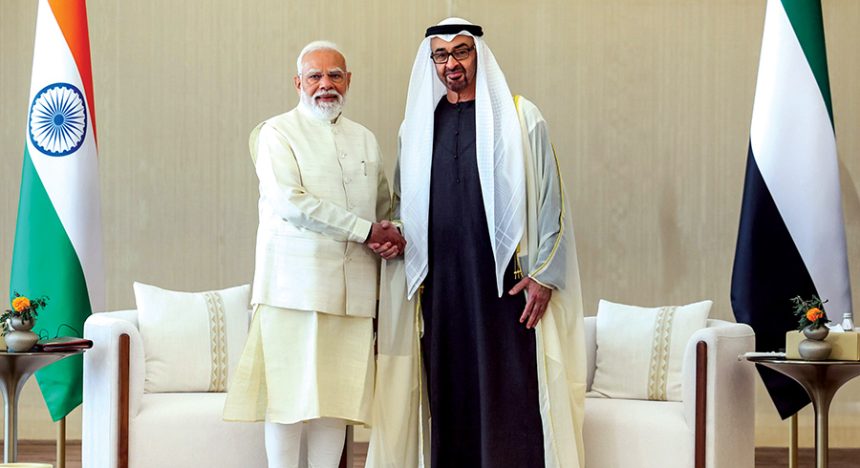
Abu Dhabi: India and the United Arab Emirates (UAE) on Friday inked a series of landmark pacts spanning strategic petroleum reserves, long-term LPG supply, defence and shipping, with Abu Dhabi pledging investments totalling $5 billion in India, as Prime Minister Narendra Modi engaged in high-level talks with President Sheikh Mohamed bin Zayed Al Nahyan amid the escalating West Asia conflict.
One of the six pacts was a strategic collaboration agreement signed between Indian Strategic Petroleum Reserves Limited and Abu Dhabi National Oil Company to strengthen India’s energy security, including cooperation in petroleum reserves and possible collaboration on liquid natural gas and liquefied petroleum gas (LPG) storage facilities.
It will enhance the UAE’s participation in India’s strategic petroleum reserves to 30 million barrels and set up strategic gas reserves in India, according to an official statement.
A separate pact between Indian Oil Limited Company and Abu Dhabi National Oil Company will facilitate new opportunities in the sale and purchase of LPG, including long term supply of the fuel and entry into a long-term sale-and-purchase agreement between the two companies.
India and the UAE also signed a framework for a strategic defence partnership which focuses on defence industrial collaboration, technology sharing, innovation and regional security cooperation, the Ministry of External Affairs (MEA) said. Under the framework, the two countries are set to explore joint development of military hardware besides boosting cooperation in a number of other crucial areas.
The two sides also signed a separate strategic collaboration pact on LPG, which is supposed to ensure long-term supply of the cooking fuel widely used in India.
The agreements came amid the ongoing conflict in West Asia, which has heightened concerns in India over disruptions to crude oil and gas supplies through the Strait of Hormuz, a critical shipping route for the country’s energy imports.
The Prime Minister described the agreements inked between the two sides as “pivotal” in vital sectors such as energy, defence, infrastructure, shipping and advanced technologies. He said they will provide a “fresh boost” to India-UAE comprehensive strategic partnership.
Modi said his visit to the UAE was “brief, yet extraordinarily fruitful” and he was confident that the outcomes will “further solidify the bonds of friendship between us, and contribute to achieving growth and prosperity”.
The UAE announced investments worth $5 billion in India – which, Modi said, will “further deepen economic ties”.
The MEA said that the $5 billion investment commitment included plans by Abu Dhabi Investment Authority and India’s National Infrastructure and Investment Fund to explore investments of up to $1 billion in India’s infrastructure sector.
According to the ministry, Emirates NBD will invest $3 billion in RBL Bank, while UAE-based International Holding Company will invest $1 billion in Sammaan Capital of India.
It said the investment commitment is aimed at creating stronger markets and generating jobs, describing it as a reflection of the UAE’s “sustained commitment to India’s development and growth story”.
“In the field of investment, the UAE has traditionally been a significant investor in India. It is cumulatively the seventh-largest investor in India over the course of the last 25 years,” India’s Foreign Secretary Vikram Misri said.
Misri further said: “This visit is a reflection of the exceptional trust and confidence that marks this very, very important relationship between India and the United Arab Emirates.”
The talks between Modi and Al Nahyan took place during the Prime Minister’s stopover in Abu Dhabi in the first leg of his five-nation tour that will also take him to the Netherlands, Sweden, Norway and Italy.
Other agreements included setting up a ship repair centre at Vadinar in Gujarat, cooperation on ports and coastal infrastructure, and an arrangement on skill development in ship repair. An agreement was also signed between Cochin Shipyard Limited and Drydocks World of Dubai.
The two sides also signed a term sheet for setting up a super-computing cluster, aimed at strengthening India’s artificial intelligence and high-performance computing capabilities. “This will add to India’s AI mission and the infrastructure involved with that,” said Misri.
The MEA said the two leaders also welcomed the operationalisation of a virtual trade corridor linking customs and port authorities of both countries to streamline cargo movement, reduce logistics costs and cut transit time.
The operationalisation of the digital trade corridor is expected to further deepen commercial integration between the two countries by improving customs coordination and cargo efficiency. It is also expected to help the two countries in “building supply chain resilience in a world that is seeing increasing disruption in supply chains”, said Misri. The two sides also exchanged views on the West Asia crisis.
“We condemn the attacks on the UAE,” Modi said in his opening remarks, adding that “the way UAE has been targeted is not acceptable”.
The UAE, which hosts a major US military base, has also faced Iranian strikes since the conflict began on February 28.
Praising the Emirati leadership for handling the situation “with restraint”, Modi said India was ready to extend “all possible support” to bring peace in West Asia.
Earlier in the day, Al Nahyan personally received Modi at the airport in Abu Dhabi, where the Indian prime minister was accorded a ceremonial guard of honour. In a special gesture, Modi’s aircraft was escorted by UAE military jets.
This was Modi’s eighth visit to the Gulf country in 12 years, the MEA said.
“Concluding a short but highly productive visit to the UAE,” Modi said before leaving. “Held extensive discussions with my brother, His Highness Sheikh Mohamed bin Zayed Al Nahyan, on ways to further deepen the India-UAE Comprehensive Strategic Partnership.”
Modi later departed for the Netherlands following his brief visit to Abu Dhabi.
The visit came amid widening differences among Gulf powers over oil production policies, the Strait of Hormuz blockade and regional alignments involving Israel and Iran – developments that have added complexity to India’s strategic calculations in West Asia.