Special Correspondent
Panaji
Stressing on the need to include Indian space science and related achievements in school curriculum to create awareness and scientific curiosity among children, at an early age, the first Indian astronaut to travel to the International Space Station, Group Captain Shubhanshu Shukla on Friday said that the sky was never the limit for him.
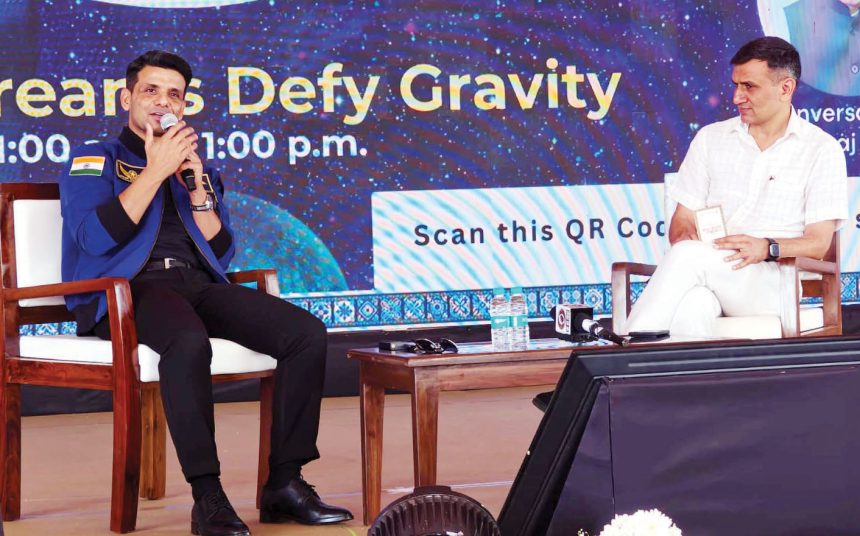
Speaking at the maiden edition of Goa Book Festival, Shukla said, “I travelled to space with a billion hearts with me; sky was never the limit, not for me, not for you,”
he said.
Addressing an audience of over 1,200 school students, Shukla spoke about his journey to space, the future of India’s space programme, and offered rare, candid insights into the challenges, discipline and defining moments of life beyond Earth.
In a session moderated by director of the National Book Trust, India, Yuvraj Malik, he took young students on an inspiring and deeply personal journey, speaking openly about fear, resilience
and perseverance.
Recalling the moment the Falcon 9 rocket’s engines ignited, Shukla admitted that he “forgot all his training” likening the experience to the anxiety of seeing an examination question paper despite weeks of preparation. He also shared the intense physical strain of launch, showing a video of him breathing during the take-off, as well as the mental challenge of isolation away from family.
Using videos and humour, the Indian astronaut brought life in space closer to the students by sharing unforgettable moments such as playing basketball in zero gravity using a fellow astronaut instead of a ball, walking on ceilings in zero gravity, dropping his laptop after returning to Earth because he momentarily forgot gravity exists and listening to ‘Vande Mataram’ from the film ‘Fighter’ while heading to the launch pad in order to gather strength for the journey ahead.
He also spoke about the long process of re-learning how to walk in gravity after returning to Earth.
Responding to questions from children, Shukla spoke about the food he missed the most in space and the emotional difficulty of being separated from his family during pre-launch isolation and the mission itself.
Emphasising resilience, he reflected on fear, and urged students to focus on the present, keep their goals in sight, and not allow small setbacks to diminish their spirit to learn, grow and serve the nation.
The Indian astronaut recalled the words of India’s first astronaut, Wing Commander Rakesh Sharma, affirming that Sharma’s 1984 statement remains true that India looks “Saare jahaan se accha” from space.
Speaking about India’s space ambitions, he talked of the ‘Gaganyaan Mission’ and plans for India’s own space station, telling students that the country’s future in space would be shaped by their dreams and aspirations.
Explaining complex scientific concepts in an engaging, fun-filled manner, Shukla shared that he was Astronaut No 634 to cross the Kármán line, the internationally recognised boundary between Earth’s atmosphere and outer space at an altitude of 100 kilometres. He also showed the students a video he captured from space, offering a breathtaking view of India from above.
Reflecting on identity, the first Indian astronaut to travel to the International Space Station said, “We often think of our city or school as our identity and when we move away from India, our country becomes our identity.” “However, when we go beyond this planet, we all become humans and the Earth is our home,” he said.
Concluding the session, Shukla urged students to work towards India’s future in space, reminding them that dreams when combined with discipline and courage, can truly defy gravity.