Diana Fernandes
Margao
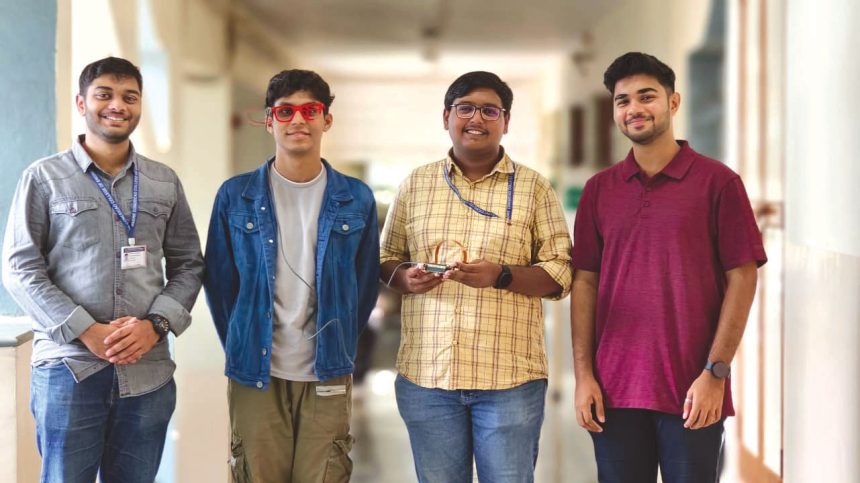
Bringing pride to Goa and setting a benchmark in assistive technology, four final-year Electronics and Computer Engineering students from Padre Conceicao College of Engineering (PCCE), Verna, have secured a design patent for an affordable, ergonomic eye-wearable gesture device.
Designed to function as an accessible Human-Computer Interface (HCI) for individuals with motor disabilities, the device enables users to operate a computer without
a mouse.
While existing commercial HCIs typically cost between Rs 30,000 and Rs 50,000, the student team – comprising Varad Naik, Aaron Gonsalves, Abhijeet Singh and David Fernandes – developed their prototype for around Rs 10,000 under the guidance of Dr Jayalaxmi Devate, Professor and Head of PCCE’s Department of Electronics and Computer Engineering.
The hands-free system is mounted on a custom, laser-cut acrylic spectacle frame. It features a webcam retrofitted into an infrared (IR) camera using an adjustable M-12 lens, a sanded-down IR LED with a diffusion layer to prevent eye strain during extended use, and an MPU6050 accelerometer and gyroscope module.
Driven by a Raspberry Pi, the system utilises an onboard ESP32 microcontroller to wirelessly stream commands.
The IR camera tracks the user’s eye movements and transmits the data to the Raspberry Pi for processing. The processed information is then sent to the ESP32, which connects via Bluetooth so the target device recognises it as a standard wireless mouse. Simple head gestures complete the interaction: a slight tilt to the right triggers a left-click, while a tilt to the left executes a right-click.
The initial inspiration grew out of the students’ shared passion for simulators, which led them to research touchless eye-tracking hardware. Finding commercial options expensive, they set out to build a cost-effective alternative to help people with mobility limitations access technology.
The development journey from ideation to working prototype spanned nearly a year, involving hardware-software integration, neural network model training and extensive testing for speed and accuracy. A Rs 50,000 grant from the Goa State Innovation Council provided crucial financial support to upgrade key components from basic webcam parts to higher-grade hardware.
The team applied for the design patent in October 2025 and officially received approval from the Patent Office, Government of India, nine months later on July 2. The milestone marks the very first patent secured by PCCE’s newly established Intellectual Property Rights (IPR) cell. Faculty and students alike noted that the grant validates the originality and practical utility of their design, serving as an encouraging precedent for future innovation at the college.
Although the team members have now transitioned into their master’s degree programmes, they remain committed to refining the device. Alongside preparing a research paper on their findings, they plan to enhance system accuracy, prepare the hardware for commercial viability and explore broader applications across assistive technologies.
Emphasising the importance of patience, research and mentorship, the creators hope their journey encourages other young innovators in Goa to persevere through the lengthy process of bringing impactful, market-ready ideas to life.