NT Reporter
Panaji
In a first in Goa’s political history, the High Court of Bombay at Goa on Wednesday quashed the Election Commission of India’s notification for the bypoll to the Ponda Assembly constituency which was scheduled to take place on April 9, effectively cancelling the byelection.
The Ponda seat became vacant following the death of former minister Ravi Naik on October 15, 2025. While the ECI issued the notification within the six-month window, petitioners argued that the incoming MLA would serve for less than a year, as the current Assembly’s term is set to expire on March 14, 2027.
The High Court agreed to the petitioners’ contention that under the Representation of the People Act, 1951, a byelection is not mandatory if the remaining term of the elected representative is less than one year.
The legal challenge was brought forward by petitioners Pritam Harmalkar and Ankita Kamat. Trajano D’Mello was an intervener through a miscellaneous civil application.
The legal challenge centered on Section 151-A of the Representation of the People Act. This proviso mandates that bypolls must be held within six months of a vacancy, unless the “remainder of the term of a member” is less than one year.
The High Court’s division bench comprising Justices Valmiki Menezes and Amit Jamsandekar ruled that since less than one year remains for the completion of the current five-year term of the Goa Legislative Assembly, conducting a byelection was not necessary.
The High Court said that it was bound by the previous decision of the Bombay High Court’s Nagpur bench in Sandeep Yashwantrao Sarode versus the Election Commission, which established the ‘incoming member’ calculation method. The High Court noted that the ECI had accepted this judgment in the past by not challenging
it further.
“It is surprising to us that the Election Commission is now heard to be arguing full throat before us that the view taken in Sandeep Yashwantrao Sarode (supra) is a wrong view and requires to be referred to a larger Bench since it has not considered a binding precedent rendered by the Supreme Court in Pramod Laxman Gaudadhe (supra) where, according to the Election Commission, the same provisions have been interpreted differently,” the court observed after stating that the ECI had accepted the interpretation of the Bombay High Court of Clause (a) of proviso to Section 151-A as rendered in Sandeep Yashwantrao Sarode (supra).
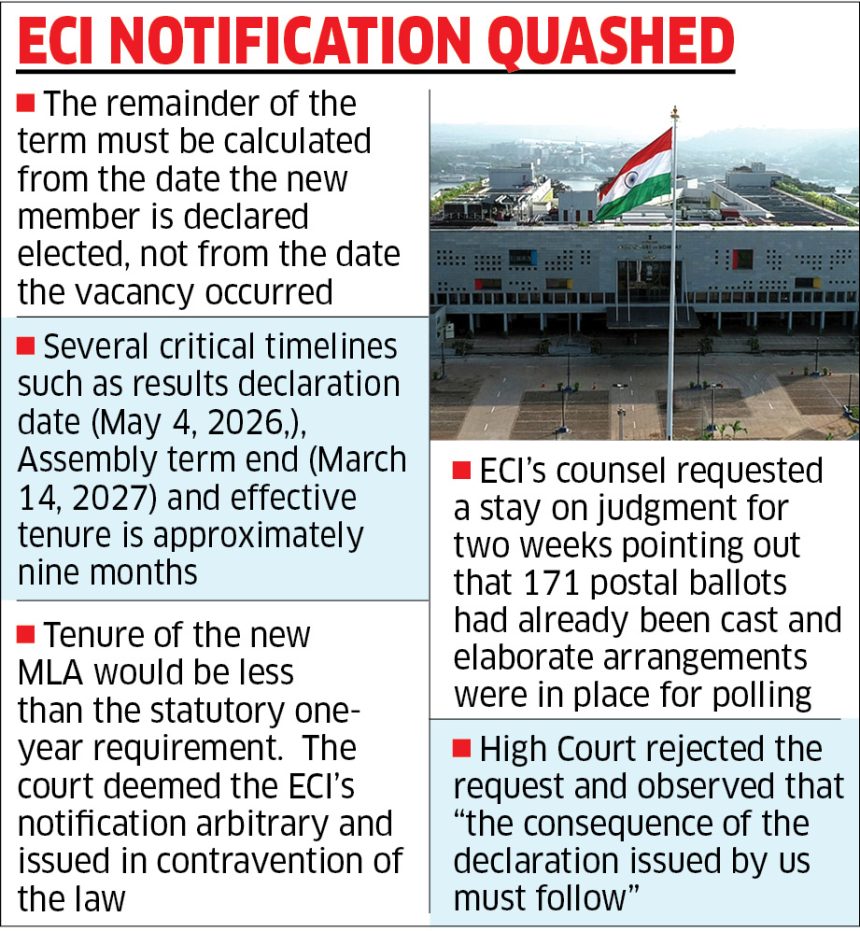
Following the pronouncement of the judgment, the ECI’s counsel requested a stay on the judgment for two weeks pointing out that 171 postal ballots had already been cast and elaborate arrangements were in place for the polling.
The authorities had reviewed preparedness for the bypoll. The expenditure observer had directed officials to strengthen surveillance measures, including checkposts at all entry and exit points, while ensuring close monitoring of suspicious cash transactions. Authorities had also intensified vigilance on liquor, narcotics, and other inducements, with law enforcement agencies being instructed to initiate prompt action in case of violations.
The High Court however rejected this request and observed that “the consequence of the declaration issued by us must follow” since the byelection has now been declared to be a nullity.
The court declared the election process a “nullity”, citing a violation of the Representation of the People Act.
The High Court observed that the “remainder of the term” must be calculated from the date the new member is declared elected, not from the date the vacancy occurred.
It also said that several critical timelines such as results declaration date (May 4, 2026,), Assembly term end (March 14, 2027) and effective tenure is approximately nine months.
The court said the tenure of the new MLA would be less than the statutory one-year requirement. The court deemed the ECI’s notification “arbitrary” and issued in contravention of the law.