

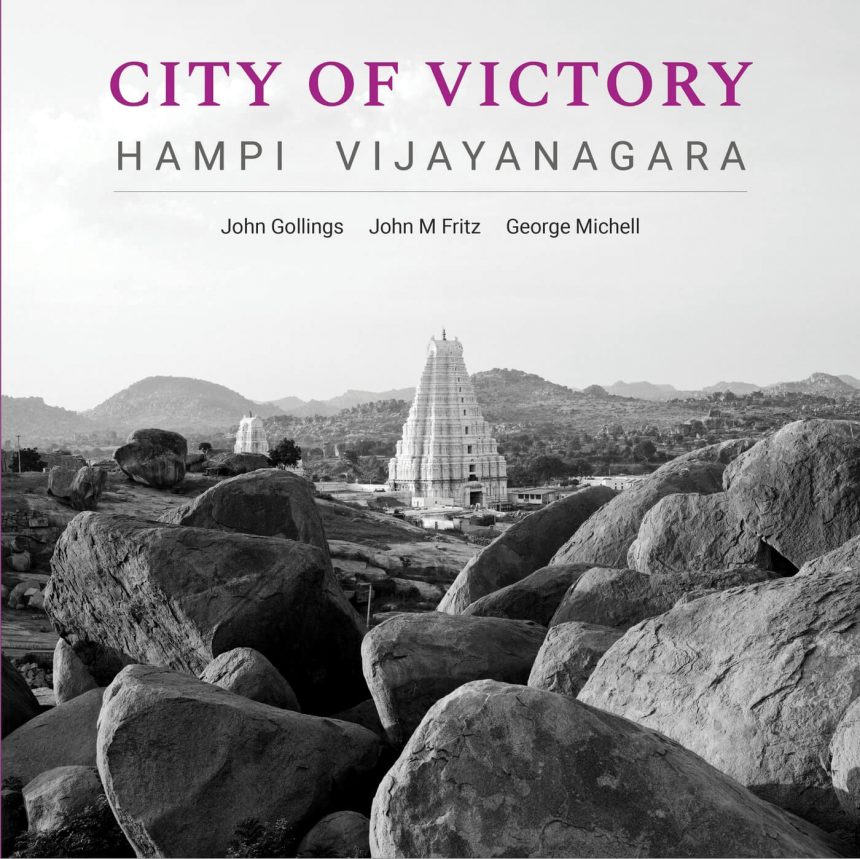
‘City of Victory’ documents 40 years of research on the historical city of Hampi,
detailing what makes it stand out among other empire ruins
KALYANI JHA | NT BUZZ
Architectural historian George Michell believes that there is no other
place like Hampi.
Earlier known as Vijayanagara, Hampi, an UNESCO world heritage site, was the former capital city of the erstwhile Vijayanagara Empire, a powerful Hindu kingdom that ruled Southern India between the 14th and 16th centuries. Covering a vast area of more than 30 square kilometres, the ruins of this empire are set in a rugged landscape of granite boulders through which flows the
sacred Tungabhadra River.
“There are marvellous historical places to visit in India. But Hampi is unique. If you go to Tanjore, where the Cholas ruled, or Badami, where the Chalukyas ruled, or anywhere kings ruled from in the past, all you will see are temples, but at Hampi, Vijaynagar, you’ve got the fortifications, the waterworks, palace structures, pleasure pavilions monuments, different temples to different cults, and how are they arranged in the landscape,” explains Michell, adding that the most significant aspect of the city was its fortification which makes it an imperial city.
“Even though it’s ruined and abandoned, it still expresses the might, the wealth, and the power of this kingdom,” he says.
The historian, together with associate professor of Anthropology at the University of New Mexico, late Dr. John M. Fritz, have now come out with a book titled ‘City of Victory’, detailing their research that was conducted over
four decades.
“John and I and a team of volunteers, went every winter season to Hampi. We had a camp, and we ran around the site, mapping and measuring everything that we could observe,” says Michell, adding that they didn’t know the research started in 1980 under the State Archaeology Department of Connecticut, would continue this long.
“We didn’t set off to do it for 40 years. We kept on discovering more and more things to study,” he says. These included the layout of the city, the fortifications, the different types of architecture, the roadways, and how the whole city worked as a capital.
After their field work, Michell and Fritz wrote up many of the things they found and had understood. “The book gives you an overview of the history and architecture of Hampi. This is an examination of the site, the actual remains of Vijayanagara, the town planning, the waterworks, and the fortifications,” says Michell.
The book has maps, drawings, and photographs about the city. In fact, the work, published by Pictor Publishing and the Deccan Heritage Foundation, features black-and-white photographs by award-winning architectural photographer John Gollings.
Gollings worked closely with Fritz and Michell and his black and white photographs taken during the 1980s, many of them at night, capture the drama of Vijayanagara’s landscape as well as the architectural forms of its principal monuments and details of
their sculpted reliefs.
Fritz in his study suggested that in the Royal Centre, the palace area, Rama was the dominant deity because the temple of Lord Rama is in the middle of the palace area. “In some ways, the kings and Lord Rama were identified with each other in some way,” shares Michell. Michell and Fritz have also described the different forms of the temples, the watchtowers, of the palaces and illustrated and talked about the different types of buildings that can be
seen today.
The book is intended for general readers and travellers, as well as scholars and students. Michell believes that it will prepare visitors to understand the magnificence of the place when they visit Hampi.
(The book will be released today at Sunaparanta-Goa Centre for the Arts,
Altinho- Panaji, at 6 p.m. George Michell will give an illustrated talk followed by a Q&A. Copies of the book will be available for sale
and signing by the author.)

