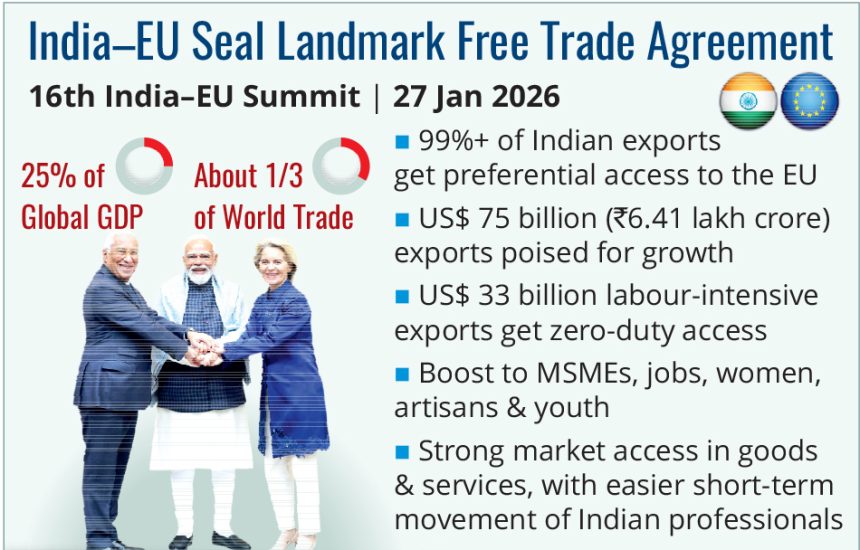
Zero-duty entry for 93% of Indian goods; imported European cars widely expected to be less expensive; grand strategic agenda unveiled to shield against global turbulence
New Delhi: India and the European Union on Tuesday sealed a landmark free trade agreement – billed as the “mother of all deals” – to create a market of two billion people with Prime Minister Narendra Modi and the top EU leadership unveiling a transformative agenda to leverage trade and defence in protecting the rules-based world order.
The two sides also inked two crucial pacts – one on security and defence collaboration and another on mobility of Indian talents to Europe – after Prime Minister Modi hosted EU leaders Ursula von der Leyen and António Costa for summit talks amid frosty ties with the US.
The free trade agreement that will account for almost a quarter of the global GDP will reduce tariffs on 99 per cent of Indian exports to the EU and cut duties on over 97 per cent of the EU’s exports to India, according to officials.
Prices of imported European cars are widely expected to come down after India agreed to gradually reduce duty under its FTA with the EU to 10 per cent from 110 per cent for 2.5 lakh vehicles a year, over six times more offered to the UK.
The EU estimated that the deal will cut up to four billion euros in annual tariffs for European exporters.
Indian sectors such as textiles, apparel, leather goods, handicrafts, footwear and marine products are set to gain from the FTA, while Europe is set to benefit in areas of wine, automobiles, chemicals and pharmaceuticals, among others.
Once the agreement is implemented, except for auto and steel, almost all the Indian goods (over 93 per cent) from India will get zero-duty access in the European Union, and of the remaining over 6 per cent, Indian exporters will get tariff reduction and quota-based duty concessions (for goods like automobiles).
Under the provisions of the pact, the EU’s wine exports will benefit significantly as the current duties of 150 per cent will see a sharp cut and the new levies will be in the range of 20 per cent to 30 per cent.
In line with their vision for a rules-based global order, India and the 27-nation bloc also rolled out a joint comprehensive strategic agenda for the next five years and firmed up a total of 13 pacts including one on the conclusion of negotiations for the FTA.
In his remarks, Modi said the global order is undergoing “profound turbulence” and, in such a context, the partnership between India and the EU will strengthen stability in the international system.
“Today, India has concluded the largest free trade agreement in its history. It is a happy coincidence that on the 27th day of the month, India is entering into this FTA with the 27-member states of the European Union,” he said.
“This historic agreement will facilitate easier access for our farmers and small enterprises to European markets, create new opportunities in manufacturing, and further strengthen cooperation across our services sectors,” Modi said in his media statement.
The Prime Minister said the FTA will boost investment, foster new innovation and strengthen supply chains at the global level. “In other words, this is not merely a trade agreement; it is a new blueprint for shared prosperity.”
The finalisation of the trade deal came nearly two decades after the two sides began negotiations on it. It may take at least six months to formally sign the deal as it will require legal scrubbing by both sides.
Hailing the mega trade deal, European Commission President von der Leyen said the India-EU partnership will send a strong message that cooperation is the best answer to global challenges, in remarks that came amid growing strain in ties between Europe and the US.
“We did it. We delivered the mother of all deals. We are creating a market of two billion people,” she said.
“And this is the tale of two giants, the world’s second and fourth largest economies, two giants who choose partnership in a true win-win fashion, a strong message that cooperation is the best answer to global challenges,” she said.
In his remarks, European Council President Costa said the key agreements signed between the two sides will reinforce the rules-based global order.
“Trade agreements reinforce rules-based economic order and promote shared prosperity. That’s why today’s free trade agreement is of historic importance – one of the most ambitious agreements ever concluded, creating a market of two billion,” he said.
In a multi-polar world, Costa added, the European Union and India are working together to grow spheres of shared prosperity.
“But prosperity does not exist without security. We will strengthen our cooperation to better protect our citizens and our shared interests, working together to counter the full range of security threats we face in the Indo-Pacific, in Europe and around the world, reaching a new level of strategic trust between us,” he said.
The EU, as a bloc, is India’s largest trading partner in goods. For the financial year 2024-25, India’s total trade in goods with the EU was worth about $136 billion, with exports around $76 billion and imports at $60 billion.