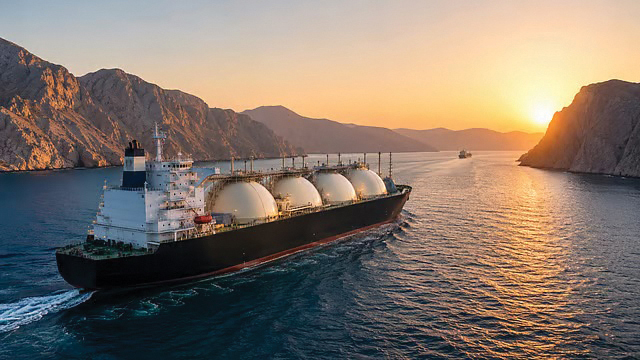
New Delhi: A Liquefied Natural Gas (LNG) carrier, chartered by an Indian firm, safely transited through the Strait of Hormuz – the first Indian LNG tanker to cross the war-hit narrow shipping lane since the war in West Asia broke out more than three and a half months back.
LNG Carrier Disha, managed by a Shipping Corporation of India-led consortium and chartered by Petronet LNG Ltd, is also one of the first commercial vessels to transit the Strait since the announcement of a preliminary ceasefire deal between the United States and Iran.
The vessel is expected to arrive at Dahej in Gujarat – the flagship import terminal of Petronet – on June 18, said Upesh Kumar Sharma, Director in the Ministry of Ports, Shipping and Waterways. Disha is carrying 62,370 tonnes of LNG, he said at a news briefing.
India meets about half of its natural gas demand through imports of LNG, with roughly 65% of those supplies sourced from Gulf producers such as Qatar and shipped through the Strait of Hormuz.
The strategic waterway was effectively closed after the United States and Israel launched military strikes on Iran on February 28, triggering retaliatory action from Tehran and disrupting regional shipping. Qatar subsequently declared force majeure on LNG shipments to several buyers, including India. Disha, one of the vessels chartered by Petronet LNG to transport Qatari cargoes, was among the ships stranded in the Strait during the conflict before successfully resuming its voyage to India.
“As we speak now, LNG carrier Disha, managed by a Shipping Corporation of India-led consortium, has safely transited the Strait of Hormuz, and she is carrying 62,370 metric tonnes of LNG cargo,” he said.
Sharma said 15 vessels – comprising 10 Indian-flagged ships and five foreign-flagged vessels – have safely crossed the strategic waterway so far, with the LNG carrier expected to be the latest to arrive in India.
The Ministry of Ports, Shipping and Waterways, through the Directorate General of Shipping, remains in continuous coordination with the Ministry of External Affairs, Indian missions abroad, shipping companies and other stakeholders to ensure the safety of Indian seafarers and vessels operating in the region, he said.
Commenting on reports of an incident involving a tanker earlier this month, the official identified the vessel as Bochem Marengo, a Hong Kong-flagged oil and chemical tanker. “All Indians on board remain safe. There is no injury or any other untoward incident on the crew of the vessel,” he said.
The ministry is also handling cases involving Indian seafarers in distress and has activated support mechanisms, including the appointment of local agents where required. In one such case, a vessel reached shore on June 14, and the mortal remains of a deceased seafarer were transported to Oman for onward repatriation to India.
Sharma said around 18,000 Indian seafarers are currently employed across the wider Gulf region. A 24-hour helpline remains operational for seafarers and their families, while more than 3,500 seafarers have been safely repatriated so far.
According to the ministry, about 325 Indian seafarers are serving on Indian-flagged vessels operating west of the Strait of Hormuz, while 13 Indian ships are currently deployed in that area.
The Directorate General of Shipping has advised recruitment and placement service licence (RPSL) companies and other maritime stakeholders to exercise the highest degree of caution while operating in conflict zones and to comply with all prescribed security and safety protocols during transit.
The ministry is closely monitoring developments in coordination with all relevant agencies, including the Ministry of External Affairs, and will continue to provide updates as the situation evolves, Sharma added.