PTI
New Delhi
Parliament on Thursday passed a bill to amend the anti-paper leak law to introduce stricter punishments, with the government expressing its commitment to go the extra mile to safeguard the interests of students, who are the country’s future.
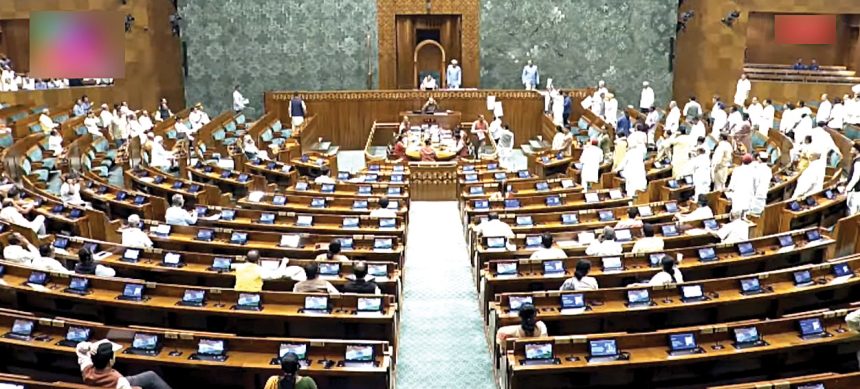
The Public Examination (Prevention of Unfair Means) Amendment Bill, 2026, was cleared in the Rajya Sabha with a voice vote amid a walkout by several Opposition parties from the India bloc.
The Lok Sabha had passed the Bill on Wednesday.
Soon after the passage of the bill, Prime Minister Narendra Modi posted a video message on Instagram, saying the important task of making a stringent law against paper leaks has been completed.
The government is taking steps against paper leaks and exam malpractices, he said, adding that it has become imperative to improve the exam system with the use of the latest technology. He further stated that the government is moving towards it so that no paper-leak mafia plays with the future of students.
According to the amended bill, individuals involved in paper leaks or unfair means in exams will get jail terms for a minimum of five years and a maximum of 10 years, and a fine of up to Rs 50 lakh. For organised crimes, the bill proposes a minimum sentence of seven years and a fine of not less than Rs 10 crore.
Replying to a seven-hour discussion on the Bill, Union Minister of State for Personnel, Public Grievances and Pensions Jitendra Singh said the government is committed to ensuring that public examinations remain transparent, credible and merit-based so that sincere efforts of students are protected.
He said the amendments would further strengthen the legal framework for preventing unfair means in public examinations while safeguarding students’ interests.
The law comprehensively addresses offences ranging from leakage of question papers and answer keys, tampering with answer sheets and computer systems, manipulation of examination processes, creation of fake websites and admit cards, to organised attempts to facilitate unfair means in examinations, he said.
“The issue is so vast and so serious here, that it cannot be left to government alone. The government is already doing its way; it will continue to do so. We call for cooperation from all sections of society…We are open to receive suggestions.” “We are proceeding with an open mind. We are not only ready to walk the talk, but we are in fact ready to walk an extra mile,” Singh said.
The minister criticised the Opposition for not properly reading the provisions of the bill, which have been very diligently worked out. He also attacked the Congress and other Opposition parties for staging a walkout just before he started replying to the debate.