

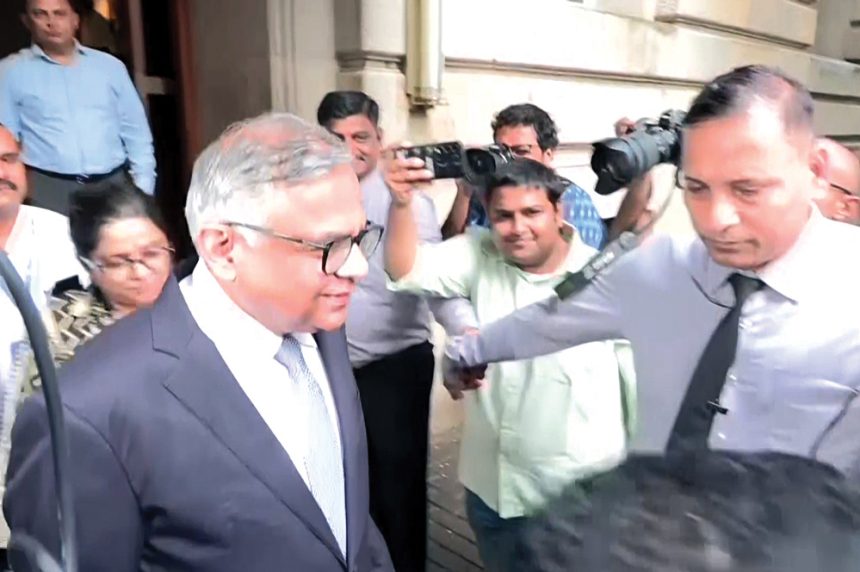
New Delhi: The Tata Trusts has challenged the validity of Tata Sons’ September 17 decision to reappoint N Chandrasekaran as chairman, arguing that the company’s Articles of Association require affirmative support from a majority of its Trust-nominated directors and that a chairman’s casting vote cannot override that condition.
The boardroom battle at India’s largest conglomerate escalated last week after Tata Sons’ directors approved a fresh term for executive chairman N Chandrasekaran in a vote that the group’s biggest shareholder called illegal. Noel Tata, who chairs the network of charitable trusts holding roughly two-thirds of Tata Sons’ shares, cast the sole vote against extending Chandrasekaran’s tenure by five years. Venu Srinivasan, the other Tata Trusts nominee on the Tata Sons board, supported the extension.
In a statement, the Trusts said there was no deadlock at the board meeting and that the resolution could not have been validly passed after one of the two Trust-nominated directors voted against it.
“There are two Tata Trusts nominees on the Board of Tata Sons. Majority amongst two is two and not one,” the Trusts said. “On September 17, 2026, one such Director voted against the resolution. Thus, the affirmative support of Tata Trusts Nominee Directors as mandated by the AoA was not given. The condition failed, and so did the resolution.”
Tata Sons’ board had voted 4-1 in favour of giving Chandrasekaran another five-year term as executive chairman, with Tata Trusts Chairman Noel Tata opposing the proposal. Chandrasekaran, who had earlier said he would not seek another term, agreed to continue after the board asked him to reconsider.
The Trusts, which collectively hold about 66 per cent of Tata Sons, said the overall board tally was irrelevant because the Articles impose a separate requirement relating to Trust-nominated directors.
“Whether the result of the vote was 4:1, or any other figure, is irrelevant. A condition is either met, or it is not. In this case the condition was not met,” the Trusts said.
The Trusts rejected the argument that Noel Tata’s opposition created a deadlock that could be resolved through the chairman’s casting vote.
“The Chairman’s casting vote is available only where there is equality of votes at the overall board level. It does not apply amongst Tata Trusts’ Nominee Directors,” it said. “There was no paralysis, and there was no deadlock. The Board put a question, and the AoA answered it in the negative. The exercise of a protective right conferred by a company’s own constitution is not a deadlock; it is that constitution working as it was written to work.”
The Trusts consequently said the September 17 resolution “was not validly passed and has no legal effect” and was “void ab initio” – legally void from the outset.
Tata Sons has proceeded on the basis that the board had validly approved Chandrasekaran’s reappointment.
The Trusts also sought to bolster its position by pointing to Tata Sons’ defence of the same Articles during the litigation surrounding the removal of former chairman Cyrus Mistry.
The Trusts said Tata Sons had previously defended the affirmative voting rights of Trust-nominated directors under Articles 104B and 121 before the Supreme Court, arguing that the provisions were legitimate protections for the company’s majority shareholder.
“The Company cannot now disown the protection it went to the Supreme Court to preserve. They are either in the Articles, or they are not. Tata Sons has already told the highest court in the country that they are,” the Trusts said.
The Supreme Court in the Mistry case had examined the special rights contained in Tata Sons’ Articles, including provisions concerning Trust-nominated directors. The current dispute, however, concerns the interpretation and application of those provisions to the September 17 reappointment resolution.
The Trusts said Tata Sons’ Articles should not be treated as provisions that can be relied upon when convenient and disregarded otherwise.

