

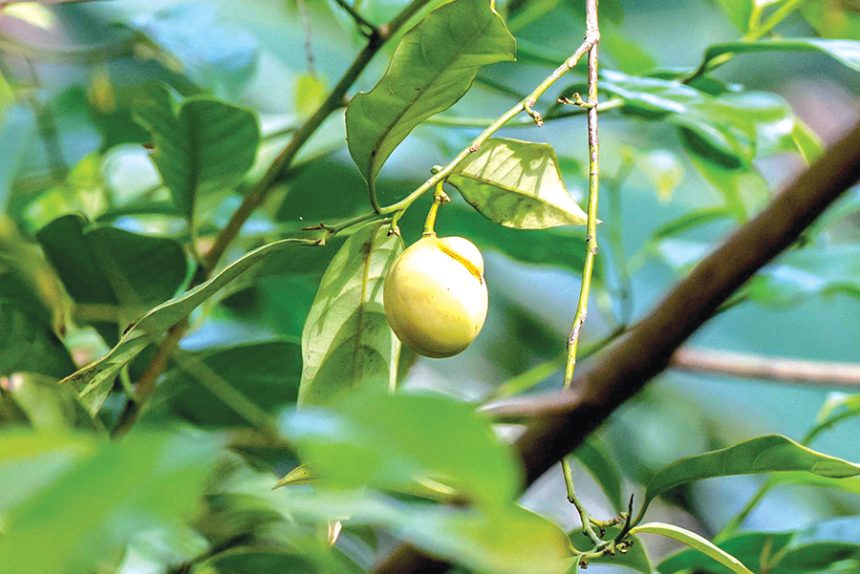
Nutmeg, the fragrant spice that adds to the distinctiveness of Goan cooking, is presently on a flavourful high for farmers in the state due to strong demand reflected in elevated prices, writes Shoma Patnaik
Amid the push to increase agriculture in the state, nutmeg known locally as jaiphal, is giving Goan spice farmers golden returns. The market for nutmeg and its sister crop viz. mace or jaaypatri, which is a separate spice that is found in the same fruit and twice costlier is highly positive presently due to strong demand.
In recent months both nutmeg and mace prices have solidified from Rs 615 per kg and Rs 1,100 per kg to Rs 870 per kg and Rs 1,950 per kg respectively. Currently the prices continues to remain firm at higher levels making cultivation extremely remunerative for local farmers. Not surprisingly interest in nutmeg farming is revived among kulaghor and plantation owners, according to the state agriculture department.
“Nutmeg is presently a very profitable crop. In general all spices are in demand and viable for cultivation. However the selling rates of nutmeg and mace are lately on the rise and lucrative,” says Chinmay Purshottam Tanshekar, Netravali, the largest cultivator of nutmeg in the state.
Tanshekar who has about 1,000 nutmeg trees, discloses that the harvesting months of the spice is in the four months of June to September, while the sale is throughout the year. “Some farmers sell the crop immediately in Diwali time and some keep for selling later as the price moves up. The price of nutmeg and mace are stable now at the higher side and not come down so far,” he says.
Horticulturist and progressive farmer Uday Bhate, Narve, says that, nutmeg can be called as the pension crop for a farmer. “The tree as it ages gives more and more fruit. It is an annuity crop as the yield for the farmer will continue in old age,” he says.
Bhate explains that Goa climatically and in all ways is most suitable for nutmeg cultivation. “The tree is mostly devoid of pests and diseases which means growing takes less effort. Moreover it requires very little tending and fertilizers. Cultivation is therefore very conducive for organic farming. The only issue with the crop is the long gestation period of eight to 10 years. It means farmers have to tend to a non-fruit bearing tree for a long time,” he says.
In the past the other problem with nutmeg cultivation faced by farmers was of dioeciousness, meaning individual plants are typically either male or female. Only the female trees produces the commercially valuable nuts and mace, while male trees produce flowers for pollination and are unproductive in terms of yield. The dioeciousness of the tree was known only after eight years. But now there are good grafts of the nutmeg tree which one is sure will yield.
A nutmeg tree on an average bears 2,000- 2,500 fruits. The harvest is sold to the Goa Bagayatdar, Ponda and to local spice factories. “Harvesting of the nut and its outer covering of mace is a bit tricky because it occurs in the rainy season, and all the fruit cannot be harvested in one go. The only way to harvest is by keep checking the tree. The drying, however, is easy and once dried properly through dehydration process, the two spices can be stored and sold over a period of time,” explains Tanshekar.
Nutmeg price realization in the state varies according to the quality. To a farmer good quality nuts fetch Rs 900 per kg and for mace it can go up to Rs 2,200 per kg. At the retail level, nutmeg sells for Rs 1,000 per kg., and mace Rs 2,800 per kg., to consumers.
“We started nutmeg cultivation almost 20-25 years back. When we started the price of nutmeg was Rs 200 per kg., and now it is Rs 800-900 per kg. We did not know at that time the price will go up, but spices always have a demand in the market and are viable crops. Local farmers just need the holding capacity and little bit of patience,” reflects Tanshekar.
Demand for nutmeg and mace is growing domestically and in the international market due to its expanding use in daily cooking, the food processing, pharmaceuticals and cosmetic industries, among other sectors. Besides adding aroma, the twin spices are also used to ward off the evil in many households.
Jaiphal and Jaaypatri are an integral part of Goa’s famed fish curry as well as the traditional dessert Bebinca. The spices are an inherent component of the Indian garam masala mix and are added to practically all delicious dishes of communities such as biryani, shir-kurma, etc.
The ICAR- Central Coastal Agricultural Research Institute (ICAR-CCARI), Goa, has also found uses for the pericarp or rind by making Taffy, a patented toffee which gives farmers additional annual income of Rs 5,600 per tree.

