Ahead of All Souls’ Day on November 2, NT NETWORK looks at how access to burial grounds and crematoria in Goa is shaped by land, community belonging, affordability, and gaps in public provision
VINIKA VISWAMBHARAN
Death is inevitable, but finding a place to perform the last rites is not always straightforward. The problem is not just the absence of a crematorium or burial ground. In some instances, it is whether a family is permitted to use one, whether it can afford the arrangements, or whether the community has a designated space at all.
Challenges in accessing spaces
Environmentalist and social activist Rajendra Kerkar, who has worked on such issues for over three decades, says, “Landlessness and social exclusion can leave families without a recognised place to perform last rites.”
He points out that forest-dwelling and pastoral communities may have lived in an area for generations without formal ownership of the land, making it difficult to secure space for burial or cremation. Kerkar also alleges that caste-based discrimination prevents some people from using facilities meant for the wider village.
“They are considered as untouchable. So, nobody wants their dead body to be burned in crematorium, which is meant for the whole village,” he says.
Land-related concerns also arise in Bhuipal, Sattari. A 2014 report quoted a Dhangar community leader as saying that Bhuipal was the only cremation ground available to the community in Sattari at the time. Kerkar says the traditional space subsequently became defunct after the land was taken over by the Goa Industrial Development Corporation (GIDC). He adds that Dhangar families now make offerings for departed souls during Dussehra along the Valpoi-Honda road, as no designated space is available in the village for their rites.
Kerkar also cites the case of Bhagyashree, a pregnant Dhangar woman whose family reportedly buried her at the foothills of Vagheri, around 14 kilometres from Keri. An account of the incident refers both to the difficulty of accessing a local cremation facility and to beliefs surrounding the death of a pregnant woman. The precise circumstances, including whether the family was denied access to an existing facility, remain unclear.
Another account, provided by Vidhya Halwankar, a relative of Sitaram Raghoba Naik, describes an alleged dispute over his cremation in Nirankle, Dabal-Savordem, where he had settled after purchasing land. Following his death in August 2013, villagers reportedly objected to the cremation on the grounds that the family were outsiders. The family then approached the Ponda Municipality, around 12 to 15 kilometres away, for
permission.
The 1999 proposal regarding Muslim kabrastan at Sonsodo, Margao, remains pending despite the acquisition of land and years of follow-up by community representatives. Advisory member of the Association of All Goa Muslim Jamats, Abdul Matin Carol says the project has seen little progress over the years, with questions remaining about the suitability of the acquired land and the facilities that can be developed there.
Referring to a survey conducted for the project, Carol says that although approximately 30,000 sq m had been acquired, only around 2,500 sq m was found suitable for development because of the land’s gradient. He says, “The usable portion would also have to accommodate facilities beyond graves, including a space for prayers, arrangements for washing the deceased, access and parking. But these figures raise concerns about whether the proposed site could meet the community’s requirements.”
“Things have not progressed,” Carol states, referring to the prolonged delay. He adds that the existing burial ground in Margao serves people from across Salcete and receives around 30 bodies a month, according to his estimate. “With limited space available, managing burials has become increasingly difficult. The current spaces are overcrowded. If we don’t reuse the graves again for the whole Margao, it won’t be sufficient,” he says, referring to the pressure on existing burial space and the increasing population of the community over the years.
On March 13, 2026, the Sonsodo project was handed back to the Public Works Department (PWD) after Goa State Urban Development Agency (GSUDA) informed the Bombay High Court that it could not execute the work.
“Goa’s flyovers and other developmental projects have been constructed over the years, yet our community is still fighting for proper burial space, which is just a flat land, since decades ago,” says Carol.
The human rights dimension
The Goa Human Rights Commission (GHRC) has dealt with complaints concerning access to burial and cremation spaces, particularly where communities have struggled to find places for their dead.
An offcial from the Commission say its approach is based on the possibility that such difficulties may involve violations of basic human rights, including the rights to life, liberty and equality. They point to cases in which people were allegedly prevented from using existing facilities or had no suitable burial ground in their locality.
One such matter involved residents of the Muslim community in Corlim, Tiswadi. In Proceeding No. 177/2021, where residents approached the Commission over the absence of a burial ground for Muslims in the village. The Commission’s inquiry report, dated November 8, 2022, records that the complaint was filed in July 2021 and that the village panchayat was asked to respond.
The report also refers to an earlier Commission order in Proceeding No. 131/2014. In that matter, the Commission, along with human rights activist, Dr. Anthony Rodrigues, had recommended that the director of Municipal Administration and the director of Panchayats take urgent steps to ensure that crematorium and burial grounds were made available to people in municipal and village panchayat areas.
Rodrigues says he has been pursuing the issue of equitable access to burial and cremation facilities since 2014. He says he subsequently followed up with civic authorities and filed Right to Information (RTI) applications to examine public expenditure on burial grounds and crematoria. “We discussed with officials on identifying land and creating common burial spaces,” says Rodrigues. “It is the prime responsibility of the state to look after the dead bodies irrespective of any social distinctions.”
Rodrigues says that despite his continued follow-ups with the government, a common framework ensuring access to burial and cremation facilities across Goa remains unrealised.
The official from the Commission also refer to a case involving Muslim residents of Santa Cruz who were allegedly told to take a deceased person’s body to their own area because they were not permitted to bury the person locally. The Commission reportedly recommended that they be allowed to use the facility, particularly as there was no suitable burial ground available to them in
their locality.
However, the Commission’s intervention does not mean that every recommendation automatically results in a facility being established. The official says, “The Commission issues notices to the relevant public authorities, examines their responses and makes recommendations. If an authority fails to implement a recommendation, the affected party may have to approach the High Court.”
When asked what minimum standards the government should guarantee, the official from the Commission identified the availability of burial grounds and the need to ensure that families are not charged for burial. Families who can afford to contribute may do so, they say, but access to a final resting place should not depend on a person’s financial circumstances.
The official also points to legal aid as an option for people who cannot afford representation. Individuals can approach the Commission in person or submit grievances by email. The District Legal Services Authorities and legal aid cells can assist eligible people who require legal representation.
An unresolved proposal
The difficulties surrounding access to funeral spaces have been raised at the institutional level for years. In 2009, the Goa Law Commission recommended ‘The Goa Public Crematoria and Burial Places Bill, 2009’, a
framework for public crematoria and burial places, intended to make such facilities accessible irrespective of caste, religion, creed, sex, domicile or nationality.
The proposal emerged against the backdrop of difficulties faced by communities that did not have access to existing facilities. Former Goa Law Commission member and senior counsel, Cleofato Almeida Coutinho says the issue was particularly pronounced among lower-caste Hindu communities.
He believes funeral facilities should ultimately be under the responsibility of the state and local authorities, rather than being left entirely to private or community management to make such
decisions.
He says, “Unless there is a law, there will be no obligation. The law creates the obligation.”
Coutinho places the issue within the framework of Article 21 of the Constitution, which guarantees the right to life and personal liberty and has been interpreted by the courts to include the right to live with dignity. He argues that this can extend to the right to a decent burial as well. “Right to live can include right for a decent burial, while using Article 21 as a broad constitutional provision,” he says.
The 2009 proposed legislation was intended to establish a more organised system for the creation, registration and management of public crematoria and burial grounds. It envisaged state-level and local-level bodies to oversee facilities and sought to ensure that people could perform last rites according to their religious practices and preferences.
Despite being drafted by the Law Commission in 2009 under the chairmanship of former union minister for law, Ramakant Khalap, the bill was never officially enacted into law. After 2012, there was regime change and the draft bill was not taken to its logical conclusion.
There have since been further attempts to address the issue. In February 2024, the State Legislative Assembly constituted a House Committee to establish and regulate a common crematorium or burial grounds for all sections of the society across all panchayats and municipal areas.The resolution also called for the government to acquire land and establish facilities before handing them over to local self-government bodies.
A separate resolution called for municipal councils and corporation to earmark burial spaces without bias based on
caste or gender, with separate sites for minority communities according to population density.
These resolutions indicate that the issue has received attention. However, the present status of the proposed framework, and
what steps have been taken since the
Assembly’s recommendations, remain
important questions.
Coutinho says local bodies should have primary responsibility for ensuring access, with the state providing financial and
administrative support. “Without adequate land, funding and clear responsibilities, however, even a policy commitment
may not translate into a usable facility,”
he says.
Facilities and services
Access also involves the practical arrangements that follow a death. At the St Inez crematorium and kabarastan, which is an integrated community burial and cremation facility located in St. Inez, Rajesh Kholkar, an employee at the facility of the crematorium, describes the charges and procedures involved in arranging a cremation.
He mentions a charge of Rs 2,800, along with a Rs 100 fee for a no-objection certificate (NOC) obtained from the Corporation of the City of Panaji. Kholkar also suggests that cremation could be provided free of charge to families unable to pay. “You also need a doctor’s certificate as part of the paperwork required before the NOC is obtained,” says Kholkar . Families may also have to account for transport, materials, labour and other arrangements.
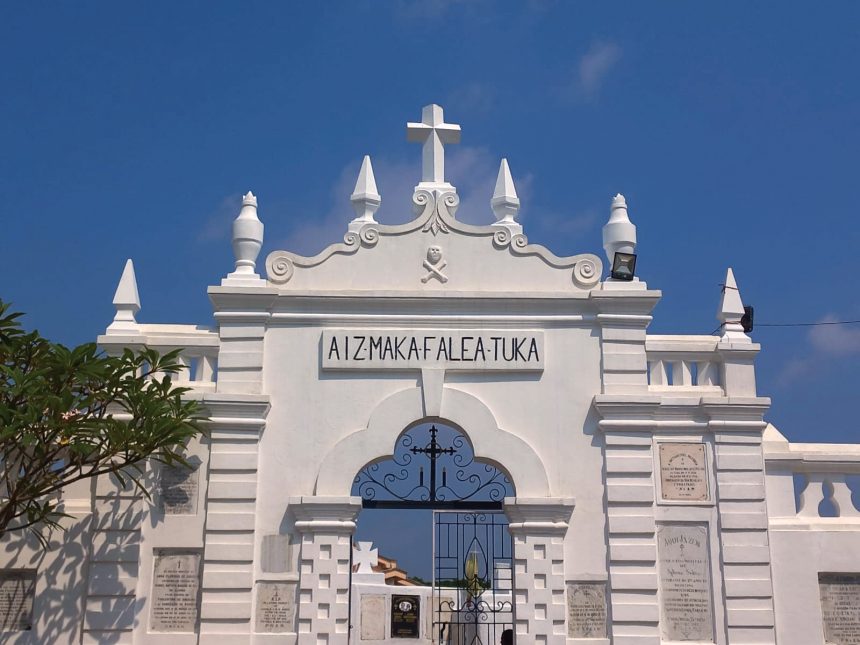
Member of the Committee of Kabristan of the Corporation of the City of Panaji at St Inez, Nazim Aga, mentions that the establishment currently holds 383 graves. He says, “We reuse the grave after every four to six years.”
The government’s role
According to director of Urban Development Brijesh Manerkar, Goa has 14 urban local bodies and that he has not come across complaints of families being denied access to cremation facilities in municipal areas during his tenure. He says municipalities use their own funds for maintenance, while the government provides grant-in-aid when required.
“If the proposal comes to us, that they want to renovate their space or do any development over there, like to have a room or to increase the pyre, they can very well send it to us and we usually do it,” says Manerkar. He cites work undertaken in Bicholim and Mapusa as examples of requests receiving departmental support.
On the possibility of introducing electric crematoria, Manerkar says there had been discussions but no formal proposal has come before him during his tenure. “Any decision would depend on the population and the
requirement,“ he adds. Manerkar also says the department has details of burial grounds and crematoria in municipal areas available in its records.
Director of Panchayats, Dasharath M. Redkar says the department provides
financial assistance to village panchayats for the construction of crematoria. However, it does not provide land directly. Communities seeking burial or cremation
facilities would have to identify and purchase suitable land before approaching
the panchayat for construction permission.
According to Redkar, the maintenance of these facilities is generally handled by local crematorium committees, which may
collect nominal charges from users. He estimates that families using Hindu cremation facilities may be charged around Rs 2,500 to Rs 3,000 for firewood, though the actual cost may be higher.
Asked about families unable to meet such expenses, Redkar says some committees may permit cremations free of charge. He says the Directorate of Panchayats could also intervene if a panchayat failed to provide access to a facility. “We can issue directions to panchayat,” he says, adding that complaints could be submitted to the directorate or the police.
Redkar says he was aware of the reported case of Bhagyashree through newspaper coverage, but was not aware of any formal complaint having been received by his department. He says the directorate could have approached the
concerned panchayat had a complaint been filed. “Everybody should be given an opportunity to cremate,” he says.