

On International Women’s Day, NT NETWORK spotlights a few achievers who have pursued their passions despite the challenges that persist, while hoping for a more inclusive society
CHRISTINE MACHADO NT NETWORK
Poetic voice
Vinita Bicholkar has always found solace in writing, especially poetry. “What I love about this art form is that it carries so much depth and you can say everything you want to say in just two or four lines. The same piece can also be interpreted differently by different people,” says the avid writer, who has 75% cerebral palsy. She has published four poetry books so far and hopes to write more.
Beyond her writing, however, Bicholkar, who holds a master’s degree in counselling psychology from Carmel College, Nuvem, has found it difficult to secure a job.
“It is challenging because many spaces are not wheelchair accessible. Some people understand and help but others feel that my basic needs are a burden,” she says.
Bicholkar also speaks candidly about her internal struggles. “When you are looked after, you begin to see your life as a favour. Being helped allows people to ignore the person on the wheelchair. But everybody has a different capacity to show love, to be present, and this should be noticed. For years, I pushed myself hard to fit into society and tried to be a perfectionist,” she says.
Over time, she has learned to be kinder to herself. More importantly, she reminds herself that she is more than someone in a wheelchair and that she has her own dreams and beliefs. “I am on a journey to ensure that I live as a person,” she says.
She also wants to see greater change in the country for people with disabilities. “When I look at people with disabilities in other countries, they can live more independently because of better infrastructure and technology. If these become available and affordable in India, people like us could truly live our lives, not just survive,” she says.
Travelling is among her dreams. “The moment I step out of the house, things become difficult. I cannot shop on my own and haven’t been to many restaurants because they are not wheelchair accessible,” she says.
While the government provides some financial allowance for persons with disabilities, she believes money alone is not enough. “To live with dignity, we need permanent jobs and proper infrastructure. Healthcare should also be provided. I want to earn enough not just to manage but to truly live. And I want this for everyone, not just for me,” she says, adding that writing is one way she hopes to contribute to change.
Chasing her dreams
Ask Sakshi Kale about her long-term dream and she replies simply: “I just want to keep running, as long as possible and as much as possible.”
The visually impaired para athlete has been excelling ever since she took up the sport. Kale initially began her sporting journey with football but was introduced to para athletics by a panchayat member during the COVID-19 pandemic. Since then, she has steadily built an impressive record.
Kale has won over 25 medals at national and international events. One of hre most memorable outings was when she represented India at the World Para Athletics Grand Prix (WPAGP) in New Delhi as the only athlete from Goa, where she won a silver medal in the 100 m event. She also clinched gold in the 100 m race at the 2nd Khelo India Para National Games 2025 and was part of the Indian contingent that participated in the WPAGP in Paris last year.
“I have learned that nothing is impossible. If you try, you can achieve anything as long as you invest time in consistent practice,” says Kale, who is currently pursuing a Bachelor of Vocational degree in Computer Science at Khandola College in Marcel.
While Vedanta has supported her financially for competitions, Kale points out that para athletes in Goa still face a lack of support. “We need specialised coaches and better training facilities for para athletes. I am the only girl from Goa who has reached the international level. If we want more participants, both the government and society need to support them financially and provide proper facilities. Families also need to encourage them,” she says.
She adds that providing employment opportunities for para athletes could also motivate more people to take
up sports.
Notes of courage
For Resha Vernekar, a former music and computer teacher at the National Association for the Blind Goa (NAB), music has always felt like home. “It is not merely sound; it is emotion, expression and healing,” she says. “From a very young age, I realised that music allowed me to communicate feelings that words often could not. It gave me confidence, purpose and a strong sense of identity.”
She adds that music eventually became an inseparable part of her life, as its ability to connect people beyond language and other barriers continues to inspire her.
Vernekar, who is currently a lower division clerk in Margao Municipality, was recently honoured at the Orchid Awards as a Woman Achiever with Disability, a moment she describes as deeply humbling. “It felt like recognition not only of my work but of my entire journey, including the struggles and perseverance that kept me moving forward,” she says, expressing gratitude to those who supported her like NAB, her family members, and her teachers.
Vernekar acknowledges that being a woman, particularly a visually impaired woman, in creative and professional spaces can bring challenges. She says, “At times, one has to work twice as hard to be heard, respected and taken seriously. Travelling independently, balancing responsibilities and managing societal expectations alongside professional commitments can be demanding.”
However, she believes such experiences have strengthened her resolve. “Every barrier we break today makes the path smoother for the women who follow. When you uplift others along the way, success becomes far more meaningful,” she says.
While she finds it encouraging that conversations around equality, accessibility and representation are growing, Vernekar stresses that awareness must translate into action. “Inclusivity should not remain a word used only in campaigns; it must become a lived reality. Individuals with disabilities should have the opportunity to work in every field with proper accessibility, dignity and respect,”
she says.
Creating beauty
Fulrani Kinalekar was born with a congenital condition that left her without fingers and toes. Now using prosthetic legs, the Pernem-based artist works in stitching and small embroidery works.
“My love for embroidery started when I saw how a simple piece of cloth could turn into something beautiful with just thread and patience,” she says. “Stitch by stitch, I realised that my ability to handle thread and needles with my short hands was something special, a gift from God. It made me realise that I could create in my own way.”
Kinalekar exhibits original designs at exhibitions. “When someone values my work, it gives me a sense of joy and achievement,” says the artist who received the National Award for Best Achievement by a Differently-Abled Individual in 2009.
“Sometimes people do not take the work of persons with disability seriously and that can be discouraging,” she says, adding that working from home also involves balancing responsibilities and maintaining consistency. But her passion keeps her going. “I focus on why I started and trust that I was born different for a reason. The support of my family and friends helps me move forward,”
she says.
Kinalekar seeks a supportive workplace where she can grow and contribute her skills. She also encourages other women: “Your dreams are valid. Start small, stay consistent and never let anyone tell you that you are
not capable.”
Stitching success
Among the must-see pieces at last December’s Serendipity Arts Festival exhibition ‘Home is Where the Heart Is’ was a crocheted Goan oyster shell window by Saligao-based textile artist Connie Godinho.
“The curator invited me to be part of the exhibition. Since the theme was ‘home’, we decided to recreate the Goan window, a symbol of our heritage and the memories we associate with our homes,” says Godinho.
In 2011, an accident left her with a spinal injury. “The early days were difficult but my faith and family support kept me positive,” she says. Four years later, inspired by a friend’s work, she turned to crochet. “I knew the basics from school but had never practiced seriously. I started watching YouTube tutorials, which kept me engaged and helped me focus beyond my disability,” she explains.
Godinho now runs ‘Connie’s Hooks & Yarns’ from home and showcases her creations at markets. “When I first exhibited my pieces, I wasn’t sure if this traditional craft would attract buyers. But it received a positive response,” she says.
Most of her pieces are custom-made rather than sold off the shelf. She hopes to experiment with new crochet techniques and design works that carry a personal touch.
Looking back on her journey, she says, “Every dark cloud has a silver lining and we need to push ourselves to overcome challenges.”
She also stresses the need for inclusiveness in Goa. “Public spaces must be accessible and wheelchair-friendly, washrooms should accommodate women in wheelchairs and there should be awareness of government schemes for the specially-abled,”
she notes.
A brush with literature
An accomplished writer and artist, one of the first things you notice about Frederika Menezes is her jovial smile. Point it out to her and she says, “I don’t see the point in thinking negatively. It only sets you back. Being proactive and positive is the way.”
Menezes, who has cerebral palsy, is today one of Goa’s noted persons with disability icons, having authored several books and showcased her artworks on multiple occasions. She is a recipient of the Yuva Srujan Puraskar Award in Literature and has also spoken at TedX events.
However, she stays focused on her work despite the recognition. “Fame isn’t about limelight; it is about balance,” she says. “I have many dreams to achieve, including seeing one of my novels adapted into a movie. I’m also working on a collection of paintings.”
While progress in societal inclusivity for persons with disability is happening, Menezes believes it needs to come in bigger steps. “Women are the backbone of societies,” she says. “Encourage women with disabilities and others by bringing their talents to the forefront. Let them be recognised.”
Designing dreams
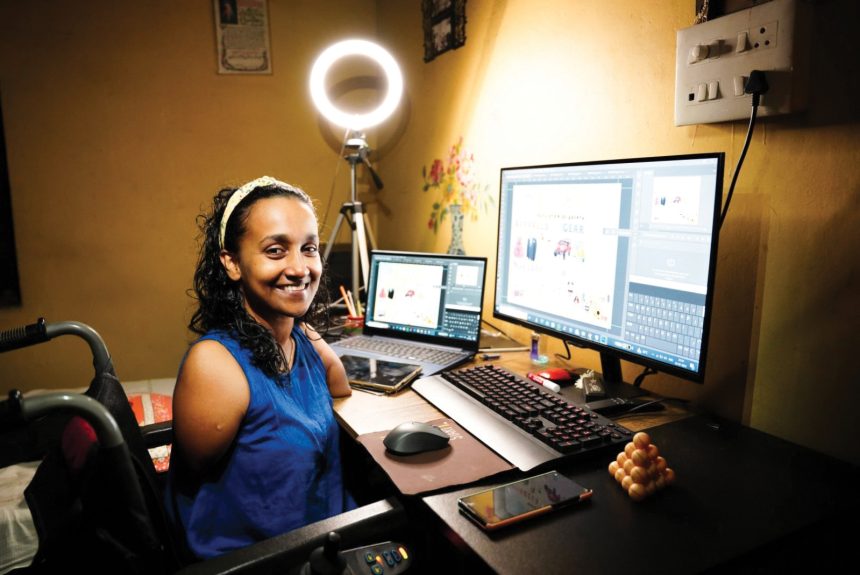
Tania Fernandes has always been fascinated by colours and movement. “There is something powerful about creating something from nothing and over time it became my passion,” says the freelance graphic designer. She adds that she is most proud of the projects where she stayed true to herself and created work that truly connects with people.
“As a freelancer, each project helped me grow, but the ones that challenged me and proved my abilities mean the most,” says Fernandes. Born with Tetra-amelia syndrome, a rare disorder characterised by the congenital absence of all four limbs, she notes that awareness about the condition is still limited. “But slowly, social interactions are helping more people understand it,” she says. For Fernandes, resilience is key. “I have learned to be patient, keep learning even when progress is slow and never let fear guide me,” she says. She adds, “Every woman’s success inspires another. Support each other, believe in yourself and never
stop shining.”

